

Bottlebrush Shrub Fungus
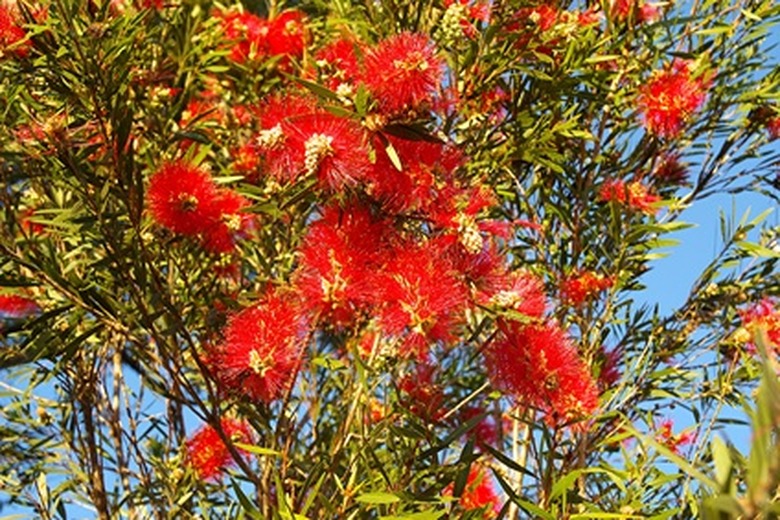
Bright red, bushy cylindrical flowers made almost entirely of stamens make the bottlebrush (Callistemon citrinus) shrub a star in early spring gardens. Native to Australia, bottlebrush thrives in USDA plant hardiness zones 8b to 10, with minimum temperatures between 15 and 40 degrees Fahrenheit. An evergreen reaching up to 12 feet high and 9 feet wide, bottlebrush also produces citrus-scented leaves. Susceptibility to fungus is one of the shrub's few shortcomings.
Fungi Affecting Bottlebrush
Bottlebrush is susceptible to the Puccina psidii fungus, according to the Australia Quarantine and Inspection Service website. Puccina psidii is widely known as eucalyptus or guava rust because it damages eucalyptus and guava trees. A second fungus, Phytphthora niederhauserii, attacks bottlebrush as root rot.
- Bright red, bushy cylindrical flowers made almost entirely of stamens make the bottlebrush (Callistemon citrinus) shrub a star in early spring gardens.
Fungus Origins
Native to Brazil, Puccina psidii arrived in Florida in 1977. It has now spread to Mexico, Central America and the Caribbean countries. Researchers at Italy's University of Catania's Department of Chemistry and Biology isolated Phytophthora niederhauserii on bottlebrush plants from a Sicilian nursery in 2003.
What the Fungi Do
The phytophthora fungus decreases root volume so bottlebrush plants can't absorb adequate water and soil nutrients. Puccina usually attacks young plants, damaging shoots, leaves and buds. In severe cases the disease can defoliate or kill plants.
Symptoms
Plants suffering from eucalyptus rust fungus have pockets of yellow spores on their leaves and buds. Left unchecked, they may cover the entire plant. The leaves sometimes develop chlorotic (chlorophyll deficient) brown lesions. Root rot fungus attacks the plants close to the soil line, turning the sub-bark tissues brown. A colony of fungus often encircles the plant's crown. Large plants sometimes develop oozing, wet cankers at the soil line. Other early symptoms include yellow shoot tips, leaf drop and branch dieback, according to the Alabama Cooperative Extension.
- Native to Brazil, Puccina psidii arrived in Florida in 1977.
- Root rot fungus attacks the plants close to the soil line, turning the sub-bark tissues brown.
Eucalyptus Rust Fungus Treatment
Homeowners can control eucalyptus rust fungus by removing affected leaves and buds. Spraying the plants with a fungicide registered to treat the disease, and disinfecting tools used on the bottlebrush, further limit its spread.
Root Rot Fungus Treatment
Symptoms of root rot fungus may not appear for months or years. Prevention is the best control for this disease, advises plant pathologist E. Thomas Smiley and his colleagues at the Bartlett Tree Research Laboratories. Where soil drainage is poor, plant bottlebrush in raised beds. Keep the plant's root collar above the soil. Use nugget mulch, which won't compact the soil, and spread it no more than 2 inches deep.
- Homeowners can control eucalyptus rust fungus by removing affected leaves and buds.
- Spraying the plants with a fungicide registered to treat the disease, and disinfecting tools used on the bottlebrush, further limit its spread.
Spray plants in consistently moist soils with a pyhtophthora-registered fungicide every one or two years. Repeat fungicide applications–especially where wet, warm conditions exist–are the recommended treatment for plants with chronic root rot symptoms. Spraying nearby unaffected plants limits the disease's spread.