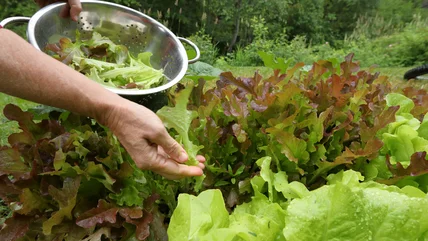
Is It Possible To Contract Cyclosporiasis From Your Homegrown Garden?
A thriving garden is something worth celebrating, and with a few basic precautions, you can help ensure every harvest is as safe as it is satisfying.
Read More

A thriving garden is something worth celebrating, and with a few basic precautions, you can help ensure every harvest is as safe as it is satisfying.
Read More
Sure, the trees put on a beautiful spring show, but their impact on the environment is a lot less pretty. Michigan is saying goodbye to them for good.
Read More
Just when you think gardening is expensive, things may get a little tighter in 2026. Here's what's going on in the world that will impact fertilizer prices.
Read More
You may be dreaming of a white Christmas, but will your region get snow this year? Here's what the Old Farmer's Almanac says we can expect this holiday season.
Read More
Planning yardwork to prep for the holidays? Then you should know what weather to expect the week of Thanksgiving. Here's what the Old Farmer's Almanac predicts.
Read More
It's always sad when a generations-old publication comes to an end. But while a 200-year-old almanac is closing, it may not be the one you're thinking about.
Read More
Boxwoods are a popular shrub for landscaping. Unfortunately, an invasive insect from Asia might be harming the plants. Keep them healthy with these tips.
Read More
"The Old Farmer's Almanac" comes out every year with pages of interesting, helpful content. But the winter weather predictions inside aren't just for farmers.
Read More
Lots of pests are unwanted, especially around the garden where they can wreak havoc. This particular pest is actually invasive, but you can keep it out.
Read More
People are always breaking records, but recently, a sunflower shot to the top of the sky as the world's tallest. Here's what kind of cultivar it was.
Read More
Making your garden attractive to birds is a worthy task that requires equipment. You could make it at home, but why not take advantage of some Prime Day deals?
Read More
The Amazon Prime Day event lasts from July 8 to 11, so don't miss these budget-friendly gardening tools and other yard essentials that are currently on sale.
Read More
If you're investing in your lawn, you might as well get the best. This brand you may not be as familiar with is leading the way in America's lawn mower market.
Read More
Plants require 16 to 20 nutrients to develop strong roots, build an effective immune system and perform specific functions, such as blooming and producing food. Of those elements, nitrogen, phosphorous and potassium are needed in large quantities. But trace minerals, such as iron, zinc and boron are also vital for a plant's health. While they absorb some nourishment, such as carbon and hydrogen, from the air, vegetation gets most of its sustenance from the ground. As preparation for planting a garden, get your soil tested. Follow the fertilization recommendations the lab report provides, as well as a few general guidelines.
Read More
Roundup is a herbicide produced by Monsanto. If it contacts the eyes, Monsanto says that after contacting a doctor or poison control, the eyelids should be held open and the eye gently rinsed for 15 to 20 minutes. Contact lenses should be taken out after five minutes of rinsing.
Read More
Carnations, also known as Dianthus plants, are poisonous with a low toxicity rate in the leaves. The flowers can also cause contact dermatitis, or inflammed irritated skin, in some people.
Read More
Proper mowing of zoysia grass is essential to maintain a quality lawn. This includes not only using the correct type of mower but also mowing at the correct height and frequency.
Read More
The Avocado tree, or Persea Americana, is a tree native to Mexico. Its fruit is a large berry with a single large pit in the center. Growers in the warmest parts of the United States cultivate avocado trees commercially, especially in California. Home gardeners also raise individual avocado trees. You can grow an avocado tree from seed, although the resulting tree may have different characteristics from its parent.
Read More
Tender perennials such as fuchsias, geraniums and verbena need special during the cool months. The plants must be brought indoors prior to the first frost. There are several methods for overwintering fuchsias, geraniums and verbena. The easiest is to bring the plants indoors before the first frost and treat them as house plants. They can be taken back outside once the danger of frost has passed.
Read More
Many gardening writers will tell you that the best time to plant asparagus is in the spring. Most of them live in the Midwest or the North. Asparagus planted in the spring in a Southern garden will generally not survive the hot summer. Autumn is the only time of year to plant asparagus in the South.
Read More
Knockout roses provide a stunning display of blooms from early spring until the first frost. These plants are chosen because they are hardy and resistant to infections. Even the hardiest plants will develop problems from time to time. The leaves of a knockout rose will turn yellow when the plant is affected by various climate and soil conditions.
Read More
The Little Gem Magnolia (Magnolia grandiflora 'Little Gem') is a variety of the Southern Magnolia that is smaller and more compact. It has an upright shrubby form, rather than a tree form. It grows 20 to 30 feet tall and 10 feet wide. The showy fragrant flowers of the Little Gem Magnolia are creamy white and measure 3 to 5 inches across. They appear in the spring and sporadically throughout warm weather. The Little Gem Magnolia is a slow-growing evergreen tree and needs little pruning.
Read More
Crocosmia Lucifer is an easy to grow perennial with sharp leaves, similar to the day lily, and bright red flowers that will heat up any garden. Hardy from zones 5 to 9, Crocosmia Lucifer can be grown in a variety of climates, as long as they lack a winter with temperatures under -20 degrees Fahrenheit. With a height of 3 to 4 feet, these flowers will surely make a statement when they bloom.
Read More
Nasturtiums are a colorful addition to any garden space. Many varieties trail or climb. The plant's Latin name, Tropaeolum, comes from the shield or circular shape of the plant's large leaves.
Read More
Horsetail (Equisetum hyemale) is a perennial plant with hollow stems and no leaves. Growing in the wild, in or along the banks of streams and rivers, it grows to 4 feet in height. Horsetail spreads by rhizomes and will, if not controlled, take over the area in which it is planted. The horsetail plant is low maintenance, with no special soil requirements. The horsetail plant is hardy to USDA zones 4 to 11.
Read More
Bamboo plants are easy to propagate from cuttings. They root quickly in soil and water. Even though these plants are hearty and grow quickly, they aren't immune to pruning errors. With a few simple tips, you'll be able to transition your existing bamboo into a new generation of plants.
Read More
When grown in the proper climate and soil, olive trees grow about 3 feet in both height and width each year. Most reach a full height of 25 to 30 feet.
Read More