

How To Propagate Rhizomatous Begonias
Things Needed
- Scissors
- Paring knife
- Soilless potting mix
- 4-inch seedling pots
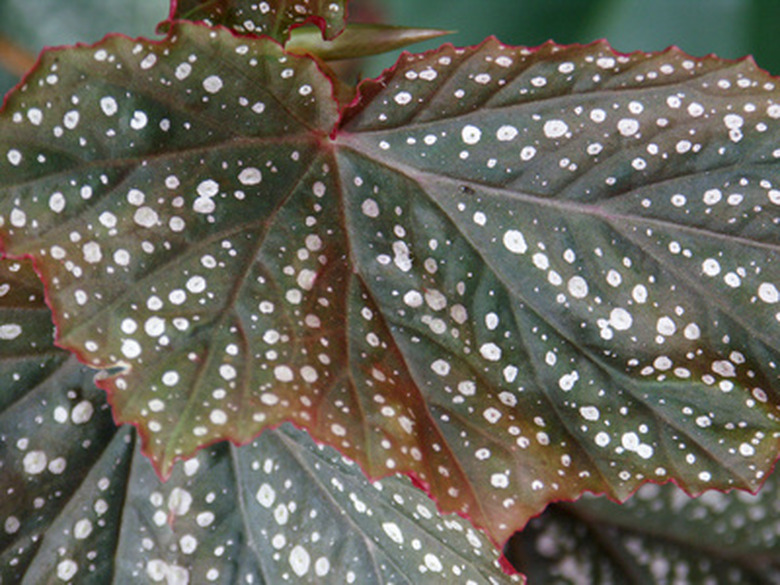
Known most for their ornately shaped and colored leaves, rhizomatous begonias (those growing from swollen underground stems called rhizomes) propagate readily from leaf cuttings. Wedges of leaf tissue that contain at least one main vein take root in moist, warm soil, creating a tiny plantlet that then grows into a new plant. Divide the rhizome to develop more new plants.
Leaf Cuttings
Step 1
Remove a healthy leaf from the rhizomatous begonia with a sharp scissors. The leaf stem does not need to be attached. Make the cut on the leaf stem 1 to 2 inches below where the leaf blade connects to the stem. Look for the sinus of the begonia leaf, which is the junction of the veins at the base of the leaf where it once attached to the stem. Note the number of main veins that radiate outward from the sinus.
- Known most for their ornately shaped and colored leaves, rhizomatous begonias (those growing from swollen underground stems called rhizomes) propagate readily from leaf cuttings.
- Remove a healthy leaf from the rhizomatous begonia with a sharp scissors.
Step 2
Slice the leaf into wedge segments with a sharp, clean paring knife. Make sure there is one main vein in the center of each wedge you cut from the leaf. The wedge segment should comprise of one vein in its center, with leaf blade tissue on both sides of it.
Step 3
Fill 4-inch seedling pots with damp, soilless, peat-based potting mix, tamping it down in the pot until the soil line is 1/2 inch from the top rim.
- Apply diluted liquid fertilizer, at one-half the dosage rate prescribed on the product label, once two leaves emerge from the cutting.
- Fill 4-inch seedling pots with damp, soilless, peat-based potting mix, tamping it down in the pot until the soil line is 1/2 inch from the top rim.
Step 4
Place one leaf cutting wedge in each seedling pot. Gently press the bottom tip of the wedge, where the vein base is located, so that it is 1/4 to 1/3 inch into the soil. Make sure the rest of the leaf cutting is vertical, or nearly so once you insert the cutting into the soil. Tamp the soil gently around the cutting base with your fingertips.
- Slice the leaf into wedge segments with a sharp, clean paring knife.
- Make sure the rest of the leaf cutting is vertical, or nearly so once you insert the cutting into the soil.
Step 5
Repeat steps 3 and 4 until all leaf cutting wedge-segments are planted.
Step 6
Place the cuttings in a shaded, warm location. This may be outside in a covered potting area or bench or indoors in a brightly lit sill or table. Do not allow any direct sunlight to reach the cuttings.
Step 7
Monitor the cuttings and soil for the next four to 10 weeks, keeping the soil moist. Remove any leaf cuttings that rot and turn black. If cuttings successfully root, you will see a small leaf emerging from the base of the cutting wedge, where the wedge's main vein contacts the soil.
- Repeat steps 3 and 4 until all leaf cutting wedge-segments are planted.
- Place the cuttings in a shaded, warm location.
Step 8
Apply diluted liquid fertilizer, at one-half the dosage rate prescribed on the product label, once two leaves emerge from the cutting. Keep the young plants in a warm location with bright, indirect light.
Rhizome Cuttings
Step 1
Pull up the horizontal rhizome of the begonia from the soil.
Step 2
Make cutting sections on the rhizome with a sharp, lean paring knife about 1 to 2 inches in length. Make sure at least one leaf scar, leaf stem base or growing bud is on each section. Remove leaf stems from cutting sections.
Step 3
Fill 4-inch seedling pots with damp, soilless, peat-based potting mix, tamping it down in the pot until the soil line is 1/2 inch from the top rim.
- Apply diluted liquid fertilizer, at one-half the dosage rate prescribed on the product label, once two leaves emerge from the cutting.
- Fill 4-inch seedling pots with damp, soilless, peat-based potting mix, tamping it down in the pot until the soil line is 1/2 inch from the top rim.
Step 4
Place one rhizome cutting in each seedling pot. Gently press the rhizome cutting that it is no more than one-half depressed into the soil. Make sure the cutting is laid horizontally and the leaf scar, bud or old stem base is facing upward. Tamp the soil gently around the cutting base with your fingertips.
Step 5
Repeat Steps 3 and 4 until all leaf cutting wedge-segments are planted.
Step 6
Place the cuttings in a shaded, warm location. This may be outside in a covered potting area or bench or indoors in a brightly lit sill or table. Do not allow any direct sunlight to reach the cuttings. Monitor the cuttings and soil for the next four to 10 weeks, keeping the soil moist. Anticipate the cuttings will blacken and shrivel, even partially rot. If cuttings successfully root, you will see a small leaf emerging from either the leaf scar of the cutting, or perhaps the cut edge. Throw away cuttings that do not create young new leaves after 12 to 15 weeks.
- Place one rhizome cutting in each seedling pot.
- If cuttings successfully root, you will see a small leaf emerging from either the leaf scar of the cutting, or perhaps the cut edge.
Tip
Both leaf and rhizome cuttings tend to root and sprout more quickly in the spring and summer months when temperatures are warm and days are long. Rather that cutting a begonia leaf, you may wedge an entire leaf with the leaf stem into the soil in the pots. Cut the leaf stem to a length of 2 to 3 inches, and push it down until the leaf sinus is in contact with the soil.
Warning
Keep the soil moist while the cuttings rest and root, but never soggy. Once the sinus of the leaf cutting begins to rot or forms a white mossy fungus, throw it away. Remove rhizome cuttings that are mushy or dry and black.
References
- SW Region, American Begonia Society: Vegetative Propagation
- "Begonias"; Mark C. Tebbit; 2005
- Cornell University: Begonias