

5 Plants To Grow Near Hostas For A Garden That's Nearly Impossible To Kill
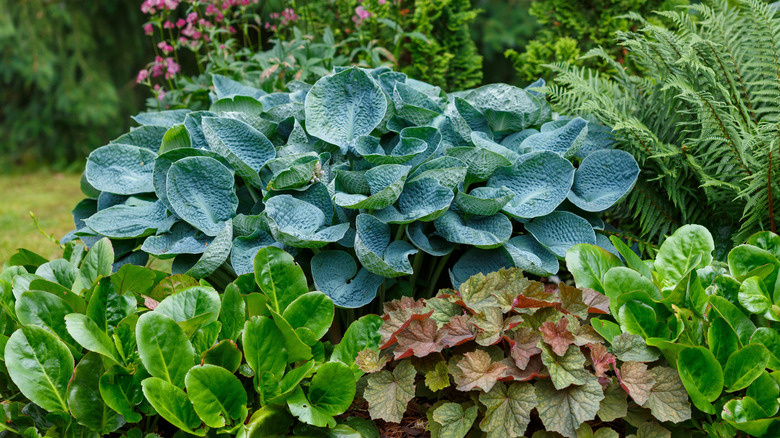
Hostas are many a gardener's "old reliable" when it comes to choosing the best plants for a shade garden. They're tough, forgiving, and nearly foolproof, with over 70 species and a staggering estimated 7,000 cultivated varieties, available in an astonishing array of forms, hues, and sizes. This incredible selection means that you could feasibly create a very attractive landscape filled with this perennial that still delivers ample visual excitement, but you might be looking to add a few pops of non-green colors to your planting. Or maybe you're anticipating very real possibility that deer, slugs, and other hosta-loving wildlife might create some sparse patches in your garden, and you'd like to preemptively reinforce the ranks with some less-tasty fare. Fortunately, you can pair hostas with other hardy shade lovers that require little fuss, including colorful heuchera, early-blooming hellebores, and whimsical sweet woodruff.
When considering which plants to grow with your hostas, it's important to understand the growing conditions these shade staples prefer. Pretty much all varieties require some degree of protection from the sun, though how much depends in part on leaf color and variegation. In general, they're hardy in USDA Zones 3 through 9 — they don't do well in zones warmer than that because they need a cold-weather dormancy period. They need well-draining soil and don't appreciate soggy sites, as this can lead to root and crown rot; the soil should ideally be slightly acidic, though they will still grow in alkaline conditions. Choosing companions with similar needs means you can water, mulch, and maintain the entire area with less effort.
Sweet woodruff is tougher than it looks
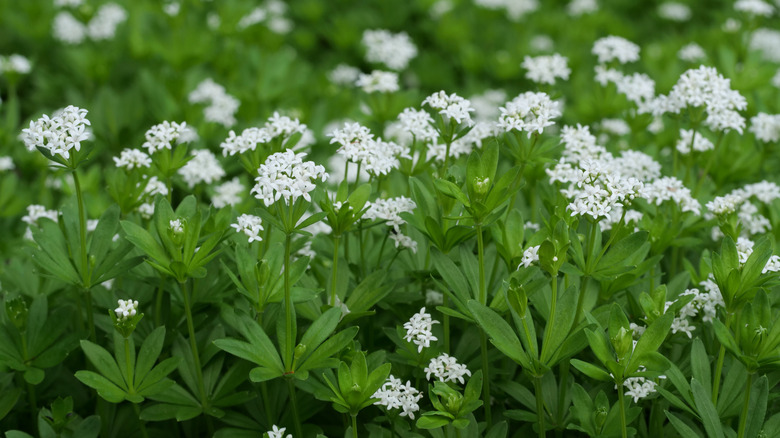
Right at home in the same shady areas and well-draining, organically rich soils as hostas, sweet woodruff (Galium odoratum) is easy to grow and can quickly fill in empty spaces. This wonderfully fragrant flowering groundcover makes the perfect addition to a garden path: despite the delicate appearance of its tiny white blossoms and leaves, it actually doesn't really mind being stepped on. In fact, sweet woodruff is also one of those uncommon plants that isn't bothered by taller, denser greenery blocking out sunlight and can even be grown under black walnut trees, as it isn't affected by the allelopathic chemical juglone.
A native of parts of Europe and North Africa, sweet woodruff thrives in USDA Zones 4 through 8. Like hostas, it prefers its soil to be a touch acidic. However, its toughness comes with one caveat: if it gets too comfortable, it can be a prolific, somewhat aggressive spreader through both rhizomes and self-seeding (for this reason, it is considered invasive in certain states like Oregon, so please do your research before planting!). If your sweet woodruff patch is getting a little too assertive for your tastes, though, you can just mow it back. This chore may even be a somewhat pleasant experience, though, as the crushed or cut foliage smells like fresh hay. Try drying the leaves and flowers and keeping them as potpourri!
Solomon's seal and hostas are family
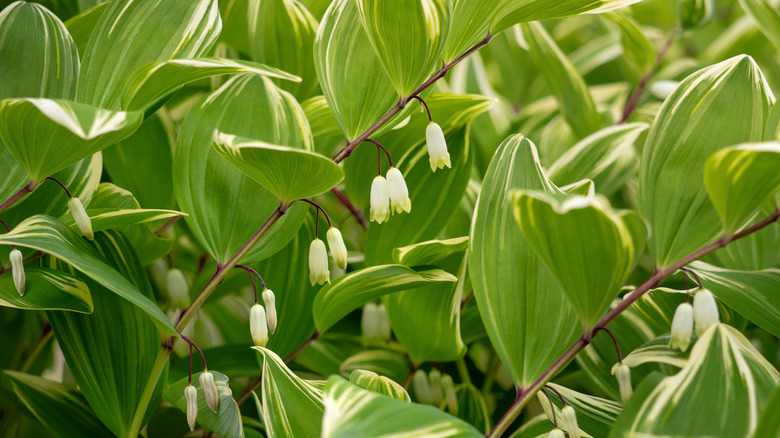
Like hostas, the species of Solomon's seal (Polygonatum spp.) typically grown in gardens are favored more for their foliage than their flowers, though the drooping blossoms do have a certain je ne sais quoi all their own if you take the time to look closely. Interestingly, hostas and Solomon's seal are both part of the asparagus family, and both are technically edible (but not the fruits of Solomon's seal, which are tasty to birds but do not agree with humans). These cousins make friendly neighbors too, with their mutual preference for shady, well-draining, moist sites in zones 3 through 9. Gardeners report that Solomon's seal tends to be slow to establish in the garden, but once it does, it's pretty much foolproof, long-lived, resistant to deer and drought, and not prone to many diseases. It's a pretty tough plant, in other words.
There are both U.S. native and non-native species of Solomon's seal that you can explore. One good hosta companion is a Eurasian variety, fragrant or variegated Solomon's seal (P. odoratum var. pluriflorum 'Variegatum'), which boasts brilliant green foliage edged with white and accented with maroon-colored stems. If you'd prefer to source a native species, check out small Solomon's seal (P. biflorum) or great Solomon's seal (P. communatum). The main difference between these two species is their size — you can probably guess which is which.
Large-flowered bellwort is a low-lift native wildflower
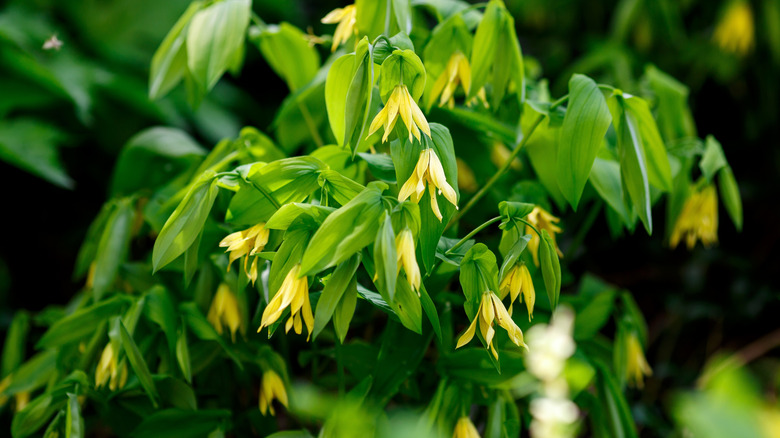
If you're looking for a unique U.S. native selection that will lend a naturalized, wildflower-forward look to your shade garden, take a look at large-flowered bellwort (Uvularia grandiflora). This long-lived perennial can be found growing wild throughout eastern North America in rich, wooded areas, and in landscape applications it makes an excellent companion for hostas. Its large, hanging yellow flowers are among the earlier bloomers in the spring. While it's flowering, its foliage can appear slightly droopy, but once the flowers have faded, it perks up, adding visual interest even when there are no blooms. This wildflower grows quickly and requires very little maintenance once established, though very young plants may thank you for some slug-deterring pine needle mulch.
Large-flowered bellwort is hardy in zones 4 through 9 and enjoys the same moist, well-draining soil as hostas, with no real pH preference. It isn't troubled by many plant diseases or insect pests, but deer do enjoy munching on its leaves. It can be propagated from seeds, but you're probably better off dividing it instead for faster results; just pick a mature clump to divide and transplant in spring or fall. Its combination of toughness, quick growth, and minimal upkeep makes it a strong choice for a low-maintenance hosta bed.
Hellebore is one of the Three H's of shade gardens
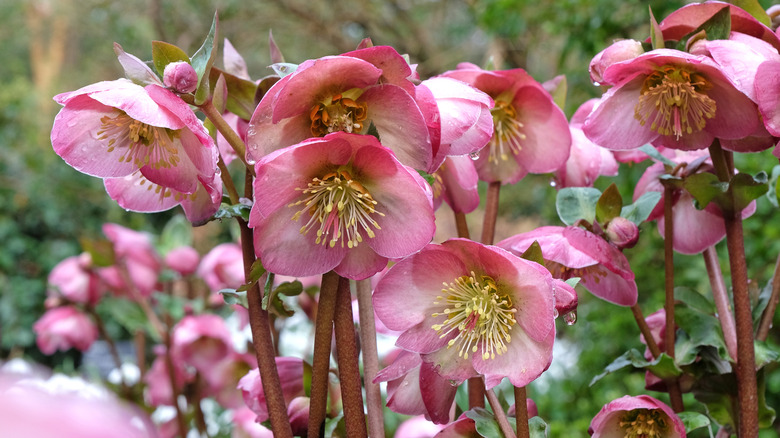
Hellebores (Helleborus spp.), also known as Lenten roses, are perennials that thrive in zones 5 through 8. Some gardeners tout hostas, hellebores, and heuchera as the "three H's" of the shade garden. These tough little plants flower in late winter and the very earliest part of spring, bringing visual interest to what might otherwise be a dreary time of the year. This, plus their love of shady spots, makes them ideal additions to a planting: hostas can be a bit lazy in the spring, so some early-blooming hellebores can provide color while they are still waking up for the season. A wide selection of species and varieties are available, with blossoms ranging in color from creamy white to pink to nearly black. Some, like the stinking hellebore (H. foetidus), are particularly sought after for their intriguing foliage.
If you like the look of your hellebore patch and would like more, good news: when conditions are ideal, they will self-seed if the blooms aren't removed. Just make sure you thin the plants out every so often so they don't become overcrowded. Keep in mind that these, like other members of the ranunculus or buttercup family, are poisonous. Whether fresh or dried, the entire plant is profoundly toxic (potentially fatal) if ingested by either humans or animals. In fact, their scientific name essentially translates to "injurious food"! The upshot of this is, of course, that peckish deer and rabbits won't touch them. That natural resistance to browsing is another reason they're such a useful choice for a resilient shade garden.
Heuchera is vibrant and adaptable
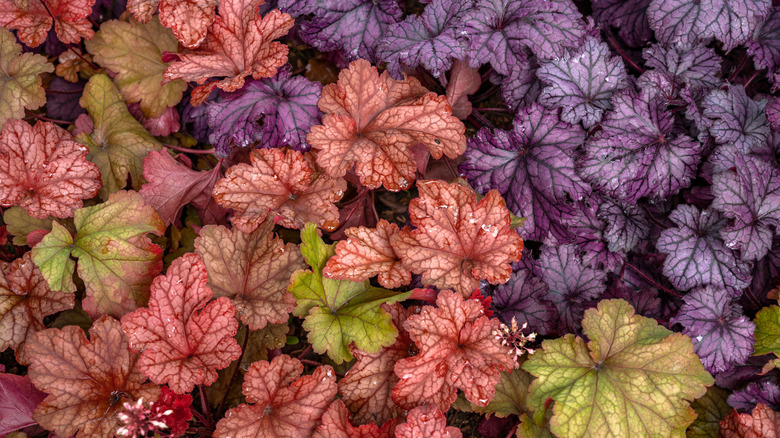
The third "H," heuchera, also known as alumroot or coral bells (Heuchera spp.), is a North American native that packs a perennial one-two punch in terms of aesthetics and ease of care. The 40-or-so species and myriad accompanying hybrids and cultivars in this genus offer a veritable rainbow of stunning foliage; from the deep royal hue of 'Palace Purple' to the pinkish-orange 'Caramel', from nearly neon shades of green to striking metallic pinks, there's almost certainly a heuchera shade to suit your style. Though it's most appreciated for its foliage, it also produces stalks of little bell-like flowers in the summer. Hummingbirds seek out these blooms, and there are some varieties that flower in particularly brilliant shades of red or pink.
Though some varieties are fine in sunny spots, most prefer the same shady sites as hostas in zones 3 through 9. They can be happy in a variety of soils, but they do tend to struggle with clay. These are hardy, adaptable plants, able to cope easily with drought conditions once established and more or less unbothered by bugs and disease. Plus, due to the unpleasant tannic flavor of their leaves, all but the hungriest herbivores usually give them a pass. One important care note for this plant is that you'll need to divide heuchera in the spring every three to four years to prevent overcrowding.