

How Tall Does A Mustard Plant Grow?
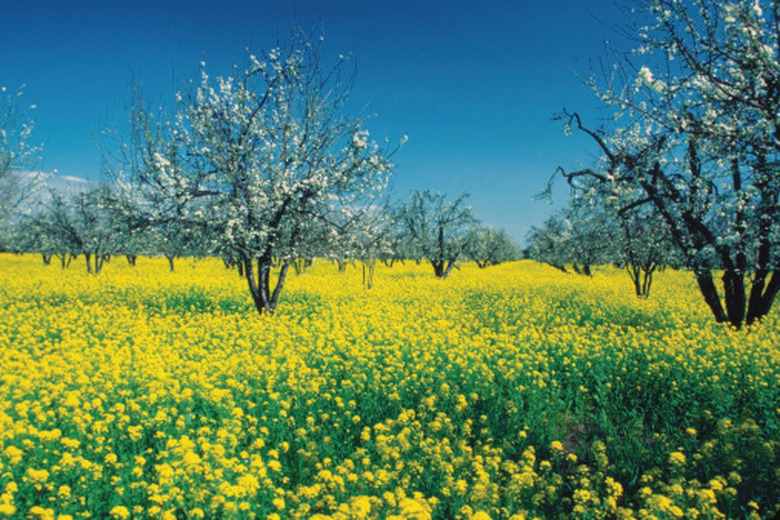
Also known as Indian mustard or brown mustard, leaf mustard (Brassica juncea) is a cool season annual that belongs to the cabbage family. Some cultivars are grown for their brown seeds, which may be made into a strong-tasting mustard condiment. Leaf mustard grows to a height of about 3 feet.
Appearance
Leaf mustard is an herb that grows to be up to 3 feet tall, producing long, erect branches and a stalk topped with dense clusters of small, bright yellow flowers. Flowers are followed by green seed pods that contain edible brown mustard seeds. The lower leaves of the plant are toothed, scalloped or frilled. Leaves may be covered in a whitish bloom. The tender young leaves are more commonly eaten than the older, tougher leaves.
- Also known as Indian mustard or brown mustard, leaf mustard (Brassica juncea) is a cool season annual that belongs to the cabbage family.
- Flowers are followed by green seed pods that contain edible brown mustard seeds.
Cultivars
Numerous leaf mustard cultivars are available in the nursery trade. Varieties include "Green-in-Snow," an Asian cultivar that offers small, pale green leaves commonly used in stir fry, "Florida Broadleaf," a flat, oval-leafed variety that grows to be about 2 feet tall and a foot wide, and "Red Giant," a dark red-leafed, white-stemmed variety that is commonly pickled. Varieties such as "French Brown" and "Burgonde" are cultivated for their seeds, which are made into stone-ground, strong-tasting brown mustards.
Location
Originally native to Asia, leaf mustard has been cultivated for thousands of years in both Asia and Europe. It is believed to have been first grown as a garden plant in central Asia and the Himalayas. The plant has naturalized widely across the United States, thriving in sunny, disturbed locations. Leaf mustard is a cool season plant that can tolerate temperatures between 20 and 85 degrees. The plant requires very little care when grown in the home garden.
- Numerous leaf mustard cultivars are available in the nursery trade.
- Originally native to Asia, leaf mustard has been cultivated for thousands of years in both Asia and Europe.
Features
Mustard greens are rich in nutrients, particularly Vitamin A, Vitamin C and iron. The greens are commonly used in pork and ham dishes and as a potted herb. Mustard oil has strong anti-bacterial and anti-fungal properties. According to the University of Purdue, leaf mustard has been used as a folk remedy for ailments such as arthritis, lumbago and rheumatism. In China, the leaves are made into a soup and used for bladder problems and inflammation.