

Difference Between Flowering & Non Flowering Plants
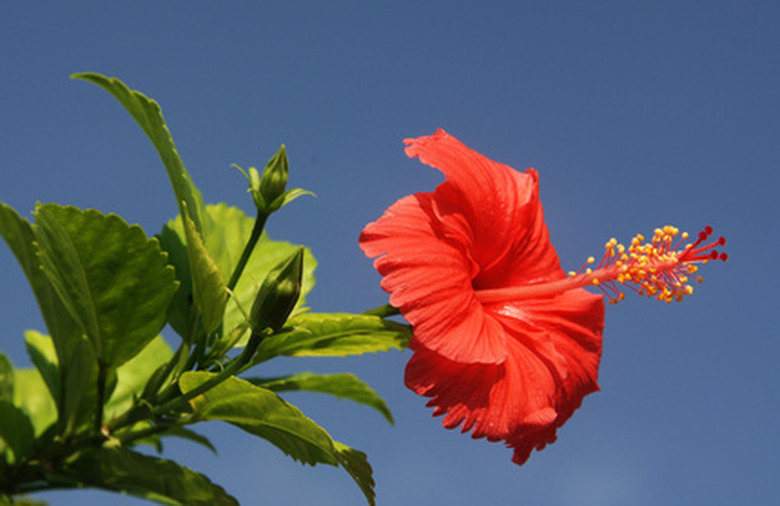
Flowering plants, also called angiosperms, are the most diverse group of plants on earth, with over a quarter million species in 435 families. What sets angiosperms apart extends beyond the presence of often bright, showy blossoms when compared to their more demure, non-flowering relatives. Flowers signify differences in reproduction and evolution between different types of plants.
Evolution
There are four major classifications of plants: mosses, ferns, gymnosperms and angiosperms. Gymnosperms are non-flowering plants that produce seeds, while angiosperms are flowering plants that produce seeds. Angiosperms evolved most recently of the different types of plants with current ideas pointing to the development of large magnolia-like flowers on evergreens in the Mesozoic era, thus introducing flowering plants into the plant kingdom. Therefore, in terms of evolution, flowering plants are much younger than their non-flowering counterparts.
- Flowering plants, also called angiosperms, are the most diverse group of plants on earth, with over a quarter million species in 435 families.
- Angiosperms evolved most recently of the different types of plants with current ideas pointing to the development of large magnolia-like flowers on evergreens in the Mesozoic era, thus introducing flowering plants into the plant kingdom.
Anatomy
Because flowering plants are more highly evolved, their anatomy is more complex as well. Flowers contain both male and female reproductive structures, including an ovary attached to a structure called the stigma that captures the pollen that fertilizes the ovary. The ovaries of flowering plants often develop into fruit, which aids in seed dispersal. By comparison, gymnosperm plants–the most familiar example of which is the evergreen tree–develop seeds directly outside the plant, without the protection of an ovary. Ferns and mosses both reproduce using spores.
Pollination
The differences in anatomy between flowering and non-flowering plants further suggest different methods of pollination. Moss and ferns, being the most simplistic plants in terms of evolution, rely on water to transport their spores. While gymnosperms have evolved seeds, they need the wind to carry pollen to the exposed seed. On the other hand, the flowers themselves of angiosperms are essential to ensuring pollination. The often brightly colored and sweet-smelling flowers attract pollinators such as bees and butterflies to feed at the flower, carrying pollen from one plant to another.
- Because flowering plants are more highly evolved, their anatomy is more complex as well.
- By comparison, gymnosperm plants–the most familiar example of which is the evergreen tree–develop seeds directly outside the plant, without the protection of an ovary.
Seed Structure
The evolution of the seed is considered one of the most important evolutionary developments in plants. Mosses and ferns rely on spores to reproduce, while gymnosperms and angiosperms produce seeds. The hard outer coats of seeds keep them protected, and dispersal of seeds is easier than the dispersal of spores, which requires water. Between flowering and non-flowering seed plants, further differences exist that illustrate the more advanced evolution of the flowering plant. In flowering plants, a process called double fertilization creates an extra layer inside of the seed called the endosperm. The endosperm contains nutritive substances used to nourish the embryo inside of the seed. Furthermore, the seeds of many flowering plants produce yet another layer called the pericarp, which we recognize as fruit. This "fruit coat" offers nutrition to animal species who, upon consuming the fruit, disperse the seeds contained within to distant locations.
- The evolution of the seed is considered one of the most important evolutionary developments in plants.
- This "fruit coat" offers nutrition to animal species who, upon consuming the fruit, disperse the seeds contained within to distant locations.
Nutrient Transport
The phloem of a plant is a vascular system used to transport nutrients from the leaves to other parts of the plant. While all plants except mosses have phloem, flowering plants have developed companion cells in their phloem. Companion cells actively transport nutrients created in the leaves of the plant into the sieve elements through which nutrients move throughout the plant.