

How To Trim Brussels Sprout Plants
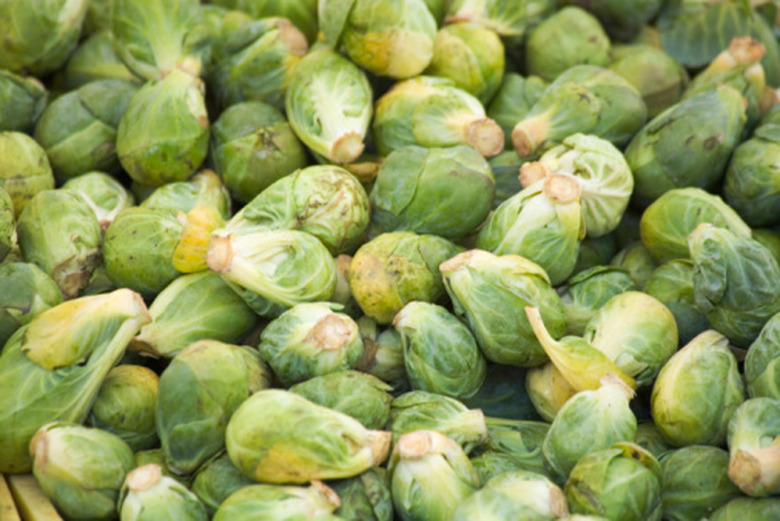
Brussels sprout plants are hardy vegetables that are members of the cabbage family. Their small, round, leafy vegetables look very similar to tiny cabbage heads. Although planted during the summer months, Brussels sprout plants are cool-weather plants that do not produce any sprouts until the fall or winter. Although severe pruning is not required, lightly pruning Brussels sprout plants will actually encourage more vigorous growth and additional sprout development.
Step 1
Wait until you see at least one sprout develop on the plant and then prune off the lowest six to eight leaves using hand pruners. Make the cut as close to the main vertical stem as possible without damaging it with the blade.
Step 2
Trim off two to three additional lower leaves each week throughout the remainder of the growing season using the same technique. Keep several large, healthy upper leaves, which feed the plant.
- Brussels sprout plants are hardy vegetables that are members of the cabbage family.
- Although planted during the summer months, Brussels sprout plants are cool-weather plants that do not produce any sprouts until the fall or winter.
Step 3
Wait until three weeks before you are planning to harvest the sprouts. Stop trimming off the lower leaves of the plant and instead cut 1 to 2-inches off of the uppermost vertical stalk using the hand pruners. Make the cut straight across the stem, preferably just above a leaf.
Brussels Sprout Plants That Produce Large Sprouts
When grown under the right cultural conditions, healthy Brussels sprouts are bright to deep green in color and look like small, tight heads of cabbage. A long-growing vegetable, Brussels sprouts require approximately 80 to 100 days when grown from seed until harvest. The typical Brussels sprout is between 1 to 2 inches in diameter. The plant requires full sun and fertile, well-draining soil with a pH of 5.5 to 6.5. Note that larger Brussels sprout cultivars typically have less uniformity, and the sprout itself has looser leaves and is less compact, characteristics that in the typical Brussels sprout plant are indicative of excess nitrogen in the soil. However, the large cultivars are known to produce sprouts with these characteristics. The "Dolmic" is a smaller plant that is ready for harvest after 115 days, although this variety is difficult to harvest by hand.
- Wait until three weeks before you are planning to harvest the sprouts.
- When grown under the right cultural conditions, healthy Brussels sprouts are bright to deep green in color and look like small, tight heads of cabbage.
References
- University of Illinois Extension: Brussels Sprouts
- University of Illinois Extension: Brussels Sprouts
- Utah State University Cooperative Extension: Brussels Sprouts in the Garden
- San Francisco Seed Library: Planting Calendar for San Francisco
- University of Nebraska-Lincoln UNL Extension: Growing Brussels Sprouts
- Purdue University: Brussels Sprouts as an Alternative Crop for Southwest Virginia