

How This Flower Was Discovered By Total Accident In 2024
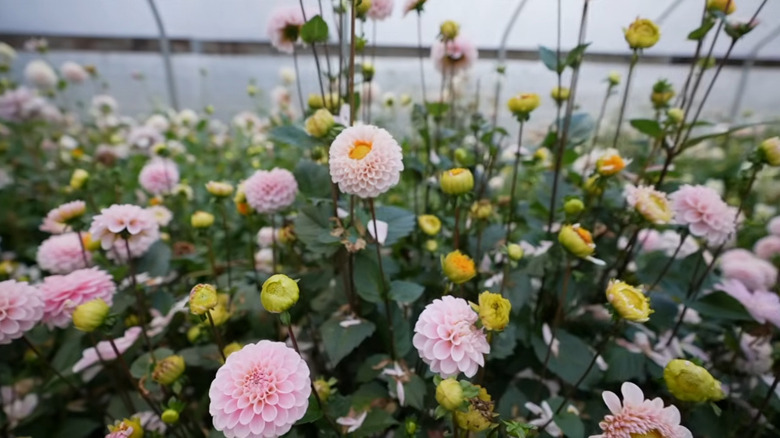
When she first saw the strange blooms in the high tunnel where she grows bridal dahlias, Kelsey Hall wasn't exactly sure what she was seeing. In an interview with The Backyard Bouquet podcast, the co-owner of the Cattle & Cut Flowers family farm in Enumclaw, WA, explained that the white and blush variety she had planted was one she was well acquainted with and had grown regularly "for years," so she was shocked to see the fused trumpet-like formation at the center of what should have been a ball-shaped dahlia. It wasn't exclusive to one plant, either. Hall stated in a Home & Gardens interview: "We had 35 of this dahlia variety planted and 6 of the 35 plants started to push blooms in varying degrees of the Daffodahlia shape. In total, we saw around 40 of these blooms." In September 2024, Hall shared the unique dahlia on social media, where Fox13 Seattle claims that it acquired the playful portmanteau "Daffodahlia."
The mutation wasn't something the farm was trying to achieve. In fact, the unexpected bloom formation worried Hall, who thought it could be a symptom of a disease that might severely impact her business. After consulting other dahlia growers and then experts at the Washington State University plant pathology department, however, it was determined that it wasn't the result of any known disease or other common dahlia problem but was probably just a "sport."
In botanical parlance, a sport is a localized natural genetic mutation. Typically, these variations appear on new growth and look different from the rest of the plant. Some stable sports can be propagated and developed into new cultivars, including certain variegated and double-flowered varieties..
You can't buy Daffodahlias yet
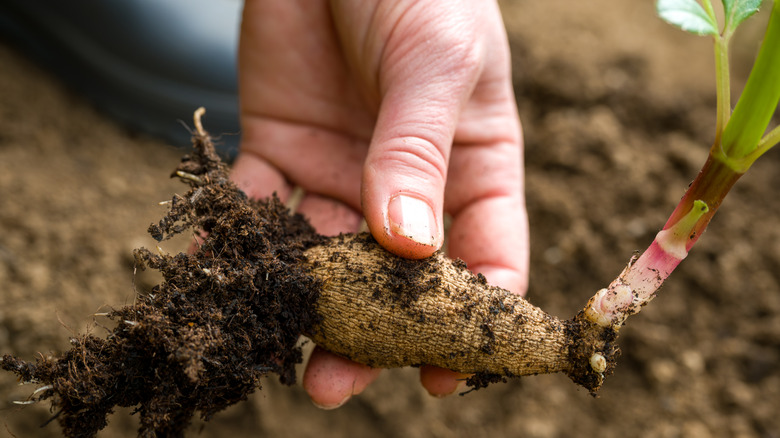
Okay, put the car keys down — you can't just run out to the store and pick up some Daffodahlia tubers. Here's the thing about flower mutations: they happen all the time, and they aren't always stable, meaning the Daffodahlia plants may not pass the genes for that particular mutation onto the next generation. Although Hall and her husband Kellen have kept some of the affected tubers for observation and made some available to others for their own experiments, she says that she thinks the dahlia plant mutation is random and may not return. "Our family has no desire to go through genetic trials, so we're simply enjoying these surprises as they come," she explained in a September 9, 2025 Instagram post.
If you fell in love with the unique bloom on Instagram, though, you can try planting your own ball dahlias and crossing your fingers for another fortuitous mutation. These flowers are suited to USDA Zones 7 through 10 and prefer fertile soil in full sun or partial shade. There are also varieties of daffodils that sport delicate pink, peach, or coral blossoms instead of the ubiquitous yellow. The pink color of these blooms can, unfortunately, be a bit short-lived, but you can help them retain it longer by planting them in the shade.