

What's The Best Fertilizer For Bermuda Grass?
We may receive a commission on purchases made from links.
Relatively untroubled by drought and comfortable growing in sandy soils, Bermuda grass (Cynodon spp.) is among the most widely used turfgrasses in the southern U.S. It springs back readily under heavy foot traffic and doesn't mind being mown very short, so it's probable you've encountered it on a weekend golf outing. If you've got this turf type and it's looking paler than plush, lawn food may be the missing piece. When choosing fertilizer for thick green grass, your Bermuda grass will enjoy a high-nitrogen formula with little or no phosphorus and some potassium — and let a soil test determine whether you need additional nourishment on top of that.
When you're looking at labels to determine nutrient levels, you'll see a series of three numbers indicating the percentage by weight of nitrogen (N), phosphorus (P), and potassium (K), in that order. This is referred to as the NPK ratio. For example, if you're looking at a package and you see 32-0-10, this indicates high N, no P, and a bit of K, which is one combination that works for Bermuda Grass. Scotts Southern Turf Builder Lawn Food is a popular option that contains this ratio. Another strong match for the high-nitrogen approach is Pennington Full Season Lawn Fertilizer.
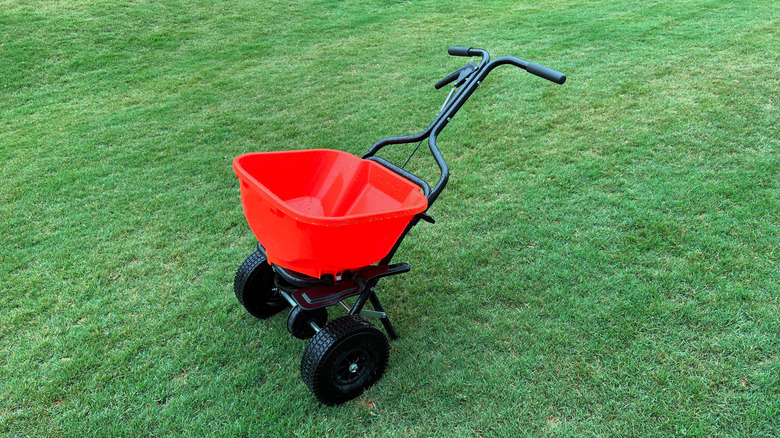
With some of the fertilizers, you can choose from granular, liquid, and water-soluble formulas. Granules are generally convenient for treating an entire lawn, while liquid products can provide a faster visual response but may require more frequent applications.
How to properly fertilize Bermuda grass (and why you should)
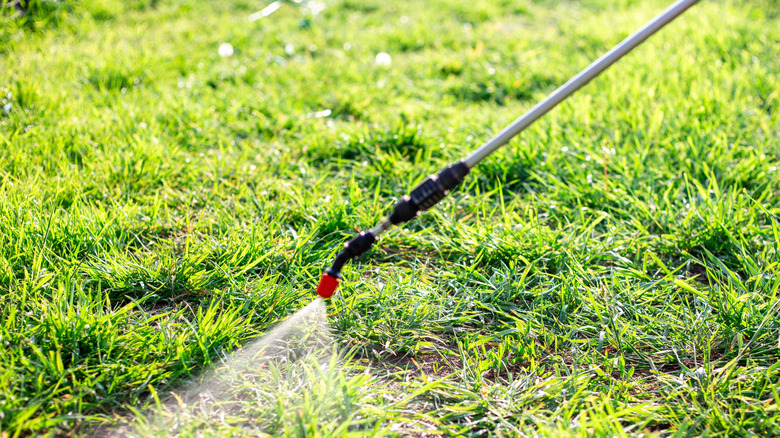
Healthy, appropriately fertilized turf is more likely to resist damage from pests and disease and can be dense enough to keep weeds at bay. In particular, turf grass needs large quantities of nitrogen, as this is the nutrient that fuels growth, and Bermuda grass is an especially nitrogen-hungry species. It's a very rapid, aggressive grower with equally heavy nutrient needs; if they aren't met, your lawn may look pale, patchy, and studded with weeds.
Keep in mind that with fertilizer, more is not necessarily better: never apply more than 1 pound of actual nitrogen per 1,000 square feet, or you may end up dealing with a nitrogen lawn burn. To calculate how many pounds of fertilizer will deliver the right proportions, divide 100 by the N amount listed on the package. For a 32-0-10 mix, that works out to about 3 pounds of product per 1,000 square feet. Whatever the total amount you need to apply, space applications about four weeks apart.
Like other warm-season grasses, this one does most of its growing in spring and summer, so it will benefit most from fertilizer then. To improve Bermuda grass growth, wait to start amending until the lawn has grown enough that you've had to mow it a couple of times.