

This Charming White Shade Flower Is Nearly Impossible To Kill
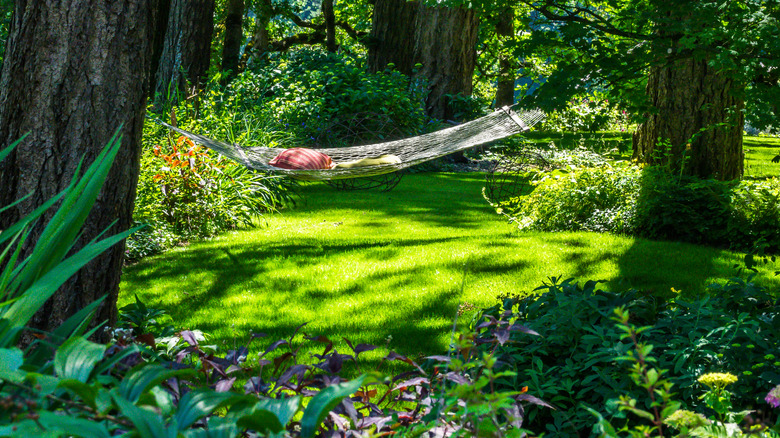
Unless you've made your peace with creating a hosta extravaganza, selecting flowering plants for your shade garden can be a bit challenging, especially if the area in question receives deep shade. If you're looking for a shade-loving plant that delivers both visual interest and nearly-foolproof ease of maintenance, you may want to check out a tough genus of perennials with an unusual name: Solomon's seal (Polygonatum spp.). With its tall, elegant arching structure and intriguing bell-like flowers, Solomon's seal has a lot to offer a shade garden architecturally. Plus, to be frank, there just isn't a lot that bothers Solomon's seal — it isn't particularly prone to pests or diseases, doesn't hold much appeal for browsing deer, and doesn't mind weathering a bit of drought. You won't even need to stake or support its stems, despite their height.
There are around 60 species of Solomon's seal, though you'll only find a fraction of those widely available to gardeners. Some of these typically tall plants, like dwarf Solomon's seal (Polygonatum humile) and fragrant Solomon's seal (P. odoratum var. thunbergii), are native to Asia, while others are native to Europe. There are also some North American natives, such as smooth Solomon's seal (P. biflorum). Fragrant Solomon's seal in particular, in addition to its sweet perfume, comes in an attractive variegated cultivar with white-edged leaves, called 'Variegatum', and a cultivar with double flowers, called 'Flora Penum'.
Solomon's seal is a low-lift shade lover
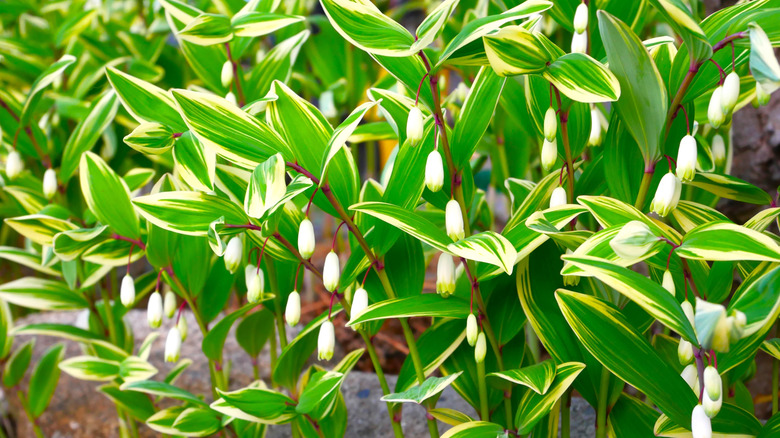
Hardy in USDA Hardiness Zones 3 through 9, Solomon's seal doesn't need much from you in order to live for potentially decades and create colonies in your garden. It does favor well-draining, moist soil rich in organic matter, but it will typically find a way to thrive even in less-than-ideal conditions. It's naturally a forest dweller, and as such doesn't mind growing in areas of deep shade. It will grow in either alkaline or acidic soil and will even happily thrive in the dry shade areas found among the roots of trees, making it one of the few selections that can be used as companion plants under pine trees. To create ideal conditions, you can amend the soil with compost or organic fertilizer rich in beneficial bacteria before planting.
If you're hoping to create another patch of Solomon's seal elsewhere in your yard, there are two ways to propagate this plant. Division is the easiest method; just dig up and transplant a chunk of an existing plant, or dig up some of its rhizomes, in the spring or fall. If you'd like to grow it from seed instead, the process takes quite a bit of time. You can sow seeds directly outdoors in the fall, but shouldn't expect anything to come of it until at least two springs later, as the seeds require two dormancy periods to germinate. If sowing indoors, provide moist conditions, with two months of cool, then two months of warmth, then two more months of cool.