

5 Beautiful Flowering Plants To Grow If You Love Hostas
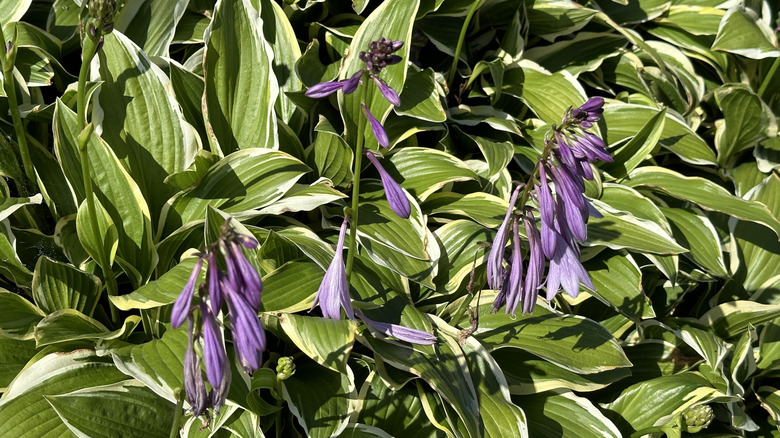
If you ask which plants would be best suited to a shade garden, many gardeners will immediately point you toward the reliable, ever-popular hosta (Hosta spp.). These perennials are mainly beloved for their leaves, which come in a wide variety of colors, shapes, and sizes, but they also put on a show of flowers in the summer. The pollinator-attracting blooms range in color from white to purple, and some have a lovely fragrance. But maybe you already have an abundance of hostas or are just looking for something a little different that can thrive under similar conditions. In that case, there are plenty of options worth exploring, from the lovely yet hardy epimedium to the whimsical foamflower.
If you're looking for plants to accompany your hostas, it's important to note the growing conditions in the spot you're hoping to fill. Hostas, in general, favor USDA Zones 3 through 9. Most varieties prefer shade, but some cultivars will tolerate a bit more sunlight than others. For this reason, they make great ground cover for areas under trees. They appreciate moist soil but not soggy roots, so it's best if the soil drains well. Additionally, a cold-weather dormant period is needed, so accompanying plants should be able to tolerate similar conditions (or should be relocated indoors during the winter) if you're hoping to create a cohesive hosta-style shade garden.
Bigleaf aster is a flowering native ground cover
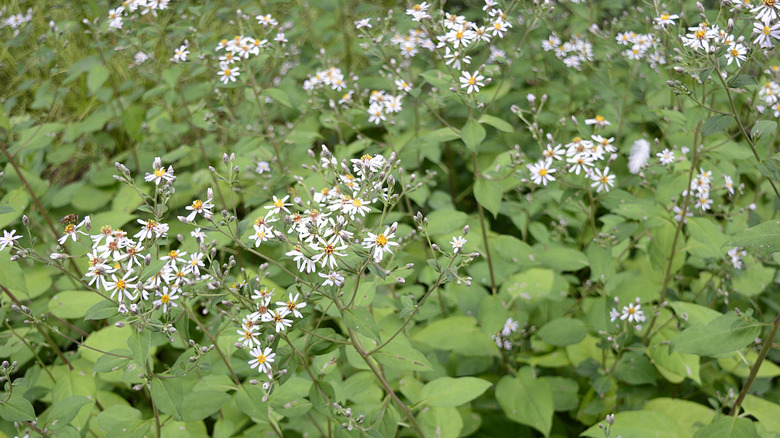
If you're looking for a U.S. native perennial that delivers the large, space-filling foliage and purplish flowers of hostas, you may want to look to bigleaf aster (Eurybia macrophylla). Its pale, blue-to-violet flowers have sweet yellow centers and bloom in the fall. Though the blossoms are very appealing to butterflies, some gardeners find the number of them a bit sparse but still opt to grow this native selection for the visual impact of its large, heart-shaped leaves. In other words, if the foliage is what you love most about hostas, bigleaf aster is an especially good choice. Interestingly, these aster leaves are actually edible, and can be cooked up as greens when they're young and tender. (Another fun fact: this plant is also sometimes called lumberjack toilet paper. You can figure this one out for yourself.)
A shade-loving member of the daisy family, bigleaf aster can be found growing wild in the woodlands and clearings of northeastern North America. This plant is best suited to USDA Zones 3 through 8 and, as you may expect from its wild habitat, can be grown in dappled or partial to very deep shade. A rapid (some might say aggressive) spreader, bigleaf aster will form colonies when conditions are just right, spreading via rhizomes and seeds. Try using it as a lush ground cover for darker areas of your garden, especially where there's moist, well-draining soil with a sandy or loamy makeup.
False lily-of-the-valley and hostas belong to the same family
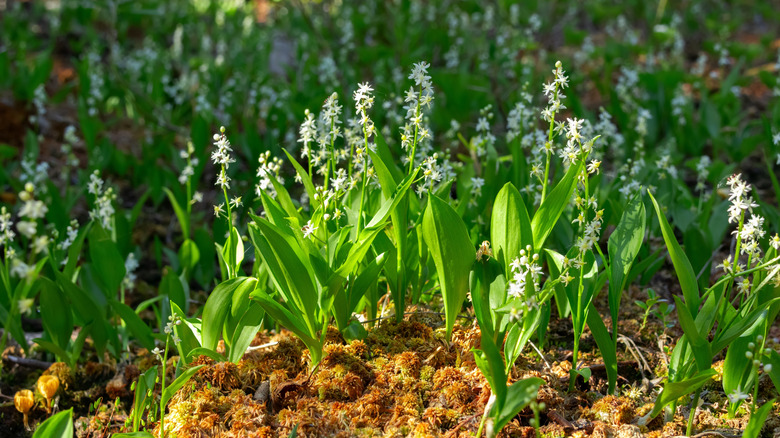
Another North American native that is right at home in the shade, false lily-of-the-valley, or Canada mayflower (Maianthemum canadense), has something besides pretty flowers in common with hostas: both are members of the asparagus family (Asparagaceae). In its native range, false lily-of-the-valley colonizes cool, moist areas, including woods and the edges of wetlands and bogs. The common name "false lily-of-the-valley" is derived from the plant's close resemblance to its non-native namesake (Convallaria majalis). As true lily-of-the-valley is both poisonous and considered invasive in parts of the U.S., false lily-of-the-valley can be a fantastic substitute for that flower, too!
With its rhizomatous spreading and mat-forming tendencies, false lily-of-the-valley makes a lovely ground cover. That makes it a particularly useful hosta companion when you want to fill in bare soil around larger foliage plants. If you're hoping for a thick carpet of this flowering perennial, you may want to buy a dozen or so to start, as one plant alone may not deliver the best results. In May and June, you can look forward to fragrant, tiny white flowers that draw insect pollinators, followed by red berries that will be enthusiastically snapped up by birds and other critters. False lily-of-the-valley grows well in zones 1 through 8, and although it prefers cooler settings, it will survive some hot weather. It especially loves soils rich in humus, but it isn't that fussy about composition and will even grow in strongly acidic soils.
Agapanthus boasts stunning purple flowers
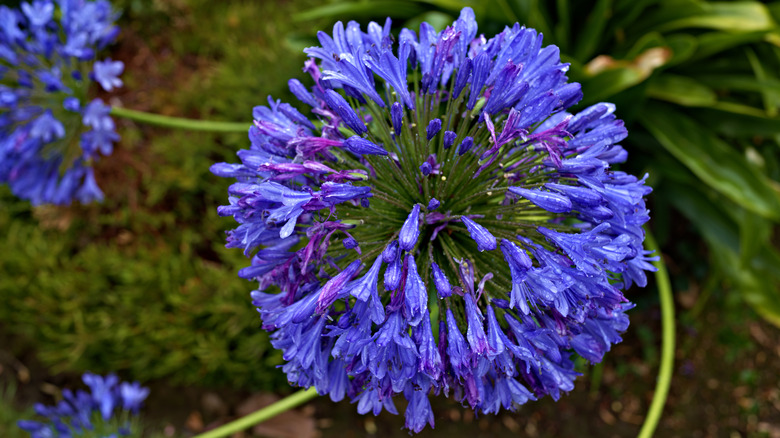
Although you may know Agapanthus, or African lily, as more of a full-sun plant, it can also perform well in partial shade. What is less negotiable is its need for a warm climate: it's typically only hardy in zones 8 through 11, though some hybrids and cultivars, such as the 'Galaxy' collection, may survive as far north as zone 6. Agapanthus grows well as a container plant, though, so cold winters are doable. In fact, root-bound container-grown Agapanthus tend to bloom the best! It isn't the closest match to hostas in growing conditions, but its flowers make it a worthwhile choice if you want a similar visual impact. Their blooms are firework-like clusters in shades ranging from purple to blue to white, perched atop stalks about two to four feet high. Those tall flower stalks also provide a contrast to the low, broad foliage that makes hostas so popular.
There are deciduous and evergreen types of Agapanthus, and winter care varies between them. The deciduous types can be allowed to dry out in their pots and then stored in a cool, dark place that won't be at risk of freezing. If you have the space and bright light to accommodate them, the evergreen varieties can be treated as houseplants indoors over the winter. Just make sure you don't move them outside until all threat of frost has passed and acclimate them a bit before throwing them right out into the blazing sun.
Foamflower shows off spring flowers and fall color
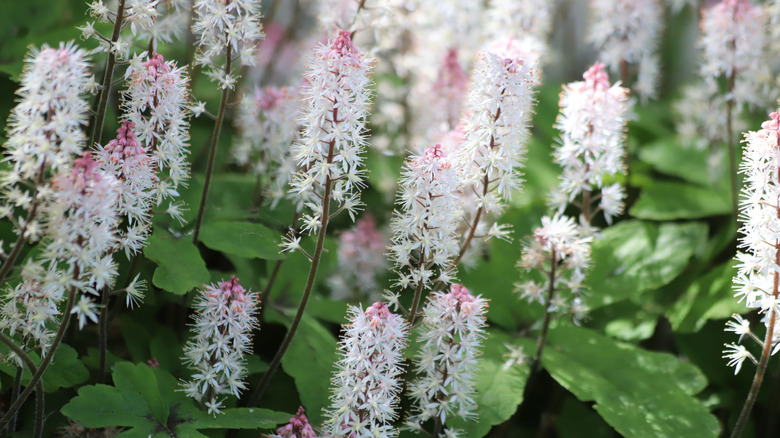
Aesthetically, the leaves of hostas are as important as their blooms (possibly more so, depending on who you ask). If you're located in zones 3 through 8 and looking for a U.S. native substitute that is also a heavy-hitter in both categories, turn your attention to the pretty little heartleaf foamflower (Tiarella cordifolia). Its common name comes from the appearance of its flowers, which appear in dreamy pink and white clusters atop stalks that rise above the foliage in springtime. In climates with mild winters, its heart-shaped leaves are evergreen, retaining their color and offering visual interest long after the flowers have faded. Better yet, the leaves change color in fall, displaying red and bronze autumnal hues. For hosta lovers who want a smaller plant with attractive foliage and delicate flowers, foamflower is an especially charming alternative.
In the wild, foamflower is found growing in moist, shady forest settings, so it does not appreciate drought conditions. It prefers to be planted in a shady spot — even deep shade — and is best grown in rich, humusy, moist soils. Keep in mind that "moist" does not mean "waterlogged"; overly wet soils can spell death for foamflower. Hostas also do well in moist but not overly wet ground. If its ideal growing conditions are met, foamflower will spread vegetatively via runners to create nice dense clumps that can be as large as two feet wide. This whimsical plant is perfect for a backyard fairy garden.
Epimedium is stunning yet tough
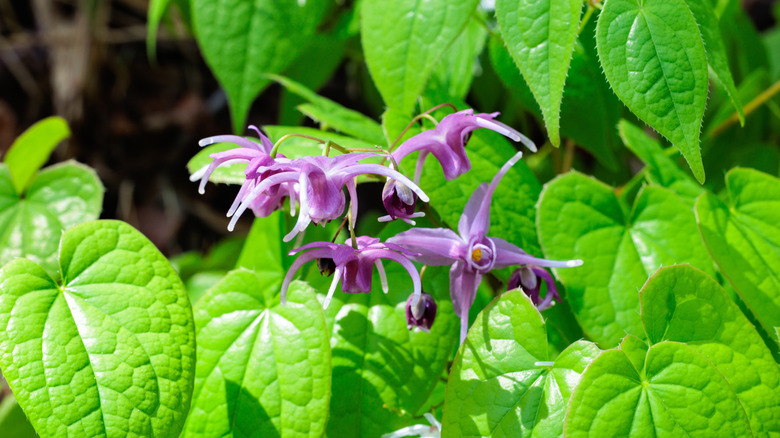
Unlike foamflower, Epimedium is well suited to dry shade, and established plants in particular have good drought tolerance. That makes it one of the better choices for those tricky shady spots beneath mature trees, where hostas can struggle as the soil dries out.
There are over 60 species beneath the Epimedium umbrella, as well as a diverse array of cultivars that bloom in shades ranging from yellow to purple, or even two-toned. Some species have foliage that changes color in the fall, showing off shades of red. Don't be fooled by the delicate appearance of its arrowhead-shaped leaves and four-petaled blooms: Epimedium is a surprisingly tough plant, unbothered by competition from other root systems, making it ideal for covering up tree roots. Additionally, it's not especially appealing to browsing deer, who find the leaves tough and not that tasty. This makes it a great alternative for spots with high deer traffic, as the four-legged creatures are quite fond of hostas.
Epimedium is a rhizomatous spreader that can create lovely ground cover. You can propagate it by dividing the mounds it forms, and should actually make sure you divide it every few years to keep it healthy. Hailing from China and some Mediterranean regions, Epimedium species are generally best suited to zones 5 through 8, though some varieties may be hardy to zone 4. This plant tends to like rich, well-draining soil, with a preference for moisture despite its drought-hardiness.