

Say Goodbye To Mosquitoes With An Ingredient You Already Have In Your Pantry

Nothing can ruin a summer evening quite as quickly as a swarm of biting mosquitoes. The itch they leave behind can last days longer than the initial encounter. Worse, they're vectors of disease, carrying microscopic organisms that can cause potentially serious illnesses. If your yard is prone to pooling water or you have a bird bath, you're likely battling an invasion of biting female mosquitoes, which need to suck blood to reproduce and lay their eggs. If you aren't quite sure you want to commit to spraying yet but you're desperate to get rid of mosquitoes humming around your pool or patio, you may benefit from trying some cultural control or home remedies first. One potentially helpful solution is to make a trap that uses an ingredient you probably have readily available: baking soda.
You may have heard of using coffee grounds to repel mosquitoes, but a baking soda trap actually functions by drawing them closer. To find prey — you, potentially — mosquitoes hone in on the carbon dioxide you exhale. If you've ever made a baking soda volcano in science class, you probably know that the reaction between a base (baking soda) and an acid (vinegar) produces this gas. A baking soda trap capitalizes on this reaction to lure hungry, CO2-seeking mosquitoes into a difficult-to-escape container. To make this trap, grab a plastic bottle, some tape, a cutting implement, baking soda, and vinegar.
How to assemble a baking soda mosquito trap
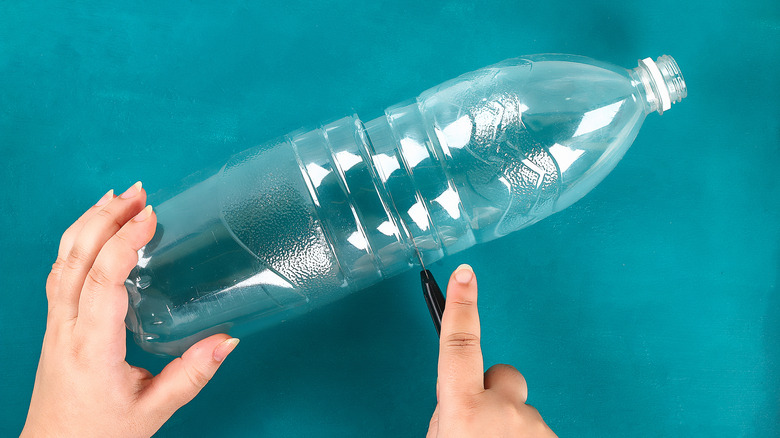
Start by cutting the bottle in half horizontally. Then, take the top half of the bottle, flip it upside-down, and insert it into the bottom half so it becomes a funnel. You may want to tape the edges where they meet. Once the trap is assembled, pour in about ¼ cup of baking soda so it settles at the bottom. Place the trap where you're hoping to trap mosquitoes, then slowly pour about a cup of vinegar in with the baking soda (emphasis on slowly, or you may risk a little volcano action). To prevent wind from dispersing the carbon dioxide gas, try to keep the trap in a sheltered area. And that's it! You'll want to refresh the mixture every couple of days to keep it effective, but you can rinse the trap out and reuse it for quite a while.
There are some easy variations of this type of trap that may also be effective. A mixture of sugar, yeast, and warm water will also produce CO2. Citric acid can also be used in place of vinegar, if you have it on hand.
It's worth noting, however, that carbon dioxide is only one of the cues mosquitoes use to locate a host. They also respond to body heat and human skin odors, so a CO2 trap is most effective when used alongside other mosquito-control methods rather than as a standalone solution. Remove standing water from around your home or plant citronella to repel mosquitoes in your garden to maximize effectiveness. Also, try adding a variety of native plants to your garden to attract birds, bats, insects, and other native bug-eating neighbors that will be happy to take the mosquitoes off your hands!