

Those Dots On Strawberries Aren't Actually Seeds
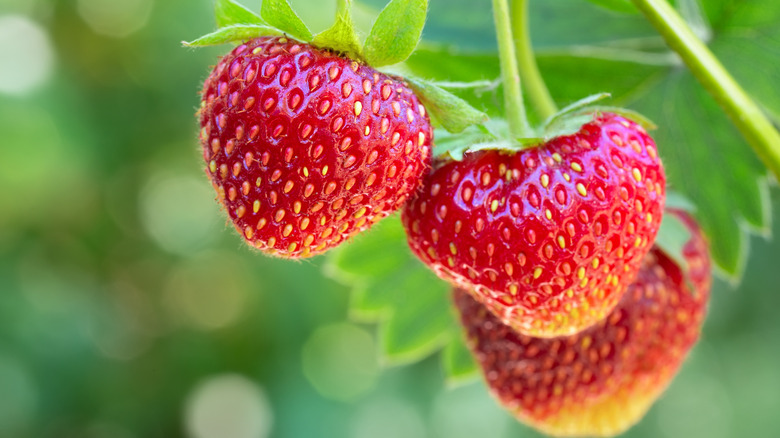
Strawberries are delicious garden snacks. Their brilliant red and slightly bumpy appearance adds not just flavor but also beauty. In some cases, these bumps are a bit hard or gritty, but even with the occasional odd seedlike texture, strawberries are tasty enough to be worth it. You might be surprised to learn that those bumps on the outside of the strawberry aren't their seeds, though. Instead, they're the plant's actual fruits, called achenes.
Strawberries aren't even considered true berries. They are often described as accessory fruits, which means the primary part that is eaten isn't the true fruit, or ovary. The delicious, fleshy part of the strawberry is considered a fruit-producing receptacle, and it creates the plant's real fruits, the achenes. If you check out a strawberry while it's still growing, you'll notice that the achenes stay roughly the same size the whole time, even though the juicy receptacle gets bigger. And it turns out that the more achenes a strawberry has, the bigger that receptacle is likely to get. A single fruit often has around 200 of these achenes on it.
Another fun fact is that inside each of the achenes is an actual strawberry seed, which has the potential to grow into a new plant (gardeners often choose to grow from runners, however). The next time you bite into a strawberry, you're enjoying a botanical oddity that packs hundreds of tiny fruits into one sweet snack.
Other fruits that are develop similarly to strawberries
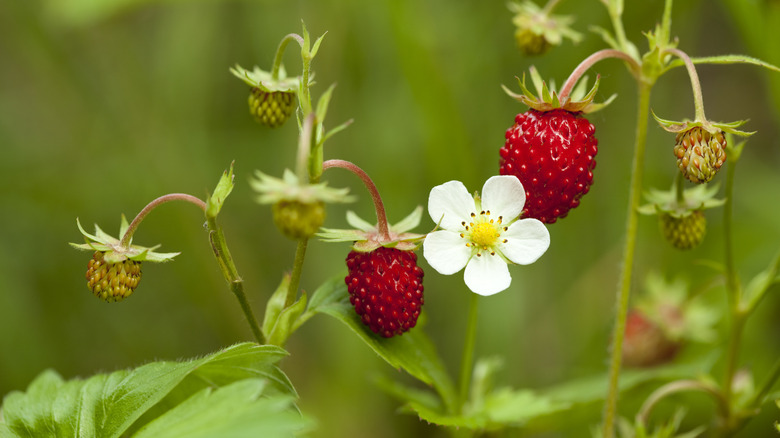
You might be surprised to learn that this fruit has some unusual relatives of its own. Strawberries are closely related to other fruits like apples and pears, since they are all in the Rosaceae family. And while apples and pears don't have achenes, they are also considered accessory fruits, meaning the part we eat isn't technically the plant's true fruit
Strawberries are far from the only plants that have achenes. Just in your own garden, you'll likely be able to find a few. Take a close look at the parts on your sunflower plant, for example. Sunflower "seeds" are actually achenes, and the true seeds are hidden inside. Mock strawberries (Duchesnea indica) are also covered in achenes, which is part of what makes them look so much like strawberries.
Since there is a seed inside each achene, you might be tempted to try putting a few in soil to see if you can grow your own strawberries. It turns out that yes, you can grow strawberry plants from the seeds in the achenes. However, most garden strawberries are hybrid cultivars that are normally propagated from runners (the small shoots produced by mature plants). If you try growing their seeds, you might end up with unpredictable results and strawberries that aren't as tasty as you'd hoped. Reputable companies sell strawberry seeds on occasion, so you'd likely be better off purchasing those if you really want to give it a shot. Just be aware that strawberry seeds can be a bit tricky to grow and don't tend to have great germination rates.