

Bananas Don't Grow On Trees
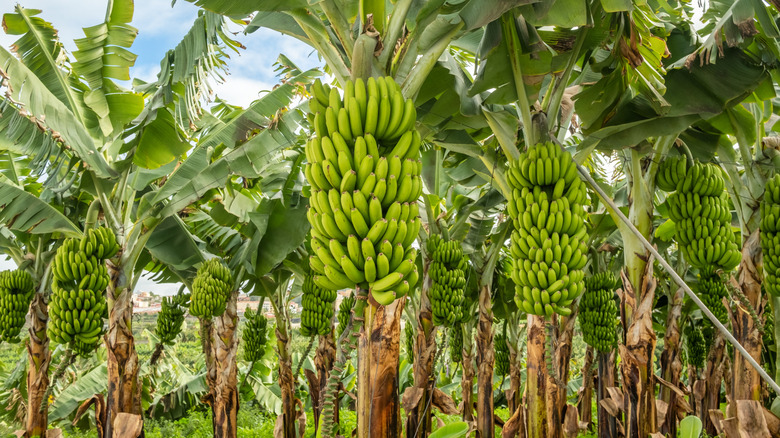
Although some of the tallest species can reach up to 30 feet high, banana plants (Musa spp.) are not actually trees, but herbs — some of the world's tallest — distantly related to ginger. One species, the giant highland banana (M. ingens), even gets the nod from the Guinness Book of World Records, with a trunk that can reach 49 feet high and some of its highest leaves up to 66 feet. "So why aren't they trees?" you may ask. It has to do with their "trunks," which are actually tender stems, not wood. Herbaceous plants do not produce woody tissue, and trees do.
And if that hasn't thrown you for a loop, here's another weird semantic quirk: bananas are actually berries! You may be wondering, "If bananas are berries, are they not fruits?" It's one of those subset situations where all X is Y, but not all Y is X. Berries are a category of fruit having multiple seeds in pulp; this is as opposed to drupes, which contain a single large seed or pit (like peaches and plums), and pomes, whose seeds are surrounded by a membrane-like core (like apples and pears). Interestingly, while bananas and tomatoes, along with blueberries and cranberries, belong to the berry group, strawberries and raspberries technically do not. Commercially grown bananas, however, are sterile, so their seeds are extremely small (and no, the hard nub at the bottom of the banana is not a seed, but the remnants of the flower from which it grew!).
You can grow your own bananas
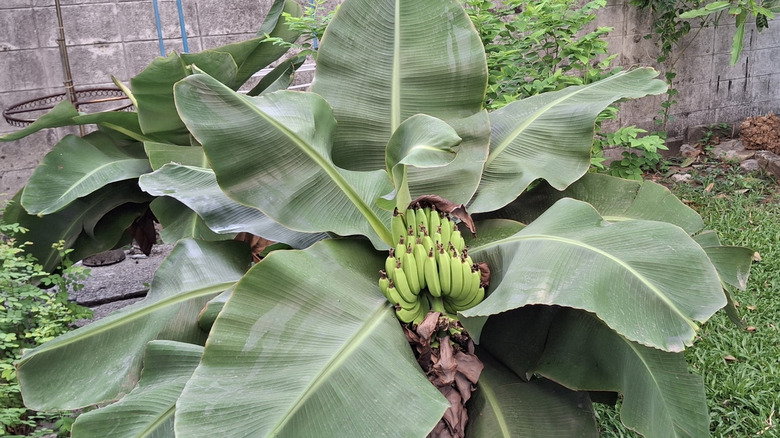
If you're enamored of the idea of a backyard banana plant, start by deciding what your goal is. Do you just want to enjoy a tropical-chic aesthetic in your yard, or are you hoping to harvest and eat your own bananas? For the former purpose, you can pretty much select any variety, as most will grow fairly tall and deliver the look you want. If you're hoping for the latter, the type of banana most often grown for food is the Cavendish cultivar of M. acuminta. In fact, there's a dwarf Cavendish banana that only gets about 6 feet high and still produces fruit that rivals what you might find in the produce aisle at the grocery store.
As tropical plants, bananas generally need warm temperatures to thrive, such as those found in USDA Zones 10 and 11. If you live somewhere like Florida, you can probably just plant them directly in your yard, as they tend to thrive all over that state. If you live somewhere that sees damaging frosts and freezing temperatures, you can grow them in containers, especially the dwarf varieties, and care for your bananas inside during the winter when it gets too cold out — as long as you have the space and don't mind a bit of heavy lifting. There are some, like the Japanese fiber banana (M. basjoo) and the black Thai banana (M. Balbisiana, which tolerates the cold better than others, but these are typically only nice to look at, not to eat.