

There's A Smarter, More Affordable Way To Build Garden Paths Without Weeds
We may receive a commission on purchases made from links.
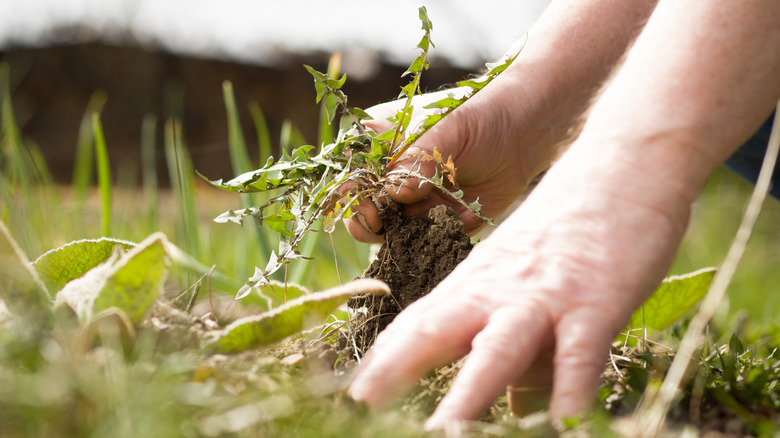
A garden path is a sweet, dreamy addition to your landscaping — that is, until weeds start to pop up between your stone or gravel pieces and you're spending hours on hands and knees pulling them out. Even if you're careful to lay down weed-preventative landscaping fabric before a gravel layer, it may not be able to stand up to the inexorable effects of sun and rain on weed seeds blown in or scattered by chance. At a certain point, not even home remedies like spraying vinegar can prevent weeds from growing in garden gravel. Another potentially more weed-resistant garden path solution you may be less familiar with is actually a by-product of rock crushing called crusher fines. As an added bonus, it also tends to be less expensive than gravel.
"Fines" refers to rock pieces that are smaller than the size of the available types of processed gravel or crushed stone being produced. So essentially, if it's the by-product of ¾-inch gravel, the fines consist of any particle that is less than ¾ inches, including dust. Because this can mean a nearly infinite mixture of particle sizes, crusher fines tend to fill in spaces more completely and compact together into a firm but permeable path surface. Gravel, meanwhile, which is more or less consistently sized, retains spaces between each piece of rock where weed seeds can germinate. Depending on your location and the specific type and color of stone used, you may also see crusher fines referred to as decomposed granite or chat.
How to build a crusher fines path
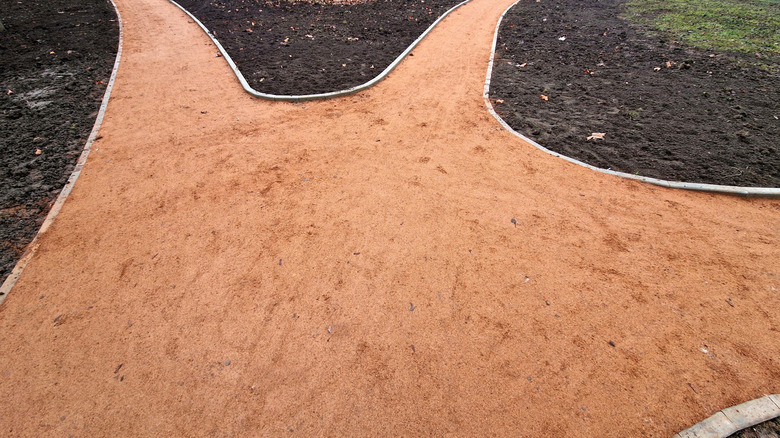
Once you've cleared out the old gravel, if you already had a path laid out and leveled any uneven sections, you'll want to lay down a fresh layer of landscaping fabric. If the landscaping fabric types sold at your local garden store seem thin or insubstantial, you may want to look at some more heavy-duty fabric options from online or specialty retailers. It's a good idea to tuck the edges of your landscaping fabric beneath the stones (or whatever you're using) of your border to keep it in place. Finally, it's time to add your crusher fines. This isn't the time to be sparing: you'll need to have a nice, thick 2- or 3-inch layer of fines to keep weeds at bay. Any deeper than that, once compacted, though, and you risk the stability of your path.
Carefully, starting at any seams in the landscaping fabric so as not to mess them up, use the flat end of a bow rake to distribute the crusher fines. After that, it's time to tamp them down. If you can't rent or borrow a tamper, you'll definitely want to purchase one — luckily, they're not that pricey, as evidenced by this BlumTrec 8x8 steel tamper, $39.99 on Amazon. Give the entire path a shower with the hose, then give it one last tamping to aid in compaction. Over the coming weeks, it will compact even more to create a hard, smooth path.