

Friend Or Foe? How To Identify 13 Common Backyard Snakes
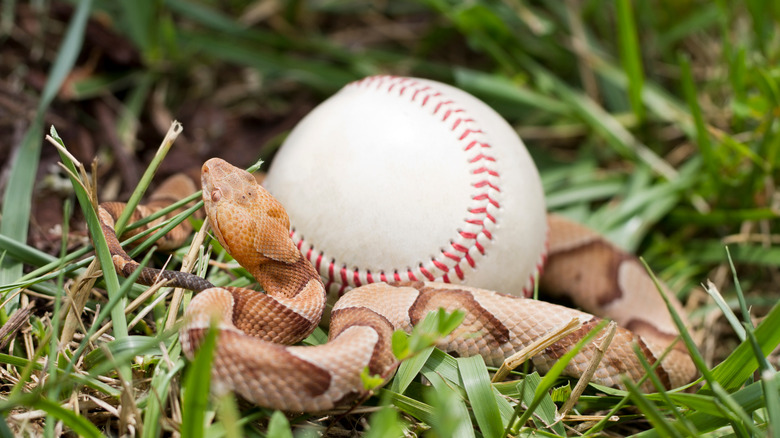
As the human population expands and residential developments proliferate, it becomes more and more likely that at some point, you will encounter a snake or two near your home. While you can try to eliminate features that may be attracting snakes to your garden or yard, it's still possible a slithering visitor might wander into your yard in search of a snack and a hiding place. In most cases, snakes want to avoid you as much as you might want to avoid them, and you probably won't even know they're around. If you do encounter a snake, it's most likely a harmless non-venomous species, like a garter snake; however, there are more than 20 venomous species in the U.S., all of which are a type of rattlesnake, coral snake, copperhead, or cottonmouth. Knowing a bit about which is which can help keep you and your loved ones safe.
There are some traits that certain venomous species share, but there are exceptions to these rules, so it's best to learn a bit about what venomous species are common in your area. If you live in Northern Florida, for example, learn what copperheads look like and what time of year you're most likely to see them in your yard. Only a handful of the 7,000-8,000 yearly venomous snakebites in the U.S. are fatal, and 25-50% of these bites don't even contain venom (known as "dry" bites). If bitten, don't handle the snake, and seek medical help quickly.
Garter snake
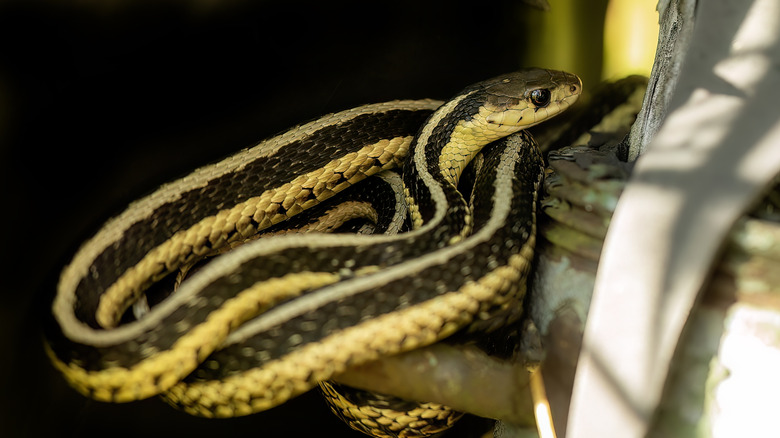
You've probably met a garter snake in your yard, as they are some of the most widely distributed snakes in North America. North America is home to 16 species of garter snake (Thamnophis spp.), and the common garter snake is particularly ubiquitous. Although often called "garden snakes" or "gardener snakes," their actual common name likely refers to their vertical striping, which resembles that of men's sock garters. Common garters are usually 18 to 26 inches long with three stripes against a darker background. They are not venomous or aggressive, but if you mess with them, you may get nipped.
Bullsnake
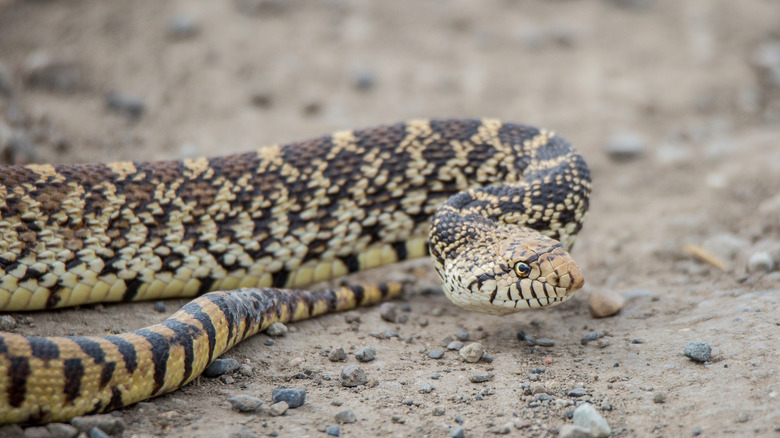
Another frequently encountered harmless snake, the bullsnake (Pituophis catenifer sayi) can nevertheless look a bit alarming due to both its size — up to 72 inches long and quite hefty — and its tendency to shake its tail in imitation of a rattlesnake when threatened. Although bullsnakes and rattlesnakes may be similar in pattern and size, there are a few ways to differentiate them. Bullsnakes have a pointed tail, while rattlesnakes have a blunt tail ending in a rattle. Also, a bullsnake's head is about the same width as its neck while a rattlesnake's head is much wider than its neck.
Eastern coral snake
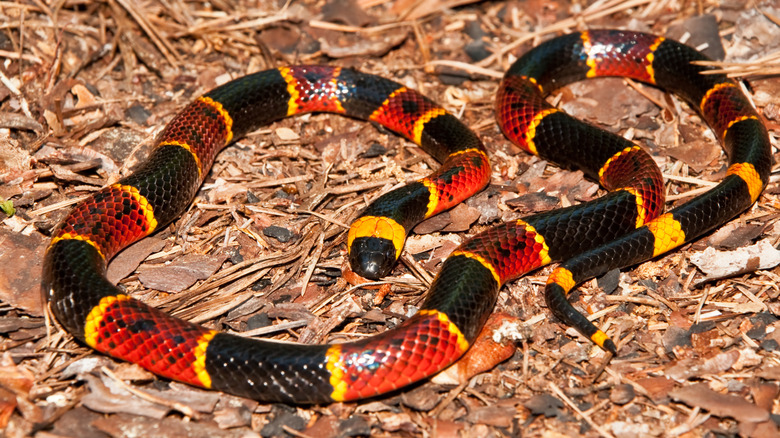
Members of the same family as cobras and mambas, brightly colored coral snakes are highly venomous residents of the Southern U.S., and the southeast-dwelling Eastern coral snake (Micrurus fulvius) is perhaps the best known and most often encountered. The rhyming aphorism "Red touches yellow, kill a fellow; red touches black, friend to Jack" can help you differentiate coral snakes from non-venomous imitators like the scarlet kingsnake. Still, it's best to exercise caution with any patterning, as color variations can occur. Coral snakes are shy and not aggressive, however, and most bites occur when somebody bothers one on purpose!
Eastern milksnake
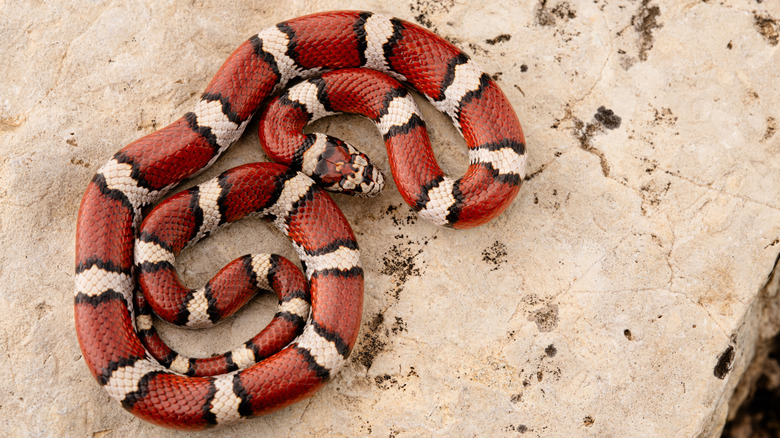
Although often visually mistaken for venomous species like copperheads or coral snakes (depending on subspecies color variations), the Eastern milksnake (Lampropeltis triangulum) is a non-venomous species. It can even be mistaken for a rattlesnake because, like bullsnakes, it will shake its tail when threatened. You can identify a milksnake by its reddish spots outlined in black, the white Y-shaped marking on the back of its head, and the checkered pattern on its underside. These rodent-eating snakes are found where prey hides, which likely led to their common name: People thought they hung around barns because they drank cows' milk.
Copperhead
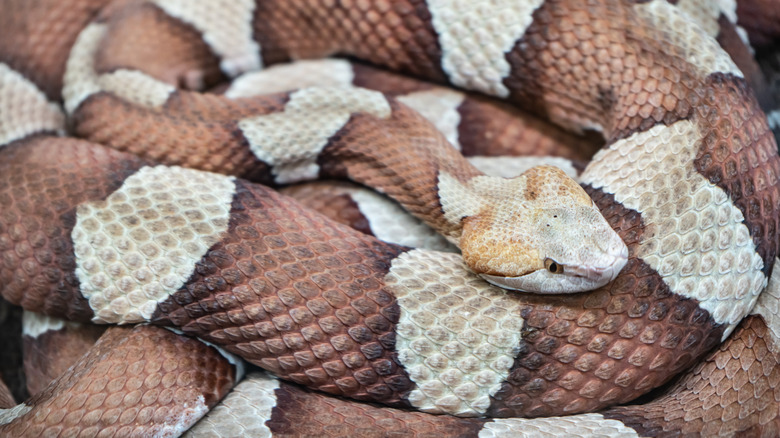
Common venomous visitors in many backyards in the Eastern U.S., copperheads (Agkistrodon contortrix) have the distinction of being responsible for the most bites on humans in most years. Luckily, bites are seldom fatal and are usually the result of a mutual surprise. Your wood pile in particular may attract copperheads, who enjoy the temperature inside. The copperhead's most obvious identifying trait is its coppery color. Copperheads are pit vipers, a type of snake that has a heat-sensing pit on its head that helps it locate warm-blooded prey and predators. Pit vipers have easily identifiable triangular heads.
Cottonmouth
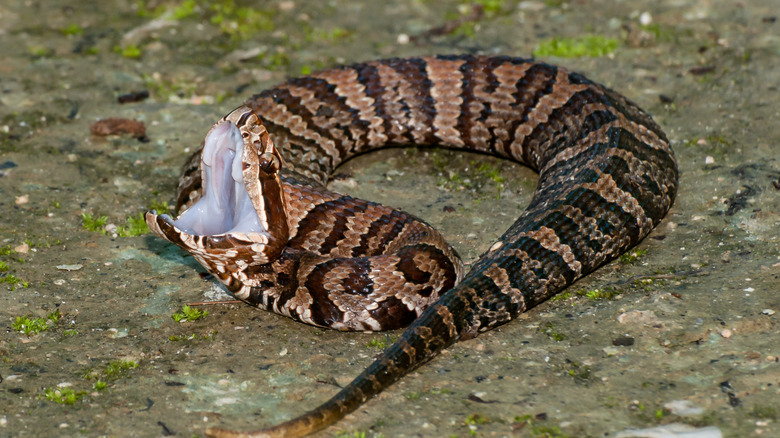
If you live in the Southeastern U.S. — and especially if there's fresh water nearby — you're likely to see the occasional cottonmouth, or water moccasin, in your yard. The Latin name for this species, Agkistrodon piscivorus, nods to the fact that they eat fish, but they'll also snack on frogs, rodents, and other snakes. These venomous pit vipers are named for the white insides of their mouths, which they open as a defensive display when threatened. Young cottonmouths have bold patterning and yellow-tipped tails, but darken in adulthood. Other identifiers include the triangular pit viper head shape and slitted pupils.
Racer
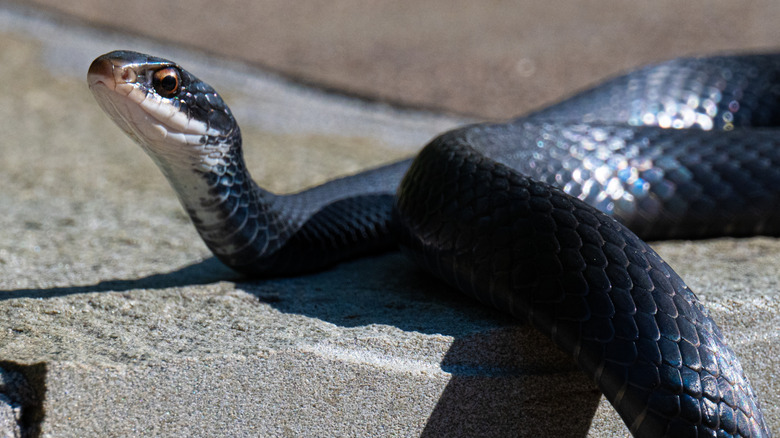
Frequently found living near people, racers (Coluber constrictor) are, as their common name might suggest, very fast. These long, slim snakes usually grow up to 3 feet long, though some over-achievers may grow as long as 6 feet. Although they often shake their tails and strike when cornered, unlike rattlesnakes, they are non-venomous. Racers are skittish and prefer to slither away at top speed rather than turn and fight, but if you manage to grab one, it's pretty likely to give you a nip. Look for a satiny black body and a white patch under the chin to identify an adult racer.
Hognose snake
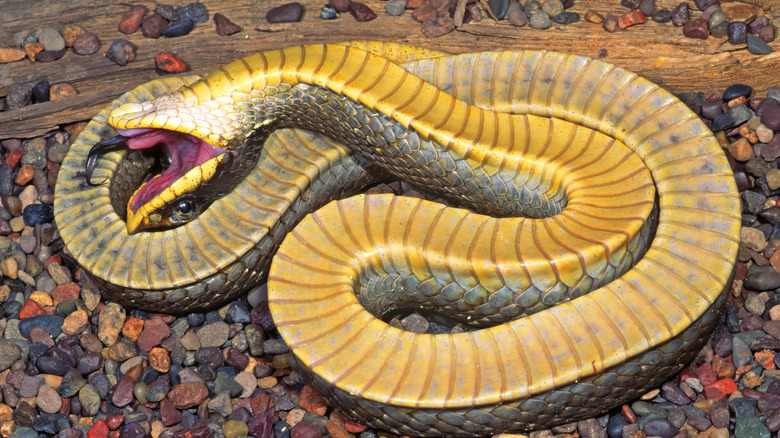
Interestingly, hognose snakes (Heterodon platirhinos) are mildly venomous, but their venom is not dangerous to humans, so they are considered harmless. These snakes' large fangs are actually located so far back in their mouths that they probably wouldn't even reach your skin if they did bite you. They use these fangs to help them subdue toads, which tend to inflate as a defense and may need to be... popped before swallowing. Although sometimes confused with copperheads, you can recognize hognoses by their upturned snouts (used for digging) and their dramatic tendency to roll over and play dead when threatened.
Timber rattlesnake
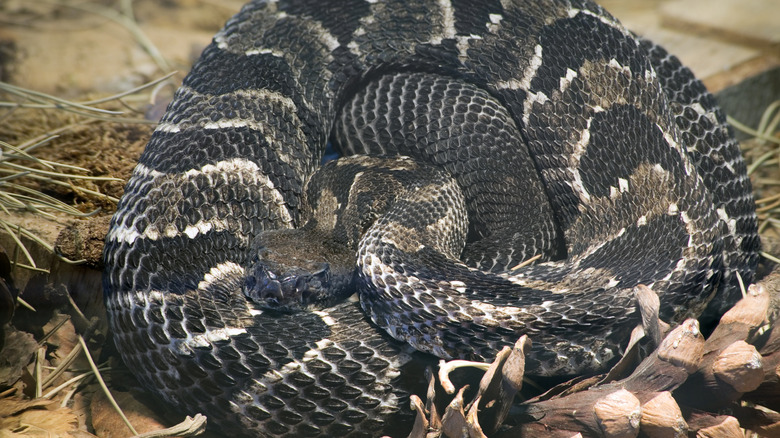
The third largest venomous snake in the U.S., the timber, or canebrake, rattlesnake (Crotalus horridus) is another pit viper that usually grows to 3 to 5 feet long (though 6 isn't unheard of). Within certain eastern and central parts of the U.S., if you encounter a rattlesnake, you can be pretty sure it's a timber rattler, on account of it being the only rattlesnake endemic to those areas. You can also look for the telltale chevron crossband pattern. These snakes prefer densely forested habitats, but sometimes housing developments do encroach on their favored territories.
Corn snake
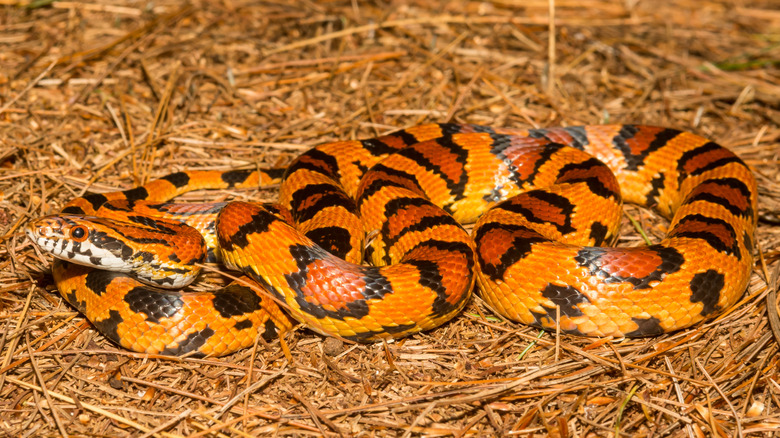
Non-venomous and colorful, corn snakes (Pantherophis guttatus) are fairly common in human neighborhoods, with a tendency to wander into structures in pursuit of tasty rodents. In fact, their common name is a reference to these excellent climbers' history of sneaking into corn cribs to feed on the mice and rats attracted to the crops. Look for red or orange blotches edged in black, as well as a marking from the neck to between the eyes that resembles a spear. Like some of the other snakes on this list, if cornered, they will shake their tails and strike to try and scare you off.
King snake
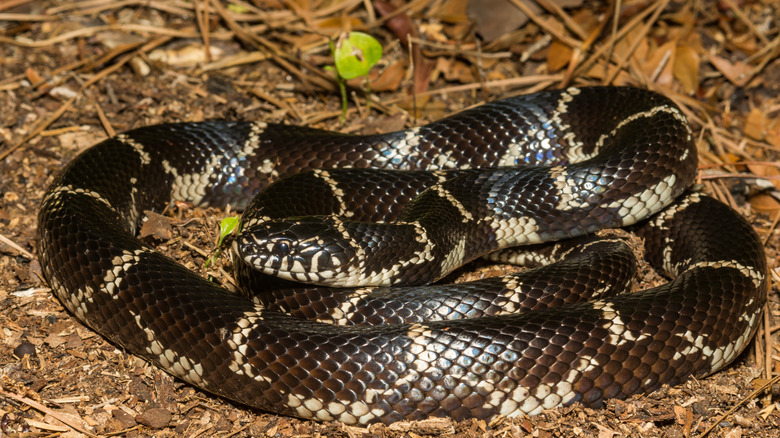
King snakes are frequent visitors near human habitation in many eastern and some central states. Eastern king snakes (Lampropeltis getula) are dark brown or black with white or yellowish cross-bands, while another common species, the black kingsnake (L. nigra), has less or no banding, possibly with speckling or almost completely black. Both are quite large, potentially topping out at 7 feet and weighing as much as 5 pounds. If pit vipers like copperheads are a potential hazard in your area, king snakes are your friends: though non-venomous themselves, they're resistant to pit viper venom, so these species are on their menu.
Water snake
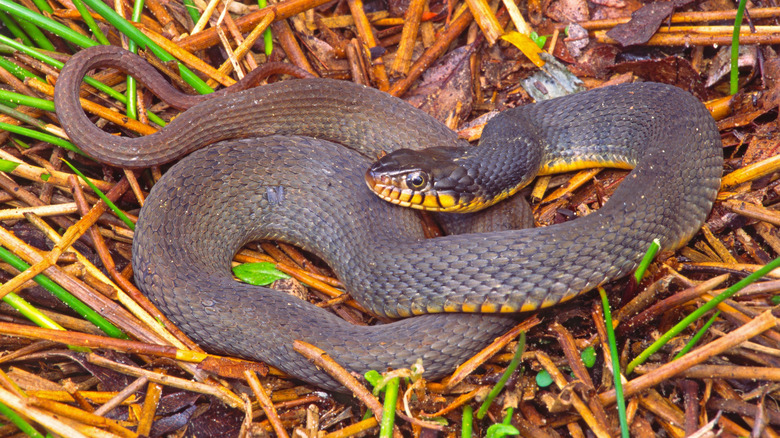
Harmless water snakes (Nerodia spp.) are often unfortunate victims of mistaken identity. Because of their preference for habitats near water, they're frequently misidentified as cottonmouths and may be harmed by frightened humans as a result. Remember that cottonmouths are very heavy, thick-bodied snakes with short tails while water snakes are more slender, with long, thin tails. Additionally, cottonmouths have blocky heads and distinct, slender necks, while water snakes have thinner heads and undefined necks. Though water snakes are non-venomous, they're notoriously grouchy, so avoid messing with them if you don't want to be chomped or sprayed with a nasty-smelling substance.
Western diamondback rattlesnake
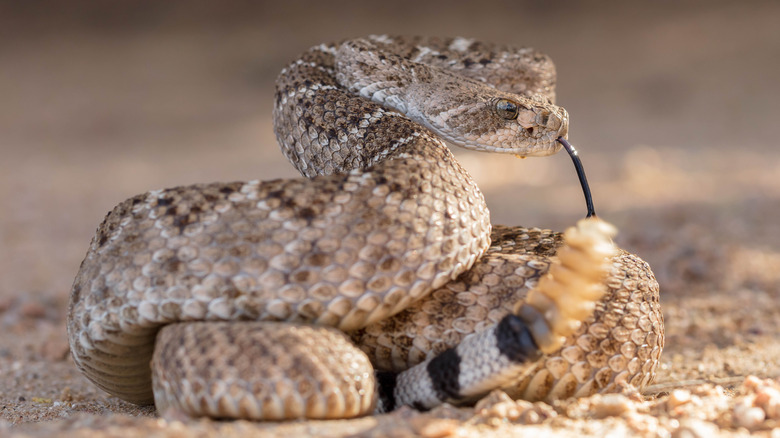
East coast snakes are somewhat overrepresented in this list, but it would be incomplete without a classic western icon: The Western diamondback rattlesnake (Crotalus atrox). These pit vipers are the largest rattlesnakes, with some growing up to 7 feet long (though most are smaller than that). And they aren't shy! Rather than slithering away from danger, they're more inclined to face down the threat. These snakes are frequently removed from neighborhoods, especially where recent construction has encroached on their natural habitats. Look for the titular diamond patterning and a black-and-white striped tail.