

The Best Way To Prepare Your Hydrangeas For Spring
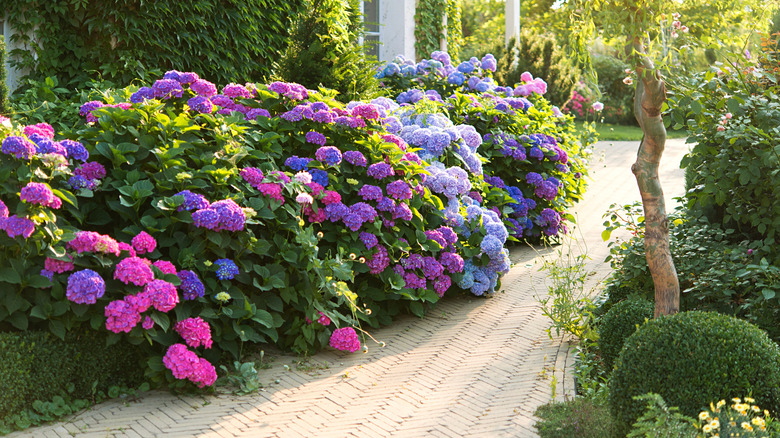
Hydrangeas are easy to love thanks to their massive and colorful blooms. And while they aren't always the easiest shrubs to grow (leading many to search for gorgeous hydrangea alternatives), their beauty ensures that they still have a place of honor in many landscapes. Part of the challenge of growing hydrangeas is the amount of diversity within the genus, with different types having different needs. And nowhere is the importance of knowing what type of hydrangea you're growing more essential than when you're preparing the plants for spring. While the techniques for how to fertilize your hydrangea plants are similar regardless of species and cultivar, that isn't the case for pruning strategies.
Regardless of what type of hydrangea you're growing, they'll likely benefit from the addition of some slow release fertilizer as winter turns to spring –though it's never a bad idea to test your soil first. Make sure not to go overboard on the fertilizer and pick one that is relatively low in phosphorus. Push back your mulch before spreading the fertilizer and water it in well. You should then move the mulch back into place. If you have less than 2 inches of mulch in the garden, early spring is a good time to add a bit more. The next step in spring prep is the tricky part: Pruning.
Which hydrangeas benefit from spring pruning and why
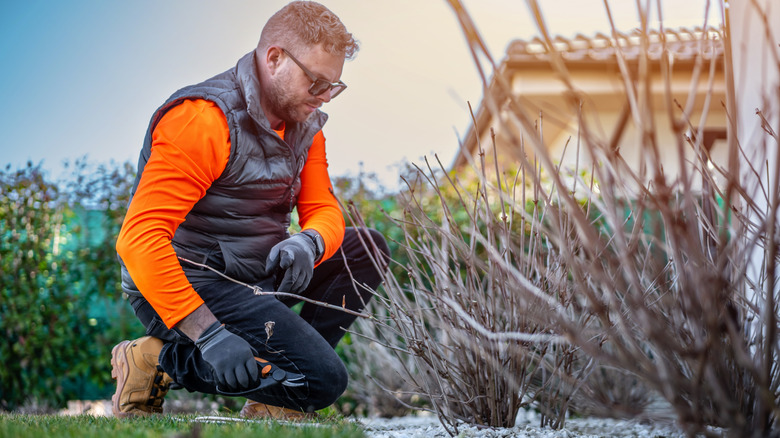
Pruning is an important part of care for hydrangeas, but doing it on the wrong plant at the wrong time can leave you without blooms for the whole growing season. While you can confidently prune your panicle (Hydrangea paniculata) and smooth (Hydrangea arborescens) hydrangeas in early spring, things aren't so simple with bigleaf (Hydrangea macrophylla) hydrangeas. Some newer bigleaf hydrangea cultivars bloom on both new and old wood (meaning even if you prune in spring, you should still get some blooms), but that's not the case for all varieties.
For varieties that only bloom on old wood, a spring prune will likely mean no blooms for the whole season. It's therefore best to avoid pruning bigleaf hydrangeas until right after they have finished blooming but before August, when the next years' buds start to form. This is also the case for oakleaf (Hydrangea quercifolia) hydrangeas. Of course, regardless of what type you're growing, you should still remove dead or diseased branches regardless of the season.
When you prune your hydrangeas, make sure to use sharp, sanitized shears, and wear gloves to avoid scratches. If necessary, sharpen your clippers or garden shears before starting. Make your cuts at a slight angle and about ¼ inch above a leaf bud. Don't add paint or other substances to the pruning wound. It will heal best if left open.