

The Best Time Of Year To Fertilize Hydrangea Plants For Beautiful Spring Blooms
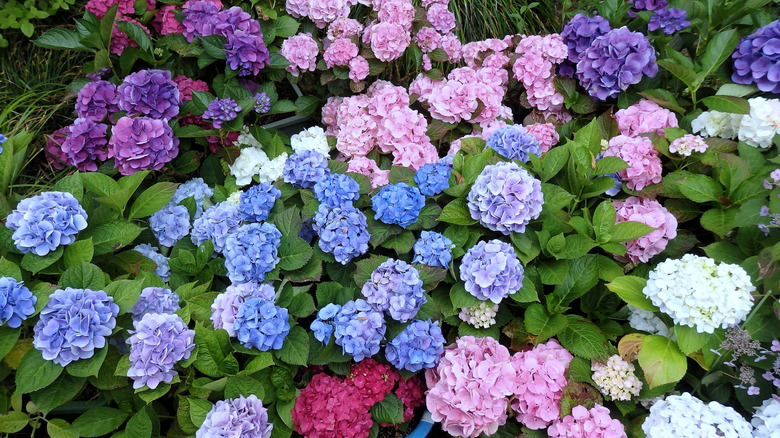
Few springtime sights are as show-stopping as hydrangeas in full bloom. While not all varieties of hydrangeas bloom in the spring — and whether or not they do can also be dependent on your location and climate — the ones that do are a sight for sore eyes.To get the fluffy, colorful puffs to look their best, fertilizing the right amount and at the right time is important.
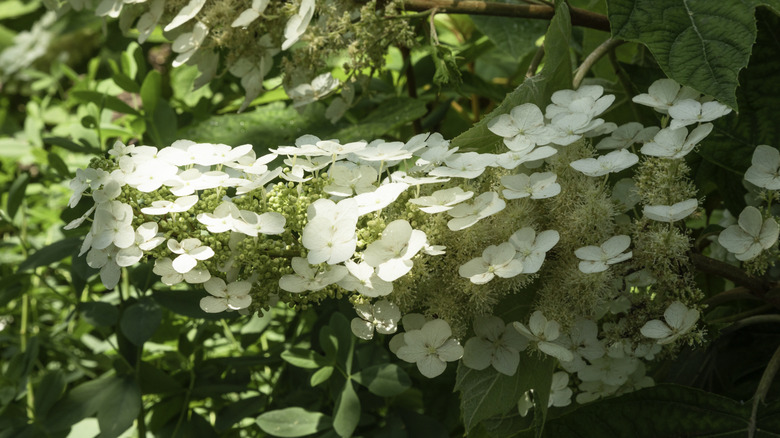
But which hydrangeas are spring-blooming species? The iconic bigleaf hydrangeas (H. macrophylla), with their stunning snowball-shaped flower clusters in shades of white, pink, purple, and blue, as well as oakleaf hydrangeas (H. quercifolia), are old wood species that typically begin flowering in late spring in USDA Hardiness Zones 7 through 11. In colder regions, however, they may hold off until things warm up in summer. New wood species, such as smooth (H. arborescens) and panicle (H. paniculata) hydrangeas, are more likely to be summer bloomers. Knowing which type you're working with can also help you know when you should prune your hydrangeas.
Ensuring your spring bloomers flourish means attending to a few tasks during the year, including fertilizing. In general, hydrangeas don't need a lot of fertilizer, especially if they're already growing in rich soil. If you spoil your hydrangeas with excessive amounts, you may see too much leaf growth at the expense of flowers. However, old wood hydrangeas can still benefit from an application in the early spring, once soil temperatures consistently reach about 50 degrees Fahrenheit.
How to fertilize spring-blooming hydrangeas
Because a little goes a long way, it's best to select a balanced, slow-release fertilizer. General purpose 8-8-8 or 10-10-10 should do the trick. Granular fertilizers may be a better choice, as fast-acting liquid products are more likely to just give foliage a quick boost with little bloom return. If there is a layer of mulch around your hydrangeas, you don't need to remove it before fertilizing. Mix the nutrients lightly into the soil in an 18-inch wide circle around the plant with about six inches between the base of the stems and the fertilizer circle. Make sure to give your hydrangeas a good drink after applying the fertilizer to help incorporate it evenly into the soil.
It's worth noting that just as important as when to fertilize hydrangeas is when not to fertilize. If you fertilize them too early in spring, before they've begun to show signs of new leaves, the roots may not be "awake" enough yet from their winter dormancy to really benefit from the nutrients. On the other hand, you shouldn't apply fertilizer too late, either. If you fertilize hydrangeas after mid-August, you run the risk of encouraging growth too late in the season. Because this late growth probably won't be strong enough to survive the winter, this can be especially detrimental to old wood hydrangeas, since this is the growth on which next year's buds should appear.