

The Beautiful Flowering Tree That May Be Illegal To Have In Your Yard Or Garden
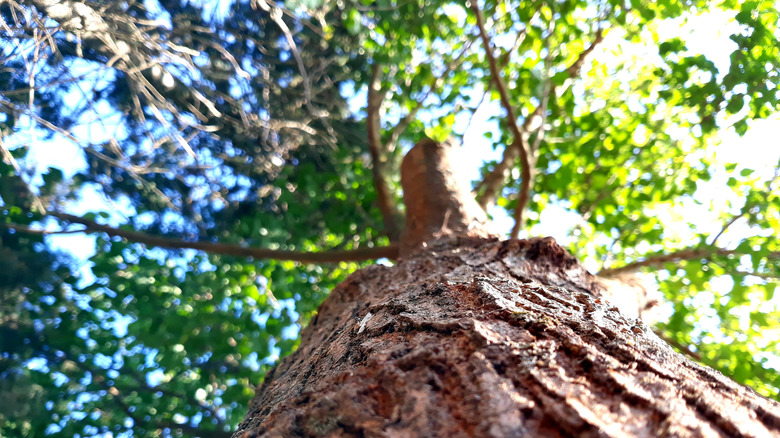
When you think of illegal plants, it's more likely in reference to something like marijuana than a common flowering tree, but it turns out mulberry trees are banned in a few cities and states. Albuquerque, El Paso, Las Vegas, and Tucson outlawed them, and they're off limits in several states as well. White mulberries (Morus alba) are the most commonly banned variety because they're invasive.
These natives to China thrive in poor soil and can grow aggressively, crowding out other plants. They're so prolific that, despite not being a native plant, they're found in all 48 contiguous states, except for Nevada. Las Vegas hopes to keep it that way, which is why they're banned there. Their invasive quality got this variety outlawed in Illinois, Kentucky, and Tennessee as well.
Red mulberries (Morus rubra) are actually native to North America, but they have their own problems. They cross-pollinate with white mulberries, and their new sprouts essentially become much more like white than red, taking on the invasive tree's worst qualities. That's why all varieties of the Morus genus are actually banned in Albuquerque. One little-known fact about mulberries is that you can't tell the difference between a white and red variety just by the color of the berries, as white mulberries can have red or even black berries.
What do you do if you already have a mulberry tree?
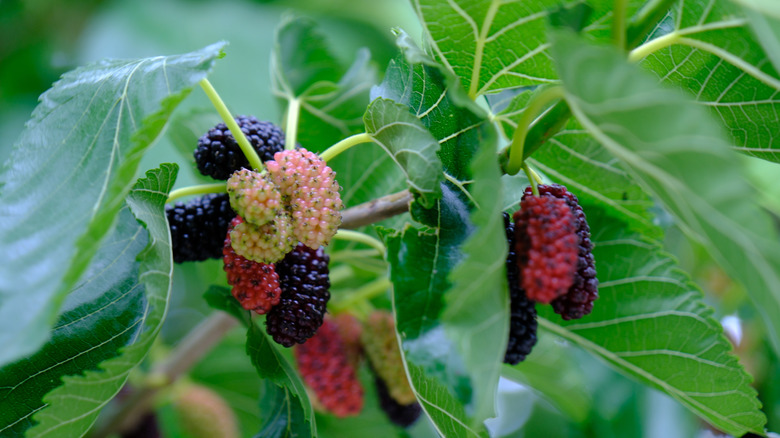
While there's a special bond between mulberry trees and birds, since they love to eat their berries, there are many good reasons to remove them — besides the whole invasive thing. Male trees, especially, sometimes trigger severe allergies or even asthma attacks among people sensitive to their pollen. Plus, its berries can stain pavement and make a mess, quickly becoming a nuisance.
So if you do have a white mulberry tree, and it's illegal in your city or state, what do you do with it? First, contact your local city or county government to get clarity on the law, as each municipality could be different. Also, most bans tend to cover the planting of new trees or the selling of them. Penalties for doing so are typically a fine. So if the tree in your yard was planted before the late 1980s or 1990s, when many of these laws took effect, chances are, you can probably just leave it alone.
Otherwise, the quickest way to kill a mulberry tree is to cut it down. But don't forget to dig up the tree's roots as well to make sure it stays dead. You can also treat the stump with an herbicide within a few minutes of cutting it down in order to kill the roots. If you don't dig up the stump or treat it with herbicide, the tree will regrow.