

The Beautiful Houseplant Joanna Gaines Uses For A Fixer Upper Vibe

If you're a fan of HGTV's "Fixer Upper" co-host Joanna Gaines, then you know that she loves houseplants, and the bigger the better. One of her favorites, the staghorn fern (Platycerium bifurcatum), can grow to be three feet across. It's no wonder she loves this showy, big-leafed houseplant, since it makes a statement in any space.
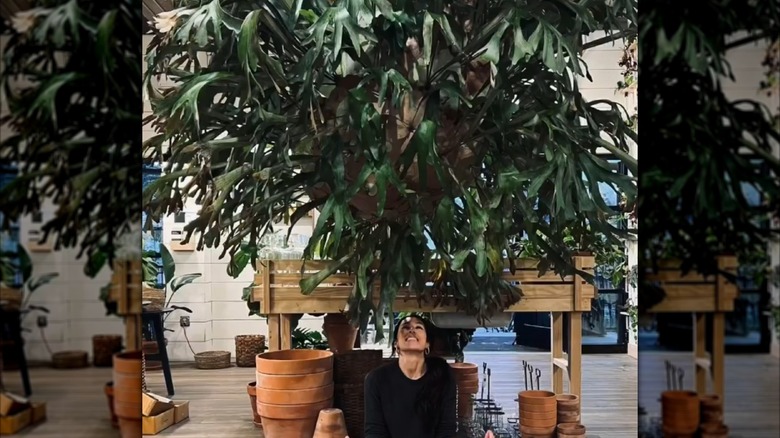
Gaines nicknamed her 26-year-old behemoth staghorn fern "Earle." It was bigger than the host herself when it was hung in her Magnolia headquarters in Waco in 2022. Earle and others like him are actually a type of epiphyte, which means they absorb water and nutrients straight from the air and not the soil. Fun staghorn fern fact: In the wild, you can see this tropical plant grow on the trunks of other trees and not in the ground. It's why you can attach young plants to almost anything, like wooden boards, wire baskets, or rocks. The plant's adaptability is probably the reason it has successfully survived since dinosaurs roamed the earth.
It plays the part of a prehistoric plant well with its giant leaves that feel oddly leathery. That's because they're covered in small, white fibers that help the plant absorb water from the air. They thrive in warm and moist environments. Staghorn ferns suffer when temperatures dip below 55 degrees. It won't mind a shady spot in your house, though, which is why Gaines mounted it in the middle of her store.
How to grow and care for a staghorn fern
If you want to plant one of Gaines favorite ferns for the perfect "Fixer Upper" vibe, then you can attach fronds of the staghorn fern directly to a wooden board or other surface using wire or even nylon hose. Or, you can also tuck them into a wire basket filled with sphagnum moss. Fertilizing the plant is a good idea, though yours might not be big enough yet to feed it banana peels as Gaines did with Earle. Instead, spritz a little liquid fertilizer on it monthly.
Once your fern really starts to grow, you may want to divide the plant if it becomes crowded. When cutting staghorn ferns for division, be careful to include both types of fronds that the staghorn produces. Foliar fronds are big and upright, and the basal fronds are narrow and flat, covering the roots. For new divisions, keep them away from drafts and mist them regularly. While staghorn ferns in the wild absorb water from humid air, in our dry homes, these plants can benefit from a weekly spray, especially when they seem wilted.
Just know that too much water can be a bad thing and lead to fungal infections, often caused by rhizoctonia. This is a common problem with staghorn ferns. If you see black spots that appear on your plant, stop watering and consider applying a fungicide. Act quickly because these fungi spread fast and kill without mercy. With a little care now, your staghorn fern might even last as long as Gaines' beloved Earle.