

Save An Old Glass Jar To DIY A New Home Your Favorite Succulent Will Love
We may receive a commission on purchases made from links.
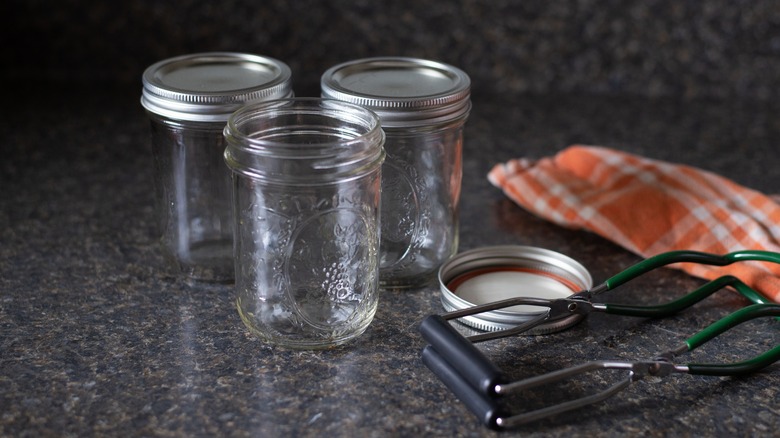
If you often forget to water plants, but you still want some nice greenery inside, then you could give this trick a try. Grab an old mason jar and your favorite succulent. You can combine the two to make an open terrarium that will (mostly) take care of itself.
Terrariums are traditionally a glass closed-ecosystem for plants, but open variations are popular as well. The concept has been around since the 1850s, when people in Victorian England needed a way to safely transport certain specimens by sea, but now they are fun DIY projects at home. Since the water doesn't naturally drain out, the jar can keep plants satiated for a longer period. Of course, you can't put just any plants in a terrarium. Slow-growers with compact shapes are best, and generally, you don't want to mix thirsty tropical plants with desert-loving species together. One will get too little water while the other gets too much.
Pairing succulents together works well in open terrariums, though. Try the spiky-leafed haworthia, slow-growing jade plants (Crassula ovata), colorful hens and chicks (Sempervivum), or rose-shaped echeveria. Succulents will love the clear glass of a mason jar better than cloudy or colored containers, which block light and stunt growth. Ditch the mason jar lid, though, as these plants will do better in open-topped environments. You can create your new succulent home in no time at all. All you'll need is the mason jar, pebbles, well-draining soil, activated charcoal, moss, plant cuttings from your favorites, and any little decorative items you might want to add as accents.
Create your jar terrarium for succulents quickly and easily
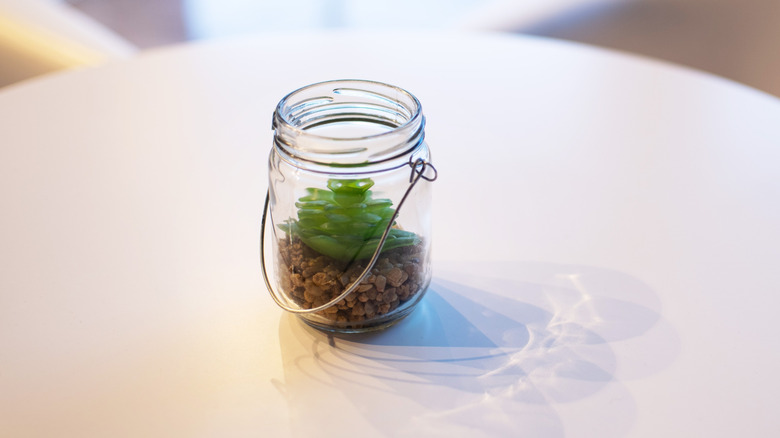
Before you get started, always clean and dry your jar. Allow chemicals from any cleaners to air out for a couple of days. Then, put pebbles or small rocks at the bottom to help keep plant roots from becoming waterlogged. Layer on activated charcoal, which neutralizes toxicity that can be bad for plants. Next, put in some moss to help keep the soil from sinking into the gravel. Add in your soil, making sure it's damp but not muddy — just about an inch and a half should do. If you're concerned about planting your succulent in shallow soil, don't worry. Many varieties have short roots, so they don't need depth to thrive.
The rocks, charcoal, moss, and soil should only take up about a quarter of the jar. Once that's set, tuck your cuttings into the dirt. If you're having trouble reaching into the bottom, grab some extra-long tweezers, like these Fri4Free tweezers, to place cuttings inside. While you can plant seeds in a terrarium, cuttings are the fastest and easiest way to ensure your plants thrive. Finally, add in any stones, twigs, or figures to set the scene.
Afterward, put the jar in bright but indirect light. The glass can get too hot with direct sunlight, which can burn your plants. Check the terrarium once every few weeks and only water when the dirt feels dry. You may also need to prune occasionally. Even slow-growing plants can get crowded in small spaces.