

How To Stake Your Pothos For A Healthier Houseplant
We may receive a commission on purchases made from links.
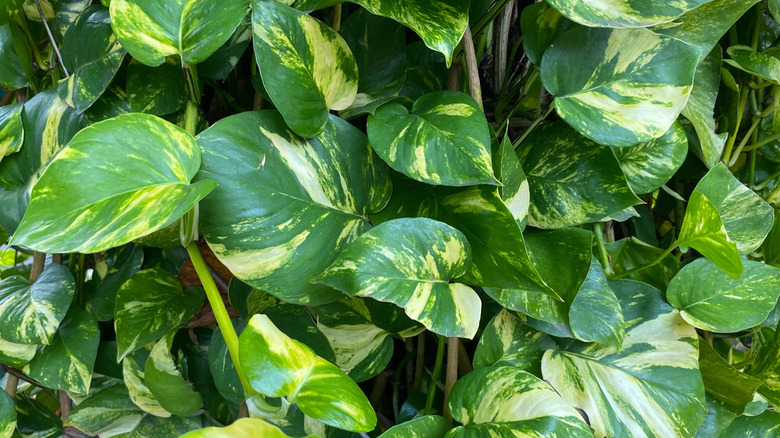
Ubiquitous in charming cafes, offices, and living rooms the world over, the reliable pothos (Epipremnum aureum) is among North America's most popular houseplants for good reason. These tropical ivy houseplants are easy to find in stores and just as easy to keep alive, with unfussy care needs, few pest problems, and a tolerance for long periods of low light. They're great choices for beginners who are just getting into keeping plants. But if you're ready to take your houseplant husbandry to the next level and you'd like to give your pothos an upgrade, you might try training your pothos up a stake or other vertical support, such as a moss pole.
It's worth noting that the foliage you'll see most often on indoor pothos consists of juvenile leaves. These are smooth and only a few inches long. However, if your pothos is allowed to climb, the highest leaves can grow much larger than the lower leaves. Truly mature leaves feature monstera-like perforations and can grow as large as three feet long! This boost in size is due to the higher leaves' increased access to light, which reduces stress associated with low light availability and makes carbon uptake easier. So basically, given something to climb on and enough light to reach for, your pothos can start to develop more impressive foliage.
How to select a climbing stake and train your pothos on it
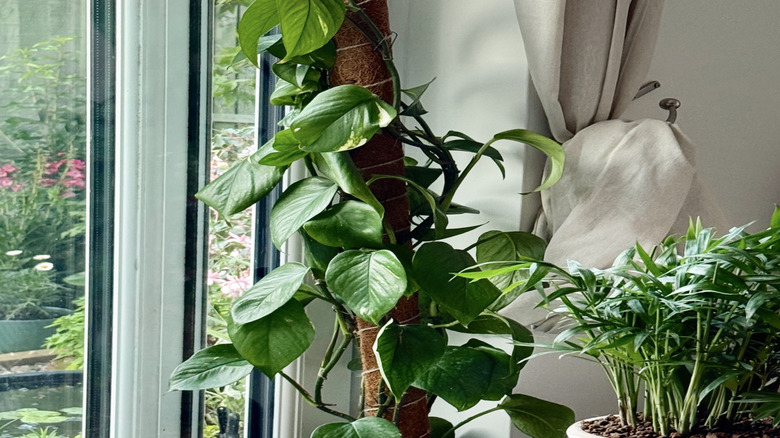
There are a few different structures you can use to start your pothos's upward journey. One common solution is a moss pole, a structure made of moss supported by a metal skeleton. You can also find poles made with coconut coir instead. Products such as the K-Brands 28-inch bendable moss pole are available on Amazon, but if you're feeling the DIY spirit, you can make a sphagnum moss pole at home. Not only do moss poles retain moisture, but they also provide a surface that plants with aerial roots will readily grab onto. Since pothos use aerial roots to climb, this might be a particularly good choice. Other supports you can try include bamboo sticks, a trellis, or a tomato cage.
If using a moss pole, make sure you give it a good soak in water before installing it. It's essential that a moss pole stays moist, as dried-out sphagnum moss will actually repel water. That means you'll need to water it regularly once it's in use, too. In a site near the center or back of your plant, carefully insert the pole. Then, starting with the longest vine, wrap the trailing tendrils around the support, following whatever direction they seem to want to go anyway. You'll need to use string, plant wire, or some other fastener to secure the vines to the support until the aerial roots have a chance to grab on. A particularly good time to stake pothos is when repotting it, since it reduces your risk of damaging roots with a clumsily stuck pole.