

How To Propagate Roses From Cuttings In Winter For More Plants In The Spring

We may receive a commission on purchases made from links.
So you dutifully pruned your rose bushes in the fall, and you've taken great care to winterize them. With no blooms to enjoy and little else to do but wait for spring, winter can seem like a glum time of year for rose fans. But if you've been thinking of adding more of these flowering shrubs to your garden, you can actually use the winter downtime to propagate your existing roses. Hardwood cuttings come from last year's growth on the shrub, and should be taken with care during the winter dormant season. With a little luck, they could be ready to plant the following fall. As an added benefit, although semi-hardwood cuttings — taken from new growth in the summer growing season — tend to root more readily, plants rooted from hardwood cuttings can be sturdier and less fragile.
There are a couple of additional caveats to keep in mind. Many newer types of roses, such as hybrid tea roses and floribundas, are actually grafted onto hardier rootstock, so you won't know what blooms you'll end up with from a hardwood cutting. Also, newer varieties may be under a patent and, therefore, illegal to propagate. Unless you're certain your roses are not grafted or not under a patent, you'll probably be better off propagating older and heirloom varieties (those introduced before 1867) just to be safe. Albas, grandifloras, gallicas, and bourbon roses are just a few examples from the heirloom classification of rose plants.
How to take hardwood rose cuttings

Before you begin, you'll need to assemble your tools. Your blade or cutting instrument should be very sharp to reduce stress to both the parent plant and the cutting. It also needs to be very clean to reduce the possibility of disease transmission. Make sure you have containers prepared for your cuttings so they don't dry out while you're searching for somewhere to put them. The containers should be prepared with loosely packed, moist potting soil. Set out some rooting hormone — Hormex rooting hormone and Garden Safe TakeRoot rooting hormone are just two of many available options — in a shallow container. You'll also need plastic bags or plastic wrap on hand to cover the potted cuttings so that they retain humidity while they're rooting.
The process for taking hardwood plant cuttings is more or less the same as that for semi-ripe cuttings. The main difference is when you take the cuttings. Choose a stem that looks healthy and shows evidence of growth, typically the remains of flowers or rosehips. Holding your blade at a 45-degree angle, take a 6-8 inch cutting just below a node. Trim the top of the cutting off down to the first set of leaves, as well. Remove the leaves from the lower portion of the cutting while leaving the upper leaves. Finally, scrape away a bit of the outer layer of skin on the lowest inch of the cutting to damage the cambium, which can encourage the cutting to grow roots faster.
How to root and plant hardwood rose cuttings
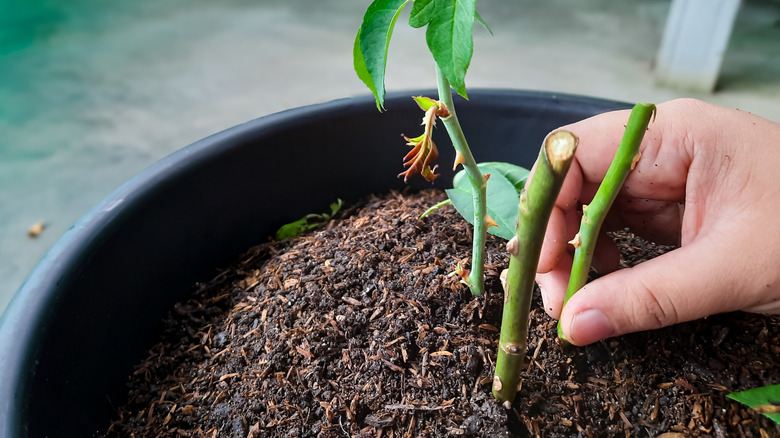
Once your cutting is trimmed and ready, dip the cut end into the rooting hormone. Although rooting hormone is technically optional when propagating from cuttings, it's probably best to use it with the hardwood sort for an increased chance of success. At this point, you're ready to stick your cutting in a prepared container. Make a hole about three or four inches deep in the soil, place the cutting inside, and carefully press the soil in around the stem. Cover the whole pot with plastic, then place it in a spot where it can receive bright, indirect light.
While your cuttings are working on new roots, make sure to keep them from drying out by misting them daily or watering from the bottom. You probably won't see any roots throughout the winter — they'll be callusing in that time — but come spring, they should start to develop. Then, all you have to do is leave them where they are and keep them watered until next fall, when they should be ready for you to plant them outdoors. Just make sure you plant them in a spot where the young plants will be sheltered from the winter wind, and hopefully you'll see some fresh blooms the following spring.