

Prune This Tree In Late Winter For A Stunning Early Spring Display
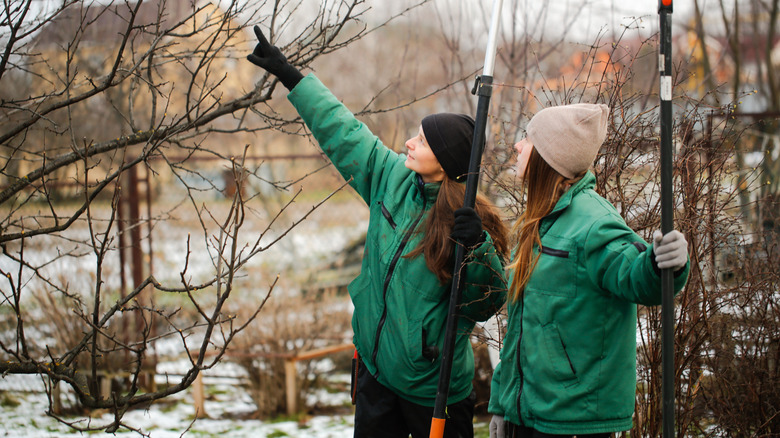
Late winter or very early spring is an ideal time for pruning many deciduous trees and shrubs in your landscape. Pruning while the trees are dormant means the process is less likely to cause them stress. Bugs and diseases are also unlikely to be a major issue during this time. And even better, when your trees are missing their leaves, it's much easier to see what you're doing. One tree that responds especially well to late winter pruning is the beautiful crabapple.
Unlike their culinary apple relatives, crabapples (Malus spp.) are grown primarily for their stunning ornamental value. In addition to their gorgeous spring blooms, they also have small and attractive fruits that decorate the trees in summer and fall. Some crabapple cultivars even have tasty fruit. Different flowering crabapple tree cultivars tend to have different growth habits, too, so take a look at the tree's habit before trimming it into its ideal shape.
Shaping the tree isn't the only reason to prune, though. Part of caring for your flowering crabapple and keeping it healthy and beautiful is making sure it is pruned for sunlight and airflow to reach all parts of the tree. Pruning also deals with unattractive suckers. And if your tree is planted near a sidewalk or walkway, late winter is also the time to remove any low-growing branches that can get in people's way.
Winter pruning your crabapple tree rewards you with spring blooms and a healthy tree

As we mentioned, pruning flowering trees can be done in late winter or early spring, so why choose winter? After all, no one wants to be doing yard work in the cold. But late winter is a better time for crabapples (and you) because you avoid accidentally cutting off spring blooms. Bloom times vary by species, but the weather is a major factor. If you wait too long, a warmer spring could mean an earlier bloom. Since you want to avoid cutting off the blooms, and you want to prune for optimal sunlight and airflow, you might as well bundle up and get it done in winter.
Before you start pruning, make sure your tools are sharp, so they neatly cut through the branches. If your pruners aren't able to easily cut through a branch, use loppers instead. Be sure to clean your tools with alcohol between cuts to prevent any transmission of disease.
When pruning your crabapple tree, it's best to first focus on removing branches that are dead or damaged. You can also confidently remove a branch if it is crossed with or rubbing against another branch. Suckers that are growing from the roots are also easy choices for removal. Next, focus on making sure that the crown is open, allowing for proper airflow and light to pass through. Don't go overboard, though, because a crabapple tree that is overly pruned can be more vulnerable to sun scald.