Copyright © 1997-2010 Demand Media. All rights reserved.
The Trumpet Creeper (Campsis Radicans) is generally described as a perennial vine. This dicot (dicotyledon) is native to the U.S. (United States) has its most active growth period in the spring and summer . The Trumpet Creeper has green foliage and inconspicuous red flowers, with an abuncance of conspicuous brown fruits or seeds. The greatest bloom is usually observed in the summer, with fruit and seed production starting in the summer and continuing until fall. Leaves are not retained year to year. The Trumpet Creeper has a long life span relative to most other plant species and a rapid growth rate. At maturity, the typical Trumpet Creeper will reach up to 2 feet high, with a maximum height at 20 years of 2 feet.
The Trumpet Creeper is easily found in nurseries, garden stores and other plant dealers and distributors. It can be propagated by bare root, container, cuttings, seed. It has a slow ability to spread through seed production and the seedlings have high vigor. Note that cold stratification is not required for seed germination and the plant cannot survive exposure to temperatures below -13°F. Trumpet Creeper has high tolerance to drought and restricted water conditions.
Ornamental: The showy flowers of trumpet creeper make this plant appropriate for some gardening and landscaping needs. It is often used as a cover for fences, arbors, walls, pillars or large trellises and as a groundcover. The cigar-like fruit may be considered decorative during winter.
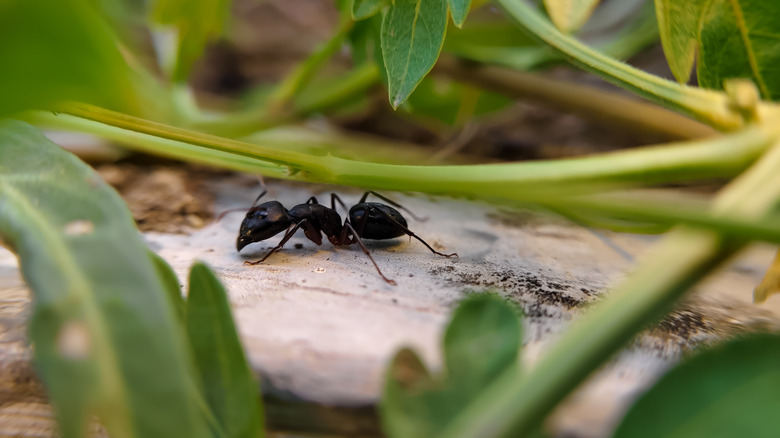
Wildlife: The tubular flowers and large quantities of nectar produced by trumpet creeper are attractants for hummingbirds and butterflies. The vines also provide habitat to ants.
General: Bignonia Family (Bignoniaceae). Trumpet creeper is a deciduous or partly evergreen vine that climbs by aerial rootlets and twining stems. This is a U.S. native. Stems can grow up to 12 m long and have numerous aerial rootlets. Leaves are opposite, pinnately compound and coarsely toothed, composed of 7, 9, or 11 leaflets. Leaflets are somewhat shiny and dark green. Flowers are yellow-orange to red, tubular, and up to 8 cm long and 4 cm wide at the mouth. Flowers are born in clusters of four to a dozen and bloom from July through August. The fruit is a flat, tapered capsule, 8-13 cm long with seeds that are flat and winged.
Distinguishing characters of trumpet creeper include its U-shaped bundle scars on the stem, abundant root-like aerial stems, opposite compound leaves that are coarsely toothed, large trumpet-shaped flowers, and its light tan bark that appears flaky on mature stems.
Trumpet creeper is native to eastern, north-central, and south-central portions of the United States and has become naturalized in New England. Its natural range occurs from New Jersey to Ontario and Iowa, and south to Florida and Texas. For current distribution, please consult the Plant Profile page for this species on the PLANTS Web site.
Habitat: Trumpet creeper is found in thickets, dry woods, waste grounds, railroads, disturbed sites, clearings, and along roadsides and fencerows.
Adaptation The USDA hardiness zones for trumpet creeper are 4-10. It grows in wet to dry soils and sand, loam, or clay soil types with a pH range of 3.7 to 6.8. Trumpet creeper prefers full sun for best flowering.
Management If not controlled, rampant growth will become a problem. Vines should be thinned throughout the growing season and cut back in winter to prevent aggressive spread.
Pests and Potential Problems Planthoppers may occasionally feed on trumpet vine but generally do not cause serious damage. Leaf spots caused by various fungi may be seen but are not serious. Mildew causes a white powdery growth on the leaves.
Seeds and Plant Production Trumpet creeper is typically propagated by cuttings. It readily roots and develops new suckers that allow the species to grow rapidly.
Seeds are prepared for germination by stratifying them in moist sand for 60 days at 4oC and 30% relative humidity. Fungicide should be added to the sand to prevent mildew formation. For spring outplanting, seeds are sown in early fall. Sixty percent germination will occur within two weeks of removal from stratification conditions. There is no special treatment required for
Trumpet creeper is an invasive weed.
If not controlled rampant growth will become a problem. Vines should be thinned throughout the growing season and cut back in winter to prevent aggressive spread.
Pests and Potential Problems Planthoppers may occasionally feed on trumpet vine but generally do not cause serious damage. Leaf spots caused by various fungi may be seen but are not serious. Mildew causes a white powdery growth on the leaves.
Seeds and Plant Production Trumpet creeper is typically propagated by cuttings. It readily roots and develops new suckers that allow the species to grow rapidly.
Seeds are prepared for germination by stratifying them in moist sand for 60 days at 4oC and 30% relative humidity. Fungicide should be added to the sand to prevent mildew formation. For spring outplanting, seeds are sown in early fall. Sixty percent germination will occur within two weeks of removal from stratification conditions. There is no special treatment required for establishment other than monitoring for water needs.
During the active growth phase, plants will need to be cutback to encourage root growth and prevent the tangling of foliage. Seedlings will need to harden in winter-like temperatures before outplanting.
| Category | Dicot |
|---|---|
| Growth Rate | Rapid |
| General Type | Vine |
| Growth Period | Spring, Summer |
| Growth Duration | Perennial |
| Lifespan | Long |
| Plant Nativity | Native to U.S. |
| Commercial Availability | Routinely Available |
| Bloom Period | Summer |
|---|---|
| Displays Fall Colors | Yes |
| Shape/Growth Form | Single Crown |
| Drought Tolerance | High |
| Shade Tolerance | Intolerant |
| Height When Mature | 2 |
| Vegetative Spread | Moderate |
| Flower Color | Red |
| Flower Conspicuousness | Yes |
| Fruit/Seed Abundance | High |
| Fruit/Seed Seasonality | Summer Fall |
| Seed Spread Rate | Slow |
| Propagations (Ways to Grow) | Bare Root, Container, Cuttings, Seed |
|---|---|
| Moisture Requirements | Low |
| Cold Stratification Required | Yes |
| Minimum Temperature | -13 |
| Soil Depth for Roots | 14 |
| Toxic to Nearby Plants | No |
| Toxic to Livestock | No |
| After-Harvest Resprout Ability | Yes |
| Responds to Coppicing | No |
| pH Range | 4.9–6.8 pH |
|---|---|
| Precipitation Range | 32–32 inches/yr |
| Planting Density | 1200–1700 indiv./acre |
| Soil Textures | Coarse, Medium |
| Soil Depth for Roots | 14 |
| Minimum Frost-Free Days | 165 day(s) |
| Salinity Tolerance | None |
| CaCO3 Tolerance | Low |
| Leaf Retention | No |
|---|---|
| Fire Resistant | No |
| Causes Livestock Bloating | None |
Source: USDA, NRCS, PLANTS Database, plants.usda.gov.
National Plant Data Center, Baton Rouge, LA 70874-4490 USA