

How To Get Rid Of Grub Worms In A Fruit Tree
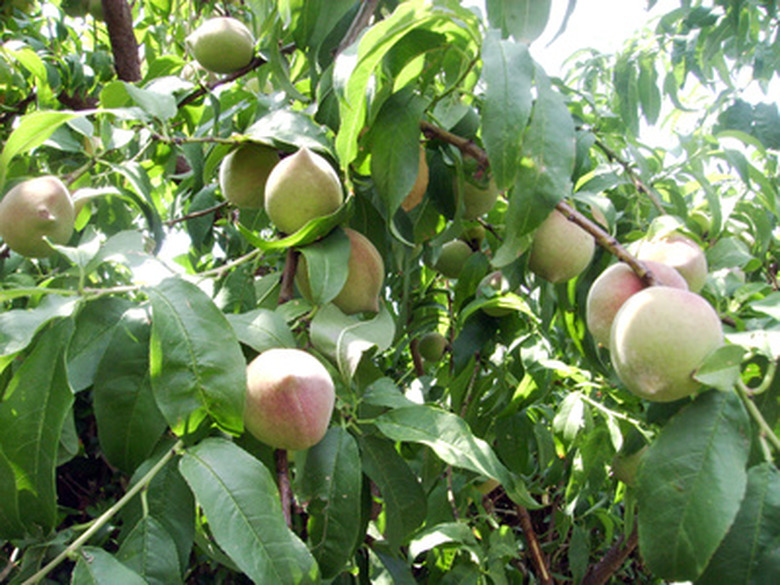
Several types of beetle grubs and moth larvae attack wounds and growths on fruit trees. Peach tree and dogwood borers prey on other types of fruit trees as well as their most common hosts. Some borers prefer dead wood or wounded bark as entry points, while others hatch in healthy bark crevices and bore directly into the cambium and sapwood. Healthy trees react by creating a sticky gum that seals the tunnels and mires the grubs in a natural glue, but larvae can outrace the trees defenses. Without intervention, one or two boring grubs could completely girdle and kill a young fruit tree.
Step 1
Spray the bark of fruit tree trunks and larger branches with carbaryl or permethrin insecticide once a month through the growing season. Follow the label instructions for application details.
- Several types of beetle grubs and moth larvae attack wounds and growths on fruit trees.
- Some borers prefer dead wood or wounded bark as entry points, while others hatch in healthy bark crevices and bore directly into the cambium and sapwood.
Step 2
Coat the fruit trees' trunks with white latex paint to protect them from sunburn damage.
Step 3
Inspect fruit tree trunks and limbs throughout the growing season for telltale patches of dead or wet bark, round entry or exit holes in bark, and gum or frass.
Step 4
Fumigate infested wood at the base of a fruit tree with a band of paradichlorobenzine or PDB. Hoe a flat area around the trunk at least 2 inches wide and 1 inch from the bark to prepare the ground for the fumigant powder. Apply the fumigant in late fall to kill fruit tree grubs over the winter.
Step 5
Measure the amount of pesticide the manufacturer recommends for the age of the tree and scatter the fumigant in a circular band on the leveled earth. Shovel soil on top of the fumigant. Mound the dirt around the trunk. Bury the fumigant and keep it from contact with the bark. Remove the treated soil the next spring before the first buds swell.
- Coat the fruit trees' trunks with white latex paint to protect them from sunburn damage.
- Bury the fumigant and keep it from contact with the bark.
Step 6
Treat grub-infested trees manually with a pocket knife and wire spear. Clear the entrance of any hole that has gum or frass with the knife point. Insert a bare copper wire with a jabbing and twirling motion to destroy the grub. Tunnels seldom go more than a few inches deep, but the holes may have twists and turns.
Tip
Be careful if digging out grubs with a pocket knife. Knife work could do more damage than the worm. Wire spears penetrate the tunnel without doing more damage to the tree. Prune infested or damaged limbs from the tree in winter. Burn the debris to destroy any insects it harbors. Keep the trees in good health by fertilizing and watering properly. Injured or drought-stressed trees quickly become targets. Frass–sawdust or shavings excreted by the larvae and ejected from its tunnel–may cling to bark or collect at the base of the tree.
Warning
Don't ignore the warning signs of frass and gum. Boring insects may do enough damage to actually fell the tree. Several generations of larvae and adults may attack fruit trees in a single summer. Sunburned bark fissures expose the tree to attack by boring insects.
Things Needed
- Permethrin or carbaryl insecticide
- Pump sprayer
- Paradichloralbenzine crystals
- Tsp measure
- Hoe
- Spade
- Pocket knife
- 2-foot solid copper electrical wire, 10 gauge