

Drought Resistant Trees In Utah
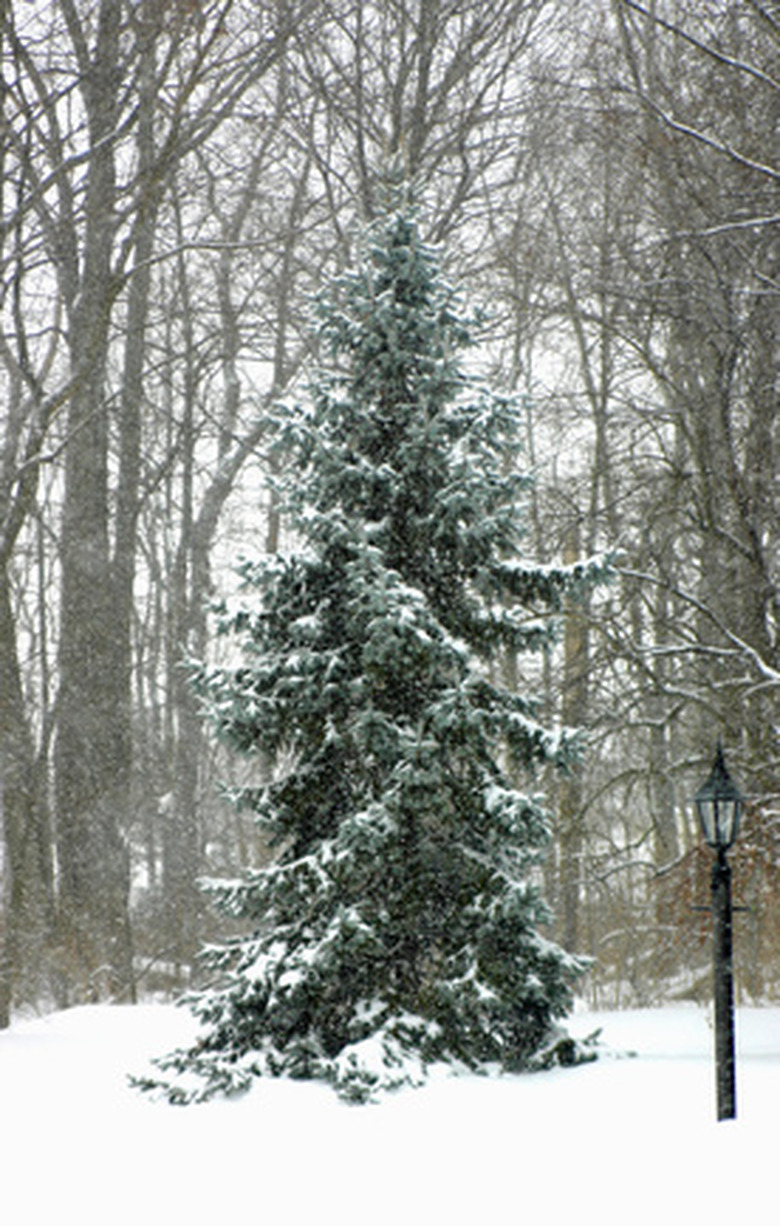
Winter visitors to Utah may see the snow-covered mountains and not realize that the area is a desert that often falls prey to droughts. Temperatures often rise above 100 degrees F in the summer, evaporating water collected from the winter snowfall. Choosing drought-resistant trees can help conserve water in the garden and add color to this dry region.
Black Walnut
Choose the plants around a black walnut (Juglans nigra) wisely. This tree produces a substance called juglone which will harm most plants. The nuts produced are edible.
Blue Spruce
Utah chose a drought-resistant tree as its State Tree–the blue spruce (Picea pungens). It will be a highly visible accent in any drought-resistant garden with its bluish-green needles.
- Winter visitors to Utah may see the snow-covered mountains and not realize that the area is a desert that often falls prey to droughts.
Camperdown Elm
Use the weeping Camperdown Elm (Ulmus glabra 'Camperdownii') as a focal point in the garden. It is prone to Dutch elm disease.
Catalpa
The catalpa (Catalpa speciosa) features giant heart-shaped leaves and ruffled white flowers. Long bean pods later develop, which may leave a mess.
Common Hackberry
The common hackberry (Celtis occidentalis) is especially suited to Utah's alkaline soils. Benign galls known as hackberry nipplegall may form on the leaves.
English Oak
The English oak (Quercus robur) grows well in Utah's dry climate. Drought can actually help ward off powdery mildew in this tree.
- Use the weeping Camperdown Elm (Ulmus glabra 'Camperdownii') as a focal point in the garden.
- The English oak (Quercus robur) grows well in Utah's dry climate.
Japanese Zelkova
The Japanese zelkova (Zelkova serrata) is a good substitute for elm trees in the landscape; it has a similar appearance without the threat of Dutch elm disease.
Kentucky Coffee Tree
The Kentucky coffee tree (Gymnocladus dioica) will be tolerant of drought after a period of regular watering to establish the roots. It will also grow in Utah's alkaline soil.
Mimosa
The mimosa tree (Albizia julibrissin) has dainty compound leaves and pink flowers that resemble powder puffs. It is a short-lived tree that is a good choice for a temporary (10 to 20 years) solution.
Persian Ironwood
The Persian ironwood (Parrotia persica) will add color to the yard throughout the seasons. The leaves begin as red, changing to green in the summer and transforming to red, yellow or purple in the fall.
- The Japanese zelkova (Zelkova serrata) is a good substitute for elm trees in the landscape; it has a similar appearance without the threat of Dutch elm disease.
- The Kentucky coffee tree (Gymnocladus dioica) will be tolerant of drought after a period of regular watering to establish the roots.
Pinyon Pine
The pinyon pine (Pinus edulis) is an evergreen conifer that produces edible seeds in its cones. Use this tree when a round shape is desired.
Utah Juniper
The Utah juniper (Juniperus osteosperma) is very tolerant of Utah's drought conditions since it is a native of the state. The blue berries serve as food for birds.