

List Of Asian Legumes
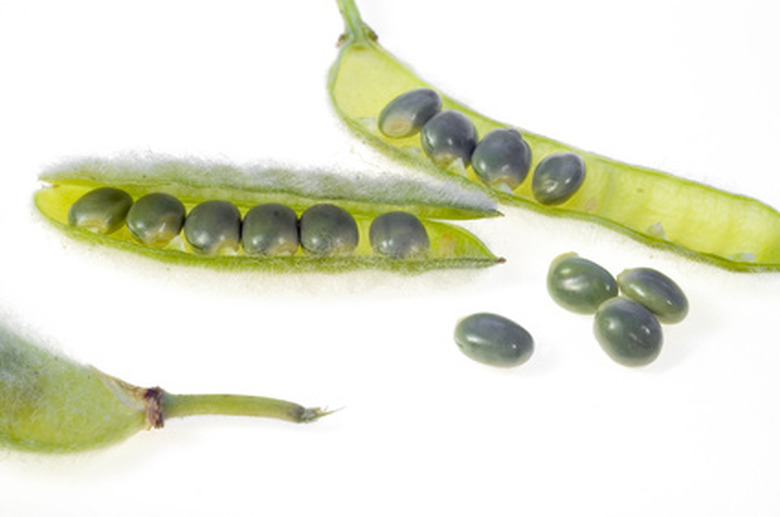
"Legume" is the name given to a seed that grows inside a pod, such as a pea. Some of the earliest known agriculture involved growing and harvesting legumes which were a vital source of protein when meat was scarce. Many bean and pea varieties originated in Asia and are commonly found in Eastern dishes. This family of foodstuff is therefore sometimes referred to as the "Asian legumes."
Step 1
Also known as the Lablab bean, the hyacinth beans is typified by its beautiful flowers in shades of vivid purple or white. They flourish in warm areas, creeping up walls and along trellises. Their pods are narrow and curve gently. In the United States the plants tend to be grown for ornamental purposes but they are commonly grown for food in Africa, Asia and India. Hyacinth beans are best eaten when young.
Snow Peas
Step 1
These kind of sugar peas prefer a cooler climate to the hyacinth beans and can be found as a staple dish in many Asian dishes, such as stir fry vegetables. Snow peas are flat and tender and can be identified by the small, barely developed seeds inside. They grow exceptionally quickly and in the right conditions of warmth, light, water and nutrient-rich soil they can be ready to harvest in just 80 days. There is evidence of snow pea cultivation in Thailand some 12,000 years ago.
Step 2
- Also known as the Lablab bean, the hyacinth beans is typified by its beautiful flowers in shades of vivid purple or white.
- These kind of sugar peas prefer a cooler climate to the hyacinth beans and can be found as a staple dish in many Asian dishes, such as stir fry vegetables.
Snap Peas
Step 1
Snap peas, or sugar snaps, are fuller and more crunchy than their snowy cousins but growing instructions remain the same. They need to be harvested very soon after flowering when the pods just begin to become plump. Leaving the peas on the vine too long makes the pods stringy, in which case the peas are best removed from the shell. Snap peas are also called Chinese peapods and are a common sight in many Chinese dishes.
Chinese Long Beans
Step 1
The long bean comes with many aliases, know interchangeably as the yardlong, asparagus or snake bean. It is another fast growing vine plant with pods up to 30 inches long available for harvesting just 60 days after sowing. In warm tropical or sub-tropical environments the beans grow so fast it is recommended the grower checks them every day in case the optimal picking time is missed. Chinese long beans grow all across South East Asia and Southern China and are common in both Chinese and Malaysian cooking.
Step 2
- Snap peas, or sugar snaps, are fuller and more crunchy than their snowy cousins but growing instructions remain the same.
- In warm tropical or sub-tropical environments the beans grow so fast it is recommended the grower checks them every day in case the optimal picking time is missed.
Soya bean
Step 1
Soya is usually found in processed products such as tofu, soya sauce and miso, but its original state is as a small bright green bean with large round peas inside. It is an excellent source of protein but less easy to grow than other legumes. The soya bean plant is sensitive to colder weather and seeds easily rot and fail to germinate if exposed to too much water. Soya has been grow in China for at least 5,000 years and today it is found all across Asia. Soya beans are delicious simply boiled in salted water and feature in many Japanese dishes.