

How To Kill Willow Trees
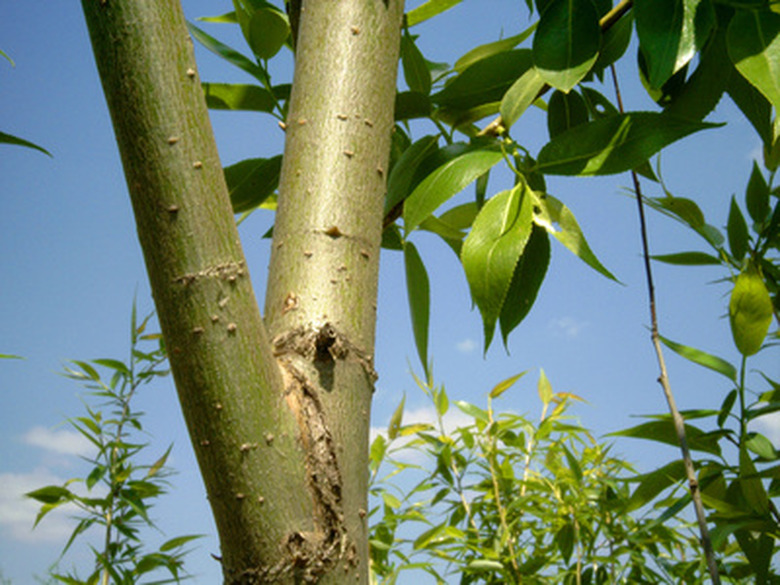
Horticulturist Ron Smith of the North Dakota State University Extension says there are only two places he knows of where willows will not grow: "in a blacktop parking lot and a desert environment." They "sucker" freely, sending up new shoots that become out-of-place saplings, and their roots can disrupt water and sewer lines. Many varieties of willow have earned the title "invasive" because of their aggressive adaptability. Killing an unwanted young willow takes patience and resourcefulness.
Step 1
Girdle the willow tree with a pruning saw or a sharp knife. Cut a strip 2 or 3 inches wide through the tree's bark and the green cambium just beneath all the way around the trunk. Water and food travels paths through the cambium up to the growing branches and leaves, so girdling the tree in early spring cuts off this supply when the tree's new growth depends on a flush of nutrients.
Step 2
Cut the tree down, starting with the upper and outer branches. Cut the main trunk off below the ground if possible.
- Horticulturist Ron Smith of the North Dakota State University Extension says there are only two places he knows of where willows will not grow: "in a blacktop parking lot and a desert environment." Water and food travels paths through the cambium up to the growing branches and leaves, so girdling the tree in early spring cuts off this supply when the tree's new growth depends on a flush of nutrients.
Step 3
Cut suckers off as soon they sprout until no new growth begins. Be on the lookout for suckers within the "drip line," the circle marking the greatest extent of the old tree's foliage. Willow roots are very shallow within this perimeter and may try to put up new shoots.
Step 4
Spray or paint the cut surface of the willow stump with herbicide formulated for broadleaf woody plants. These herbicides may contain glyphosate, 2,4-D or triclopyr. Use only herbicides labeled for use on willows.
Step 5
Spray the foliage of small willow trees with a contact or systemic broadleaf woody herbicide containing glyphosate, 2-4D or dicamba that is labeled for use on willows. Most herbicide sprays are non-specific, meaning that they will kill any plant they contact, so use them carefully and according to package instructions.
- Cut suckers off as soon they sprout until no new growth begins.
- Most herbicide sprays are non-specific, meaning that they will kill any plant they contact, so use them carefully and according to package instructions.
Step 6
Use the basal bark herbicide application method to kill a tree that can be left standing. Girdle an established willow tree's trunk close to the ground and paint oil-soluble herbicide on the wound to poison the tree systemically. You can apply the oil-based herbicide directly to saplings. Use only a herbicide labeled for use on willow and follow dilution instructions exactly.
Tip
Willows are persistent and will re-sprout whenever they are able to get enough water, nutrients and sunlight. Be patient and keep cutting shoots away under the soil line; the death-by-many-cuts approach may take several years.
Warning
Hire professionals to take down large trees. It is dangerous work for amateurs who are not familiar with the proper equipment. In addition, willow twigs and branches driven into the ground and missed during cleanup will sprout new trees.
Things Needed
- Pruning saw and loppers
- Sharp knives
- Water or oil-based broadleaf woody herbicides
- Bucket and herbicide applicators
- Garden gloves