

How To Take Care Of English Ivy In Containers
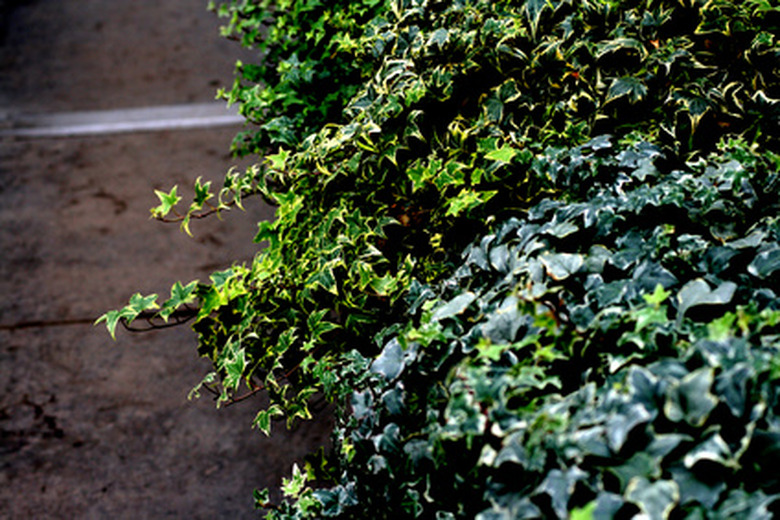
Native to Europe, English ivy (Hedera helix) is a fast-growing trailing vine cultivated for its foliage. Because of its tendency to become invasive as it climbs by aerial roots, avoid planting English ivy outdoors in the landscape. However, this species can be grown in containers either indoors or outdoors.
English ivy is hardy in U.S. Department of Agriculture zones 4 to 9, though outdoor container plants are less hardy. Propagation is usually by rooting tip or stem cuttings. The sap of these plants can cause skin irritation, so gloves are recommended when handling them.
Tip
English ivy can quickly become invasive in the landscape. Therefore, this species is best grown indoors as a houseplant.
Indoor Care of English Ivy
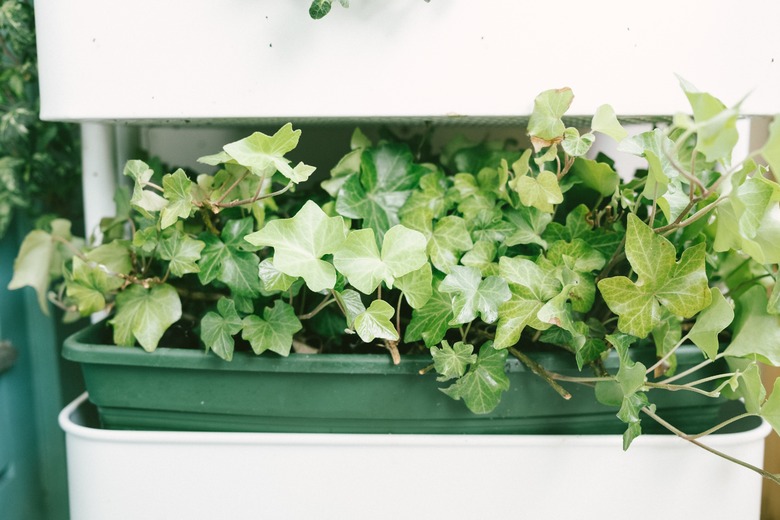
English ivy, which is typically propagated by rooting cuttings, can be grown indoors in containers and hanging baskets. They can also be pruned into topiaries. Let's go over the care needs of this species.
Light and Temperature Requirements
For best results, **English ivy plants indoors should be kept in bright, indirect light, but out of direct sun.** Artificial light works well. Alternatively, you can place the plant in a window that faces north, east or west. Low light may hinder the growth of English ivy and may cause variegated cultivars to lose the variegation in their leaves.
English ivies do best when kept at temperatures between 50 and 70°F.
Tip
English ivy plants, especially variegated cultivars, should be planted in indirect light.
How Often to Water English Ivy
**English ivy indoor plants should be watered when the top 1/2 inch of the soil dries out.** It is important to make sure the containers have plenty of drainage holes so that the roots of the plant are not sitting in wet soil or standing water.
Caring for English ivy also means providing enough humidity. You can increase the humidity by placing your English ivy plant on a tray of wet pebbles or keeping it near a humidifier.
Fertilizing English Ivy
English ivy plants indoors will benefit from fertilizer during the growing season. Look for a houseplant formula meant to promote foliage growth. Avoid fertilizing these plants when temperatures are cool or when they are not actively growing.
English Ivy Pest Problems
Like many indoor plants, English ivy houseplants can suffer from infestations by common pests such as mealybugs, aphids and scales. Spider mites can also become an issue with indoor plants kept in dry conditions. Periodically dipping the plants in water with insecticidal soap can help keep these pests at bay.
It is also important to grow English ivy in well-draining soil and to avoid overwatering, which can lead to root rot.
 Volkan Kaçmaz
English Ivy Containers Outdoors
English ivy, especially slow-growing variegated cultivars, can also be grown outdoors in containers, though in this case they will only be hardy to USDA hardiness zone 6 because the roots are not protected by soil. These plants grow best in full to part shade and like soil that is loamy and has an acidic pH.
Warning
Container-grown plants require more protection than plants growing directly in the landscape, so always increase the suggested USDA hardiness zone by two to determine a safe growing zone for your potted plants. For example, English ivy grown in the landscape is rated for zone 4, but when grown in containers, zone 6 is a safer guideline.
Eventually, however, these plants grow beyond the confines of their containers and can take root in the soil, which is the first step to the vine becoming invasive.
Outdoor variegated cultivars also tend to lose their variegation and slow-growth habit.