

How To Tell How Many Seeds Are In A Pumpkin
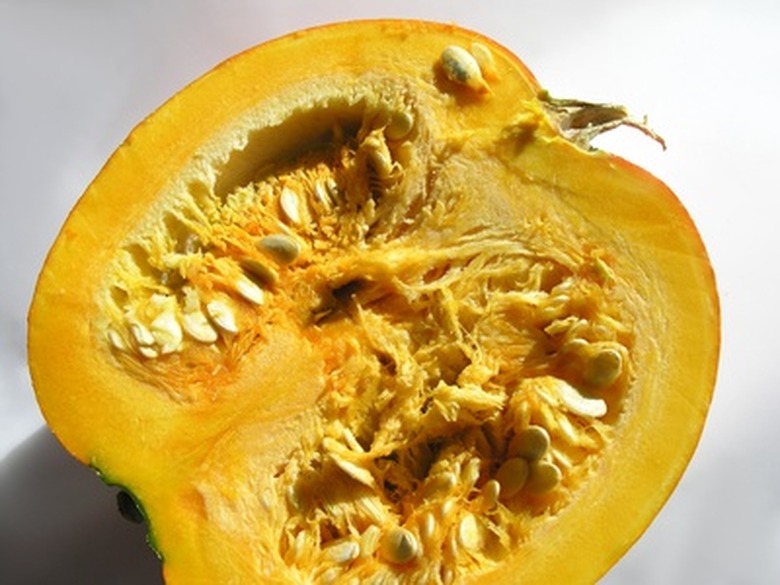
Things Needed
- Knife
- Newspaper
- Colander
- Paper cup
- Kitchen scale
Pumpkin seeds are a nutritious and tasty source of essential fatty acids, vitamins A and B, and calcium. If you want to roast your own pumpkin seeds at home, choosing pumpkins with the most seeds is important. Estimating the number of seeds in a pumpkin is also a fun and educational activity for elementary school children, and it's a little faster than counting out each seed one by one.
Step 1
Check the pumpkin for ripeness. Most pumpkins are orange, but some varieties are white or yellow. Whatever the color, make sure the pumpkin has no trace of green on it. The riper a pumpkin, the greater number of fully matured seeds it.
- Pumpkin seeds are a nutritious and tasty source of essential fatty acids, vitamins A and B, and calcium.
- Whatever the color, make sure the pumpkin has no trace of green on it.
Step 2
Compare the pumpkin sizes. Most pumpkins contain several hundred seeds, but the larger the pumpkin, the more seeds it will contain.
Step 3
Learn the pumpkin's variety. Some pumpkins are grown for seed oil because they produce more seeds. Additionally, pumpkins that come from Central Europe's Styrian region tend to produce seeds that have very thin shells, or no shells at all. This makes them easier to roast and eat. Look for "naked-seed" pumpkin varieties like "Eat-All" and "Snack-Jack" to get the most seeds from one pumpkin.
- Compare the pumpkin sizes.
- Look for "naked-seed" pumpkin varieties like "Eat-All" and "Snack-Jack" to get the most seeds from one pumpkin.
Step 4
Cut off the pumpkin's top with a knife. Scoop the insides out with your hand, and then place the seeds and fibers on a newspaper. Make sure there are no seeds left behind in the pumpkin.
Step 5
Separate the wet fibrous material from the seeds and place the seeds in a colander to wash off any remaining fibers.
Step 6
Place the paper cup on a kitchen scale and set the tare weight to zero, then place 10 seeds into the cup. Record the weight of the 10 seeds.
Step 7
Weigh all of the seeds. Divide the total weight by the number you recorded.
- Cut off the pumpkin's top with a knife.
- Scoop the insides out with your hand, and then place the seeds and fibers on a newspaper.
Step 8
Multiply the resulting number by 10. This will tell you approximately how many seeds are in the pumpkin.