

How To Do Furrow Planting
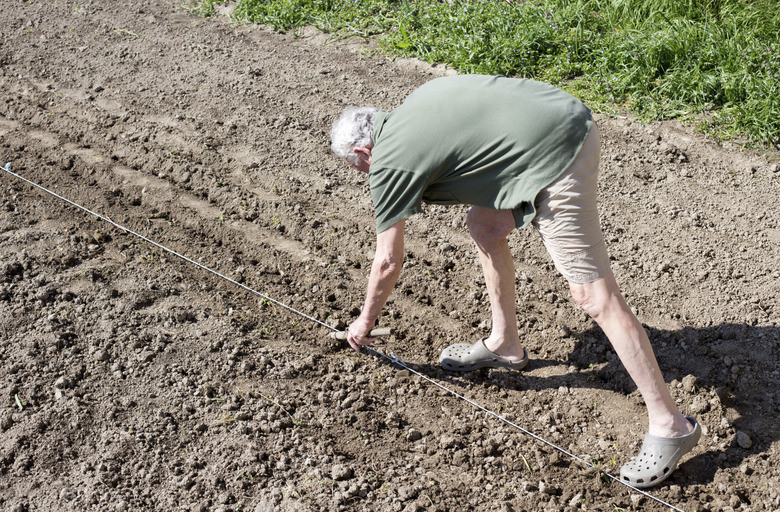
When you're faced with planting either dozens of seeds or young plants that need deep planting, don't furrow your brow — furrow your row.
When you're faced with planting either dozens of seeds or young plants that need deep planting, don't furrow your brow — furrow your row. In addition to saving the time of digging individual holes, both flat bed and raised bed furrows can help deep-rooted plants develop stronger underground plant parts, because dirt is slowly filled in around them as they grow. They also make establishing tiny seeds for shallow-rooted seeds a much quicker process.
Staking a Claim
By setting short, sturdy stakes at either end of your planned furrow row and tying a string between them, you'll be able to keep to a straight line as you create your furrow. Tie the string or cord at the base of each stake so that it rests on the ground, and make sure to secure it tightly at each stake, so that it creates a straight line. If you have more than one crop, or are planting a large amount of one crop, set up additional stake-and-string rows 2 or 3 feet apart.
Getting Entrenched
When digging the furrow, a hoe held at an angle will help you create a long, narrow trench that's anywhere from 2 to 6 inches deep, depending on the crop. Deeper furrows will likely require a second pass of the hoe. Adjusting the depth according to the seller's recommendation is always the wisest course. For example, shallow-rooted vegetables, such as lettuce (Lactuca sativa), do well in shallow furrows made by scraping a 1/4-inch furrow with the handle of the how. Your final step will be to thoroughly soak the furrow with a hose just before seeding or planting.
- When you're faced with planting either dozens of seeds or young plants that need deep planting, don't furrow your brow — furrow your row.
- By setting short, sturdy stakes at either end of your planned furrow row and tying a string between them, you'll be able to keep to a straight line as you create your furrow.
Seeding and Filling
It's important to set the seeds, tuber chunks or plant crowns into the furrow at the spacing recommended on the seed packet or seller's instructions. Small seeds such as lettuce are often sprinkled lightly along the row. Once seedlings emerge, they are thinned to the recommended plant spacing, Larger pieces like potato chunks (Solanum tuberosum) need to be at least 6 inches apart. Press seeds or plants lightly into the bottom of the furrow. As the seedlings emerge, you'll gradually fill the furrow with soil to cover the plants' root systems.
Raising Your Game
By raising a garden bed above the soil line, you'll be able to improve drainage and help the soil warm more quickly — two attributes that easily rotted seeds appreciate during the cold, damp spring. If you already have framed beds, your preparation tasks are limited to turning the existing soil, and adding enough compost or garden soil, as needed, to ensure that the bed is at least 6 inches above the soil line. When making new raised beds, use garden soil created by digging paths between the beds, as well as compost and topsoil, as needed.
- It's important to set the seeds, tuber chunks or plant crowns into the furrow at the spacing recommended on the seed packet or seller's instructions.
- If you already have framed beds, your preparation tasks are limited to turning the existing soil, and adding enough compost or garden soil, as needed, to ensure that the bed is at least 6 inches above the soil line.
Furrowing Raised Beds
Raised bed furrows are generally short enough so that you don't have to run a stake to help you keep the furrow straight, but there's no reason you can't. With raised beds that are about 24 inches wide, you'll be able to create two furrows that are 12 inches apart. (Crops that need more room between rows are better suited to the flat-bed system.) Other than these differences, the actual digging, seeding and filling is much the same as it is for flat-bed furrow planting.