

Description Of A Coconut Tree
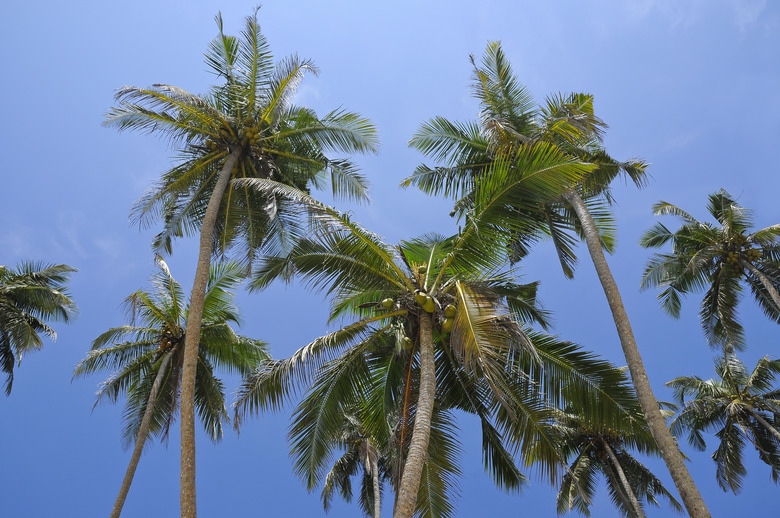
Coconut trees are familiar to anyone who has ever visited or seen pictures of a tropical beach. Coconut trees are a species of palm trees. While all coconut trees are palm trees, not all palm trees are coconut trees. They're one of the most popular fruit-bearing trees in the world.
Leonsbox/iStock/GettyImages
What Does A Coconut Tree Look Like?
A coconut tree or a coconut palm is a member of the species Cocos nucifera. This is a member of the palm family, and it's **a tree that's cultivated the world over for its fruit,** the coconut. Despite its name, the coconut isn't a nut, it's a particular kind of fruit. The coconut has a fibrous outer husk, a hard shell, an interior containing a thick layer of coconut "meat" and water in the deepest part of the interior.
- Coconut trees are familiar to anyone who has ever visited or seen pictures of a tropical beach.
- A coconut tree or a coconut palm is a member of the species Cocos nucifera.
- This is a member of the palm family, and it's **a tree that's cultivated the world over for its fruit,** the coconut.
Coconut trees can vary in size and thickness, but they look similar to a standard palm. Coconut trees have a textured trunk. The trunks are slender, and the trees themselves generally rise to a height of about 80 feet. The bases of coconut trees are very thick, and the top of the tree is capped by a growth of fronds. Palm fronds are leaves that are similarly shaped to feathers and fan outward from the trunk of the tree. Hanging at the top of the tree near the trunk and shaded by the fronds are the coconuts.
Because coconut fruits are buoyant, they float very easily. Coconut fruits falling into the water and floating away on the tides is one way that the fruit has been dispersed across the tropics and parts of the world where coconuts are now very plentiful.
- Coconut trees can vary in size and thickness, but they look similar to a standard palm.
- Palm fronds are leaves that are similarly shaped to feathers** and fan outward from the trunk of the tree.
Where Are Coconut Trees Found?
Coconut trees are found throughout the southern hemisphere in places where it's humid and hot. Tropical and subtropical climates see the most proliferation in the growth of coconut trees. Coconut tree growth in the continental United States is limited to the southern part of the state of Florida. However, Hawaii, Puerto Rico and Cuba are other places where coconut trees grow.
While the western part of the world utilizes and enjoys the fruit of the coconut tree, the growth and utilization of coconut trees and coconuts is far greater in places like South Asia, India and the Polynesian region of the world. Coconut trees are found in the Caribbean islands, Madagascar, Tahiti and other warm and humid places.
Malaysia, Indonesia, the Philippines and Thailand are other places where coconuts are prevalent and widely grown. Surfing culture in Hawaii has made the specter of the coconut tree and the coconut plant itself widely associated with the state, but it's much more prevalent in Asia and the tropical parts of South and Central America.
- Coconut trees are found throughout the southern hemisphere in places where it's humid and hot.
- ** While the western part of the world utilizes and enjoys the fruit of the coconut tree, the growth and utilization of coconut trees and coconuts is far greater in places like South Asia, India and the Polynesian region of the world.
What Environment is Best for Coconut Trees?
Coconut trees can only grow in a tropical climate. A tropical climate is characterized by significant heat and humidity and the prevalence of sandy soil. Coconut trees need significant rainfall to thrive and also require temperatures that don't dip far below 40 to 50 degrees.
Because of the need for sandy soil versus the kind of rich peaty soil that characterizes the climate of places like Europe and the American northeast, **coconut trees live only in climates that are near beaches or shorelines.** Areas with low humidity, like the California desert, for example, is a climate in which some palm trees can survive, but the coconut palm tree isn't among them.
The best weather conditions result in the best coconut fruit production. Coconut palm trees can flower and produce up to 75 coconuts a year per tree if they're granted their optimal living conditions. However, these conditions are extremely rare, particularly outside of farming areas since weather patterns are unpredictable and the chance of blight is high. Typically, **most coconut trees produce about 30 coconuts per year.**
- Coconut trees can only grow in a tropical climate.
- ** Areas with low humidity, like the California desert, for example, is a climate in which some palm trees can survive, but the coconut palm tree isn't among them.
What Parts of the Coconut Can Be Used?
One of the truly remarkable things about coconuts is that every single part of the fruit can be used: the husk, the hard shell, the soft inner flesh and the water, milk and oil. Each of these elements has value economically and socially.
The tree itself is attached to a very strong fibrous root system. There's an abundance of fiber in coconuts and the fruit can be used to feed humans and animals who are able to deal with the excessive amounts of fiber in the fruit.
The expansive usefulness of coconuts is unique to fruit from a tree. Almost no other fruits have as many marketable and usable elements as the coconut.
What Are Coconuts Used For?
Coconuts are tremendously useful and an extremely valuable piece of the world economy. In Indonesia, the coconut palm is knowns as **"the tree of a thousand uses."** Every bit of the coconut, from the outer husk to the liquid inside is used in multiple ways, from home furnishing to food to medicine.
- One of the truly remarkable things about coconuts is that every single part of the fruit can be used: the husk, the hard shell, the soft inner flesh and the water, milk and oil.
- Every bit of the coconut, from the outer husk to the liquid inside is used in multiple ways, from home furnishing to food to medicine.
The outer husk of the coconut can be used to weave sacks, rugs, lampshades, home furnishings and other accouterments. They can be used as natural scrubbers and to make rope. The shells can be used to steam food and for baskets and other handicrafts. The inner fruit of the coconut is pure white and can be eaten either raw or cooked. Coconut milk can be squeezed out of the coconut and drank or used in hair and skin products.
Coconut water and coconut oil are tremendously efficacious products that are extremely hydrating and loaded with antioxidants. Coconut oil, aside from being a cooking agent and generally a healthful addition to the diet, is used widely in the beauty industry. It's found in hair conditioner, moisturizer, cuticle cream and a variety of makeup products.
- The outer husk of the coconut can be used to weave sacks, rugs, lampshades, home furnishings and other accouterments.
- Coconut milk can be squeezed out of the coconut and drank or used in hair and skin products.
Why Are Coconuts and Coconut Trees So Popular?
Coconut trees are extremely popular and valuable because they've helped sustain life in some parts of the planet since the beginning of time. The coconut tree has provided shade, food, building materials and a means to make clothing; it has been used for medicine and as a sealer for joints for boats, making water travel possible. It has truly been a life-giving plant.
In the modern world, coconut trees, coconuts and coconut by-products are a critical part of the world economy. For countries that export coconuts to other parts of the world, they're a sustaining part of their gross national product. They're immensely valuable as a trade item and help small island nations supplement the income from tourism. This is especially critical in countries where citizens have limited natural resources to trade.
- Coconut trees are extremely popular and valuable because they've helped sustain life in some parts of the planet since the beginning of time.
- For countries that export coconuts to other parts of the world, they're a sustaining part of their gross national product.
Coconut trees are also popular because **their presence is synonymous with the beach,** relaxation and the good life. Coconuts exist in virtually all tropical climates. If you're in view of a coconut tree, chances are that you're on vacation or spending time in a beautiful, tranquil and tropical part of the world.