

The Life Cycle Of Wisconsin Fast Plants
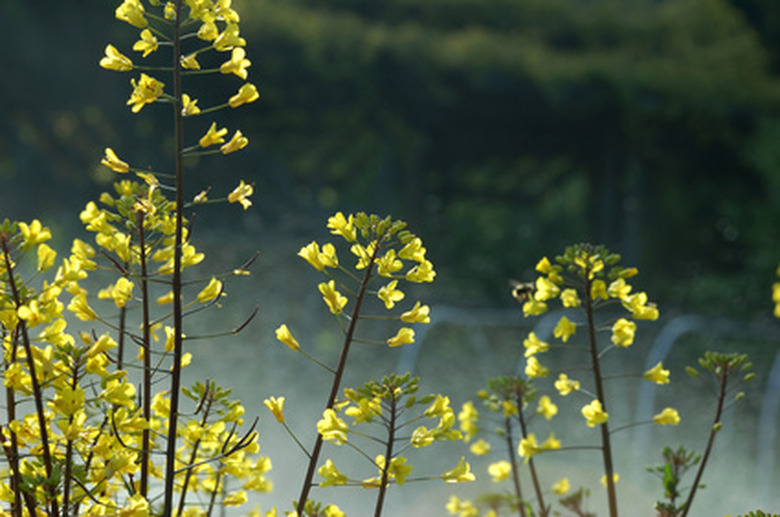
Wisconsin Fast Plants are a patented variety of rapid-cycling Brassica rapa developed by Dr. Paul Williams at the University of Wisconsin-Madison as a research model for studies in plant disease. Fast Plants live their whole lives in 35 to 45 days; perfect timing for science classes as well as plant geneticists. School children have used the little mustard relative for studies in biology for over 20 years.
Germination
Fast Plant seeds lie dormant until a combination of warmth, moisture and light activate hormones that trigger growth in the embryo. The growing plant, or cotyledon, breaks out of the moisture-weakened seed covering and sends a root growing down into the soil. Within one or two days, the Fast Plant cotyledon rises past the surface and opens into the first leaves of the plant which begin to photosynthesize light to produce food for the new plant.
Growth and Development
For the first 12 days of its life, the Fast Plant produces plant tissue; "true" leaves to gather the large amount of light that the adult plant needs, a stem up to 8 inches tall and branches. The plant's size, shape of its leaves, branching habits and other characteristics define the plant as a Brassica rapa.
- Wisconsin Fast Plants are a patented variety of rapid-cycling Brassica rapa developed by Dr. Paul Williams at the University of Wisconsin-Madison as a research model for studies in plant disease.
- Within one or two days, the Fast Plant cotyledon rises past the surface and opens into the first leaves of the plant which begin to photosynthesize light to produce food for the new plant.
Flowering
At about two weeks of age, Fast Plants infloresce. They produce specialized leaves called sepals that provide shelters for flowers containing pistil and stamen–the sexual organs of an angiosperm. Fast Plants form flowers and bloom within only a few days. Fast Plants need temperatures below 80 degrees to produce viable flowers; hot temperatures produce sterile inflorescence.
Pollination
Once the flowers are open, the pollen must be transported from the anthers on one plant to the stigma on another–Fast Plants do not self-pollinate. Most plants depend on insects, but Fast Plants have the added benefit of hand pollination by human students wielding "bee sticks." True to their fast life cycle, each Brassica rapa flower must be pollinated within a few days before it fades.
Fertilization and Seed Development
Stigma send pollen downward to the plants' ovary where, if it reaches and fertilizes the egg successfully, a zygote forms the beginning of a new plant embryo. Fertilization must take place within 24 hours of pollination and within five days, the flower's petals, designed to attract pollinators like bees, will fall away. The ovary forms a protective cover as a shell forms around each fertilized egg. Embryos are packed with food to carry them through their dormancy. The process, called embryogenesis takes approximately 20 days.
- At about two weeks of age, Fast Plants infloresce.
- Fertilization must take place within 24 hours of pollination and within five days, the flower's petals, designed to attract pollinators like bees, will fall away.
Seed Distribution and Death
Fast Plants are annuals, which means that the plant lives for one season and dies after it has set seed. As the plant dries, the plant ovary is pulled open by shrinking tissue, dropping ripe seeds on the ground and into the wind. Those that land where they have the right conditions will germinate and grow into new plants.