

How To Identify The Difference Between Male & Female Holly Bushes
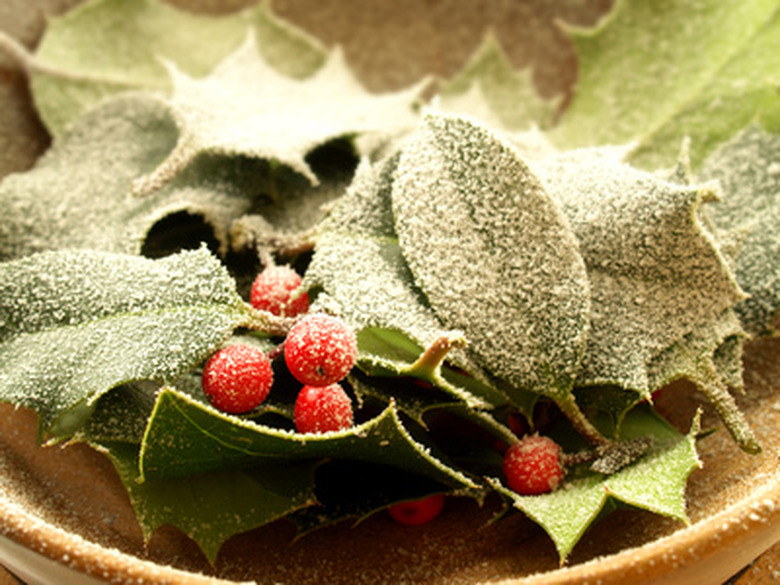
Holly, one of the traditional evergreens of the holidays, is a dioecious plant, which means holly plants are either male or female, and only the females have berries. In order to successfully produce seeds to propagate more plants, both sexes must grow in proximity to each other. Look for clues to the sex of the plant to guarantee berries on your holly bush.
Step 1
Look at the leaves on the plant. Female holly tends to grow more leaves lower on the plant than male shrubs of the same variety and age. Leaves on male plants often exhibit fewer points.
Step 2
Observe the trees when they bloom in the spring. Male blooms contain four insignificant petals with obvious extended pollen-laden anthers. Male holly flower centers are vacant.
- Holly, one of the traditional evergreens of the holidays, is a dioecious plant, which means holly plants are either male or female, and only the females have berries.
Step 3
Examine the fragrant white or pinkish flowers. Female plant flowers display four or five small petals. Insignificant sepals that hold no pollen stand around a distended four-chambered carpal that houses the plant's ovary.
Step 4
Look for berries beginning in late summer on female plants. Most female plants produce red berries but some produce yellow or white berries; all are very hard and soften as the seeds ripen through the fall and into winter.
Step 5
Ask the nursery operator when in doubt. There are dozens of varieties of holly; some respond to lack of presence of the opposite sex by developing complete flowers so they can self-pollinate and some have rounded, not the familiar spiny leaves.
- Examine the fragrant white or pinkish flowers.
- There are dozens of varieties of holly; some respond to lack of presence of the opposite sex by developing complete flowers so they can self-pollinate and some have rounded, not the familiar spiny leaves.
Identify The Difference Between Male & Female Holly Bushes
Look for any labeling or naming on the holly that could give the plant away, especially if the plant is still in or was previously kept in a nursery. Some nurseries or suppliers sell only female-flowering hollies. Inspect any flowers that appear on the holly bush. Male flowers lack this larger, single organ but instead feature multiple short stamens, each with a pollen-bearing anther at the end. If fruits develop on the bush it is definitely female.
Warning
Holly berries are mildly toxic to humans but favorite winter fare for birds. Holly leaves are sharp. Always wear gloves when handling plants.
Tip
When shopping for holly, look for male and female members that are compatible. Often the names will indicate the relationship (China Girl and China Boy) or a color will give away the relationship (Blue Princess and Blue Prince).
References
- The Flower Essence Society: Male and Female Flowers
- University of California Statewide Integrated Pest Management Program: Holly — Ilex Spp.
- Walter Reeves/The Simple Gardener, Inc.: Holly –- Male vs Female Flowers
- Ohio State University Extension: Sexes in Ornamental Plants
- University of Florida: Ilex Opaca — American Holly