

How To Plant Bittersweet Vines From Seeds
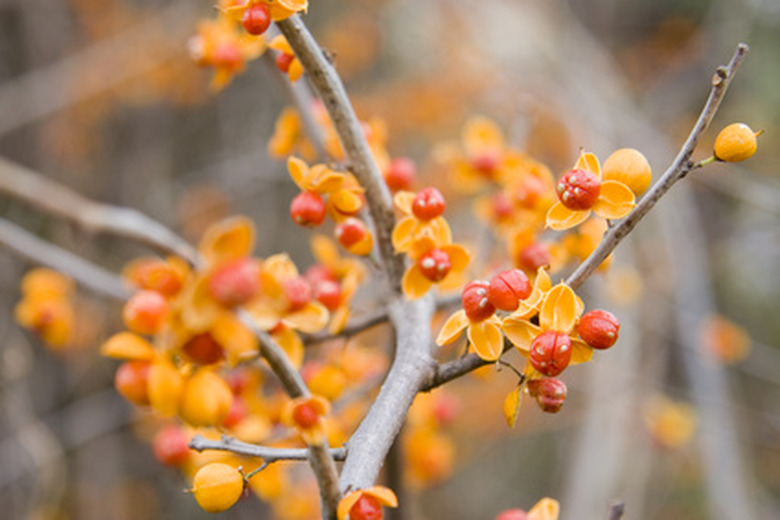
Bittersweet comes in two major varieties: American and Oriental. Oriental bittersweet is considered invasive in most states and will grow out of bounds. American bittersweet is vigorous, climbing everything in its path, but not invasive. Bittersweet is a dioecious vine, which means it needs both a male and a female plant to produce seed. Knowledge of how to harvest and care for this seed will help you grow a healthy bittersweet vine.
Step 1
Pluck the ripe red berries off the bittersweet vine when the yellow capsules surrounding them break open. The time for harvest will fall between mid-September and November.
- Bittersweet comes in two major varieties: American and Oriental.
- Oriental bittersweet is considered invasive in most states and will grow out of bounds.
Step 2
Lay the berries out at room temperature for two to three weeks to dry. When they seem shriveled and dried, remove the outer red berry covering and dry the seeds for another week.
Step 3
Place some peat or sand in a resealable plastic bag and moisten it slightly. Put the seeds in this moistened medium and place the bag in the refrigerator for three months with the temperature between 34 and 41 degrees F. This cold period will help the seeds germinate.
Step 4
Plant the bittersweet seeds 1/4 to 1/2 inch deep in well-drained soil. Bittersweet will grow vigorously in almost any soil type. It will also grow in both full sun and full shade, but needs sun for fruit production. Space multiple plants 12 to 36 inches apart. Make sure they have some kind of support to climb.
- Lay the berries out at room temperature for two to three weeks to dry.
- Place some peat or sand in a resealable plastic bag and moisten it slightly.
Step 5
Water the bittersweet seeds, keeping them moist until they start to grow. After this point, these plants need little care other than pruning. Annual pruning will keep them from strangling other plants and growing out of bounds.
Bittersweet Plant Growing
Plant bittersweet vines in a location with full sun or partial shade and average garden soil. Amend poor soil by digging a 2-inch layer of compost into the soil before planting. Apply the water directly to the soil, keeping the foliage as dry as possible. Fertilize the vine annually in early spring with a generous shovelful of compost or slow-release organic fertilizer. Prune bittersweet annually in winter. Remove damaged and diseased branches as well as those that hold spent berries. Branches that have already produced berries will not produce again. The vine will regrow in spring. Spray infested vines with a mixture of 1 quart of insecticidal soap and 1 tablespoon of isopropyl alcohol.
- Water the bittersweet seeds, keeping them moist until they start to grow.
- Apply the water directly to the soil, keeping the foliage as dry as possible.
Things Needed
- Resealable plastic bag
- Peat or sand
- Water
- Support
References
- Rodale's Landscape Problem Solver; Jeff Ball and Liz Ball
- A Guide to Natural Gardening; Jim Knopf, et al.
- Missouri Botanical Garden: Celastrus Scandens