

Bark Disease On Fruit Trees
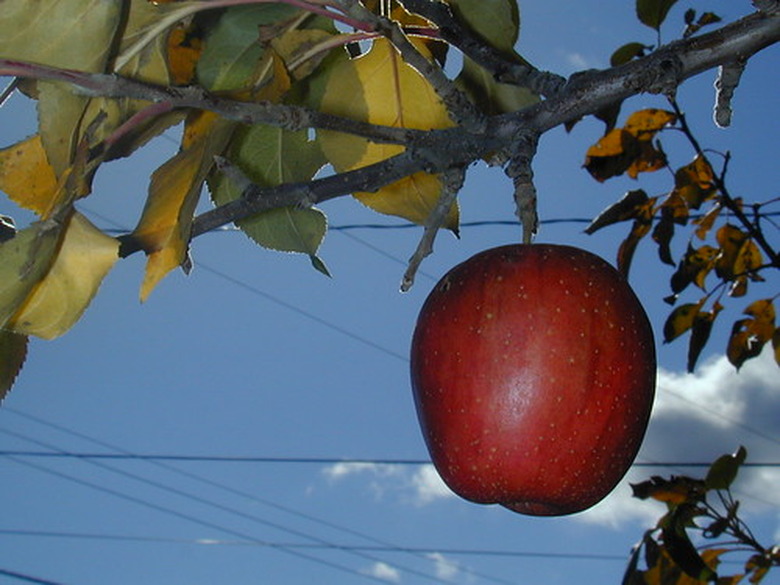
Most diseases of the bark on fruit trees cause cankers or knots. Some diseases are fatal, while others just result in a smaller crop. Chemical treatments can help prevent diseases, but are not effective in controlling diseases after a tree is infected. Proper cultural methods of caring for fruit trees are the best way to prevent diseases.
Causes
Diseases that affect the bark of fruit trees occur sporadically during certain periods of growth and with specific environmental conditions. Bacteria, fungi and viruses enter open wounded areas of bark caused by weather, insects, pruning, mowers or other mechanical means. Fruit trees are especially vulnerable to diseases during bloom season, because pathogens can easily enter the flowers.
- Most diseases of the bark on fruit trees cause cankers or knots.
- Diseases that affect the bark of fruit trees occur sporadically during certain periods of growth and with specific environmental conditions.
Stone Fruit Diseases
Stone fruits are those with soft edible flesh around a hard pit. Trees in the Prunus family, such as apricots, cherries, peaches and plums, produce stone fruits.
A common disease that affects stone fruits is black knot, which is caused by the fungus Dibotryon morbosum. Elongated hard black knots girdle and kill small branches. Black knot also grows on tree trunks, but seldom girdles the trunk.
The fungus species, Valsa, causes oval cankers on the branches and trunks of trees. The cankers continue growing until it girdles and kills the affected area.
- Stone fruits are those with soft edible flesh around a hard pit.
- A common disease that affects stone fruits is black knot, which is caused by the fungus Dibotryon morbosum.
Crown galls are caused by a soil borne bacterium, Agrobacterium tumefasciens. Large corky or woody tumors grow on the trunks of affected trees at or just above the soil level.
Pome Fruit Diseases
Pome fruits have firm edible flesh and many small hard seeds. Apple (Malus sp.) and pear (Pyrus sp.) trees produce pome fruits.
The fungus species, Nectria, causes 2 kinds of cankers. The open cankers grow in concentric circles as healthy plant tissue grows over infected tissue. The closed cankers are covered by dead bark. Nectria fungus also affects the fruit.
- Crown galls are caused by a soil borne bacterium, Agrobacterium tumefasciens.
- The closed cankers are covered by dead bark.
The Botryosphaeria fungus causes White Rot. Small circular spots enlarge to cankers with slightly depressed centers. White Rot also affects the fruit. Burrknot is mass of abnormal root tissue that grows from the rootstock of apple trees. It stunts the growth of the affected tree and can girdles the trunk. The weakened tree is liable to break during hard winds or with a heavy crop.
Cultural Treatments
Fruit trees should be planted in full sun in well-drained soil. Wet or compacted soil weakens the trees and makes them more susceptible to diseases. The trees should be planted the recommended distance apart to allow for good air circulation, which helps prevent fungal diseases.
- The Botryosphaeria fungus causes White Rot.
- It stunts the growth of the affected tree and can girdles the trunk.
Infected limbs and branches should be pruned out and destroyed. Leaves, rotten fruit and other debris under diseased fruit trees should be removed and destroyed. If diseased plant material is added to a compost pile, it could spread the disease further.
Chemical Treatment
Fruit trees should be fertilized at the recommended rate and times to encourage healthy growth. Insecticides can be used to get rid of insects that carry diseases.
Most fruit tree diseases cannot be controlled but they may be prevented by applications of a fungicide. Some types of fungicides for fruit trees are copper, sulfur and Bordeaux, which is a mixture of calcium hydroxide and copper sulfate. Fungicides should be applied according to the manufacturer's directions.
- Infected limbs and branches should be pruned out and destroyed.
- Most fruit tree diseases cannot be controlled but they may be prevented by applications of a fungicide.
The local county extension office can provide information on fertilization of fruit trees, as well as chemical treatments for fruit tree diseases.