

How To Identify An Apricot Tree
Apricot trees, like many other fruit trees, produce blossoms in spring and edible fruit through the summer. But unless you're familiar with fruit trees, or a professional arborist, you may have trouble identifying apricot trees. Telling apricot trees apart from other types of fruit trees isn't so difficult when you know which identifying features to look for. The fruit, leaves, even the general size and shape of the tree, are all clues that can be used to help reveal its identity.
Step 1
Observe trees in May and June, if possible, when the fruit begins to ripen on the tree. Identification of apricot and other fruit trees is much easier when the fruits are present. Most varieties of apricot trees bear orange fruit in early summer.
- Apricot trees, like many other fruit trees, produce blossoms in spring and edible fruit through the summer.
Step 2
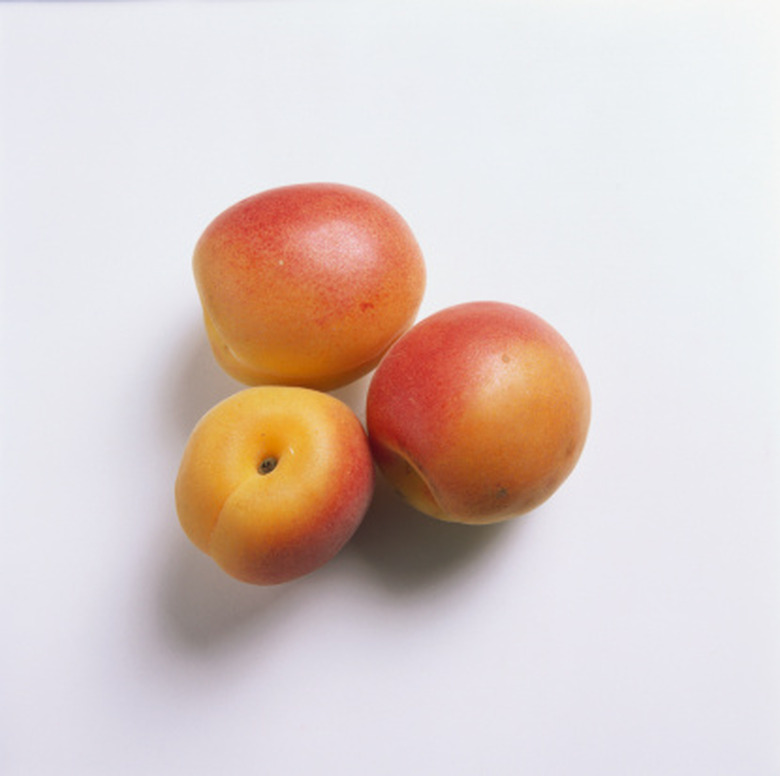
Identify the fruit. Apricots have the same rounded shape as apples and are roughly the same size, but the skin of the fruit is orange or yellow, rather than red, in color. Often, apricots will appear more darkly-colored at the bottom of the fruit, with a lighter tone near the top. Apricot trees do not always produce fruit, however, so it's possible that no fruit will be present on the tree even at the height of the growing season.
Step 3
Measure the tree's shadow in the noonday sun to determine the height of the tree. Apricot trees are not large, growing approximately 20 to 30 feet tall.
Step 4
Observe the habitat of the tree. Apricot trees grow in sunny, well-drained areas. If the tree you're identifying is heavily shaded or situated on moist earth, you are probably not looking at an apricot tree.
- Apricots have the same rounded shape as apples and are roughly the same size, but the skin of the fruit is orange or yellow, rather than red, in color.
- Apricot trees do not always produce fruit, however, so it's possible that no fruit will be present on the tree even at the height of the growing season.
Step 5
Examine the flowers of the tree. Blossoms will begin appearing on apricot trees in late winter to early spring, growing in shades of pink, white and red. The flowers will have a slightly spicy floral scent. The flowers may grow double rows of petals, depending upon the species of apricot tree.
Step 6
Examine the leaves of the tree. Apricot tree leaves grow singly, in an alternate pattern along the stems. The leaves have a heart-like shape and the edges are finely serrated.
- Examine the flowers of the tree.
- The flowers may grow double rows of petals, depending upon the species of apricot tree.
References
- Texas A&M AgriLife Extension: Home Fruit Production – Stone Fruit
- Clemson Cooperative Extension: Ornamental Cherry, Plum, Apricot & Almond
- National Gardening Association: Plant Care Guides – Apricogt
- Living and Raw Foods: Identifying and Harvesting Edible and Medicinal Plants in Wild (and Not So Wild) Places