

How To Grow Pear Trees In Michigan
Things Needed
- pH test kit
- Sulfur (optional)
- Lime (optional)
- Shovel
- Water
- Lopping shears
- Mulch
- 13-13-13 fertilizer
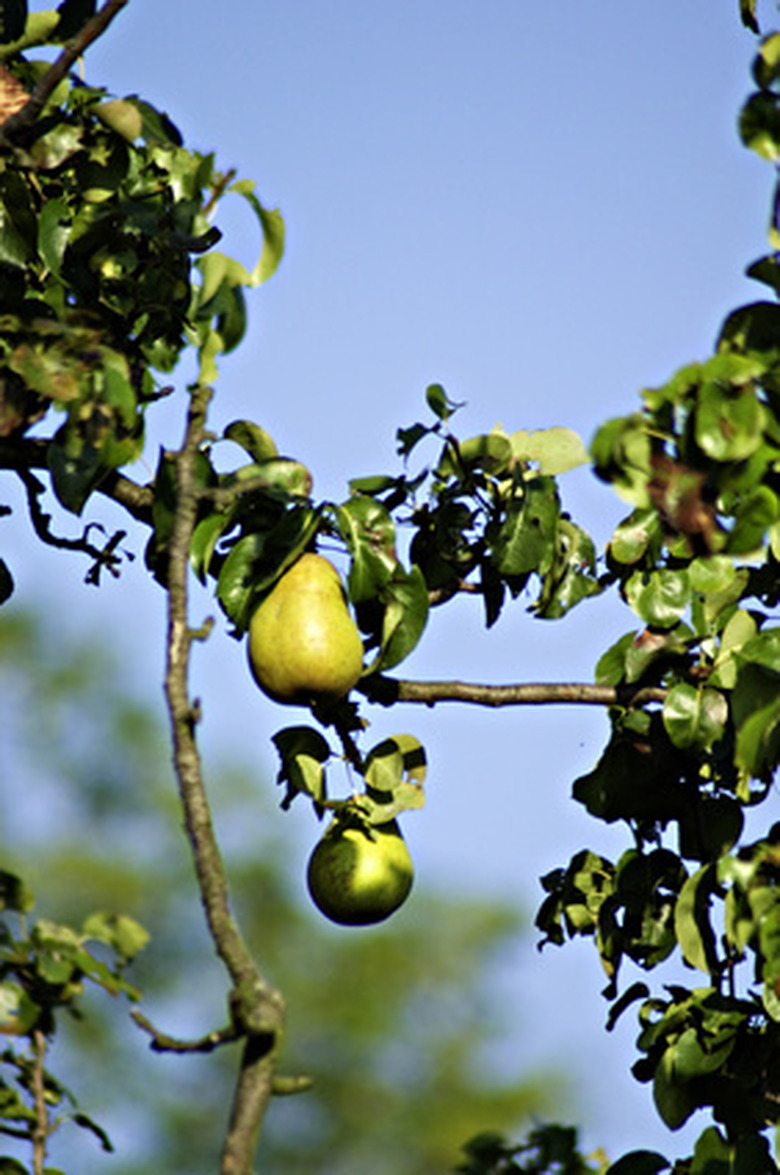
Pear trees grow well in Michigan, with Bartlett and Bosc being the major varieties produced commercially in Michigan. The most cold-hardy fruit trees, pears aren't bothered by Michigan's long and chilly winters. Home gardeners can plant their own pear trees in the spring from container saplings or bare-root trees. Gardeners must carefully prune and fertilize a pear tree during its early years to develop a healthy mature pear tree.
Step 1
Select a good location for your pear tree, one where the tree will receive full sun and have enough space to mature. Pear trees are not as particular about soil quality as other fruit trees but do prefer a pH of 6.0 to 6.5, according to Texas A&M University.
Step 2
Test your soil's pH with a home test kit. Collect a small soil sample, then moisten it. Place a tester strip on the moist soil and, once the strip has turned color, check the pH value on the corresponding color chart. Amend soil by adding sulfur to lower the pH or lime to raise it, following the instructions at the Garden Helper website.
- Pear trees grow well in Michigan, with Bartlett and Bosc being the major varieties produced commercially in Michigan.
- Amend soil by adding sulfur to lower the pH or lime to raise it, following the instructions at the Garden Helper website.
Step 3
Dig a hole twice the size of your pear tree's root ball. Remove any weeks, rocks or roots from the hole.
Step 4
Remove your pear tree from its container. Break apart the root ball with your fingers and separate any circled or tangled roots. Place the pear tree in the hole at the same depth as it was planted in the container.
Step 5
Backfill the hole with soil. Once the tree is securely planted, water it until the soil compacts around the pear tree's roots and becomes saturated with water. Continue to water the newly planted pear tree once a week until the soil becomes saturated with water.
- Dig a hole twice the size of your pear tree's root ball.
- Break apart the root ball with your fingers and separate any circled or tangled roots.
Step 6
Cut your newly planted pear tree back to a height of 24 to 30 inches right after planning. Remove any side branches. This helps the tree develop a proper shape and cuts down on future pruning.
Step 7
Mulch the base of your newly planted pear tree to hold water in the soil.
Step 8
Fertilize the newly planted pear tree when it begins to grow again. Scatter 1/2 cup of 13-13-13 fertilizer around the soil in a 2-foot radius. Water the fertilizer to soak it into the ground. Apply 1/2 cup of fertilizer for every year of the tree's age for the first four years, always in the springtime. After the fourth year, apply 2 cups of 13-13-13 fertilizer each year.
- Cut your newly planted pear tree back to a height of 24 to 30 inches right after planning.
- Mulch the base of your newly planted pear tree to hold water in the soil.
Step 9
Prune the tree by selecting three to four main fruit-bearing branches spaced evenly around the base of the tree. Cut away all competing branches. Prune any suckers off the base of the tree or that grow from the intersection between branches and the trunk. Continue to shape the pear tree each year by eliminating competing branches and by removing those that grow vertically.