

The Best Flowers For Direct Sunlight
When talking about plants, "direct sun" or "full sun" is sun exposure of at least six hours per day. Although most flowering plants need a higher level of sun than many plants that produce only foliage, long periods of sun during the summer can be hard on some plants. However, there are some flowers that prefer direct sun for long periods of time.
Duranta
Duranta (Duranta errecta) is considered a native plant in most parts of the U.S. It produces large white trumpet-shaped flowers that open in the evening. The plant is a quick-growing broad-leafed annual that grows to the size of a shrub over the summer. One plant can produce hundreds of flowers in the evening that produce a pleasing fragrance when they open. All parts of the duranta plant are poisonous.
- When talking about plants, "direct sun" or "full sun" is sun exposure of at least six hours per day.
- Although most flowering plants need a higher level of sun than many plants that produce only foliage, long periods of sun during the summer can be hard on some plants.
Bougainvillea
The bougainvillea (Bougainvillea glabra) forms colorful bracts of purple, pink or magenta at the end of long thorny branches. It can be grown in containers or in the ground, but it is not frost tolerant and needs protection during the winter. In frost-free areas a bougainvillea can get large, up to 6 feet tall or more, but in most areas it works well as a container plant or hanging basket in full sun.
Zinnia
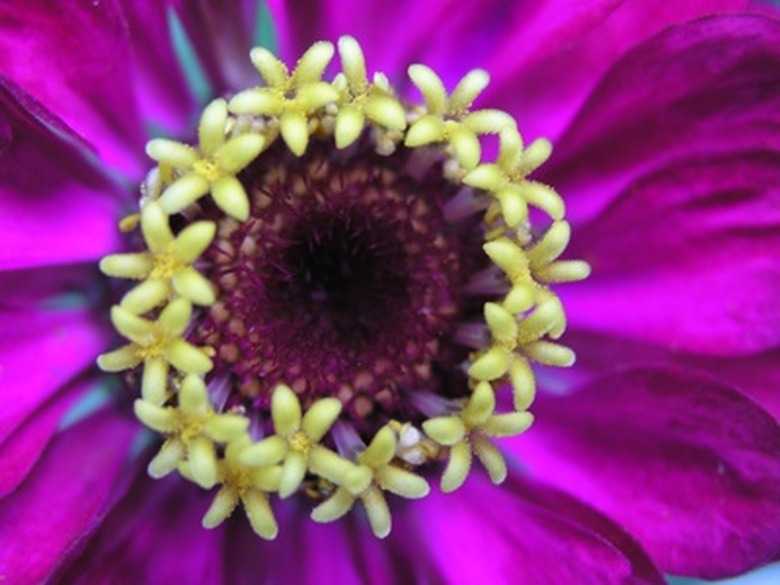
The zinnia (Zinnia elegans) is a favorite flower for growing in full sun. The large variety of colors available combined with the heat tolerance makes zinnias a garden favorite. There are low-growing border-type zinnias as well as tall zinnias appropriate for cutting available. They grow easily from seed.
- The bougainvillea (Bougainvillea glabra) forms colorful bracts of purple, pink or magenta at the end of long thorny branches.
- In frost-free areas a bougainvillea can get large, up to 6 feet tall or more, but in most areas it works well as a container plant or hanging basket in full sun.
Marigold
Marigolds (Tagetes erecta) are a garden favorite and the orange, yellow or white blossoms light up the garden when planted in full sun. There are tall types and small border types available, and they all can be easily grown from seed or transplants. Remove spent marigold blossoms so the plant will keep producing flowers for a longer period of time.
Black-eyed Susan
The black-eyed Susan (Rudbeckia hirta) is a native wildflower in the U.S. that blooms in early summer. However, new improved varieties have a longer bloom period and much larger flowers with different colored blooms than the native variety. Some types are perennial, coming back year after year, while others reseed in the garden and return in the spring.
Sunflower
The sunflower (Helianthus annuus) is available in varieties that are very decorative and provide more color than the standard tall types that produce large seed heads. Varieties are now available that produce red, orange and bi-colored flower petals. There are even varieties that only grow 12 inches tall for colorful borders. All sunflower varieties grow best if planted in full sun.
- Marigolds (Tagetes erecta) are a garden favorite and the orange, yellow or white blossoms light up the garden when planted in full sun.
- The sunflower (Helianthus annuus) is available in varieties that are very decorative and provide more color than the standard tall types that produce large seed heads.
Cosmos
Cosmos (Cosmos bipinnatus) is a native wildflower in most parts of the U.S. The simple daisy-like flowers are produced on sturdy branching plants in full sun during the warmest part of the season. They are available in many colors, from purple to bright orange, with some double-petaled varieties available. Cosmos reseed and often form a fall crop of flowers. Cosmos perform best if there is at least 6 inches of space between plants.
Cockscomb
Cockscomb (Celosia argentea var. cristata) is one of the most interesting flowers to grow in full sun. The most striking feature is the large velvety flowers, or combs, that form on each plant. The flowers can last up to six weeks or longer, and the plants reseed prolifically. Cockscomb grows under the most demanding garden conditions and provides color until fall if planted in late spring when the ground is warm.
- Cosmos (Cosmos bipinnatus) is a native wildflower in most parts of the U.S.
- The simple daisy-like flowers are produced on sturdy branching plants in full sun during the warmest part of the season.