

How To Grow Spanish Moss
Things Needed
- Healthy Spanish moss
- Organic compost
- Garden sprayer
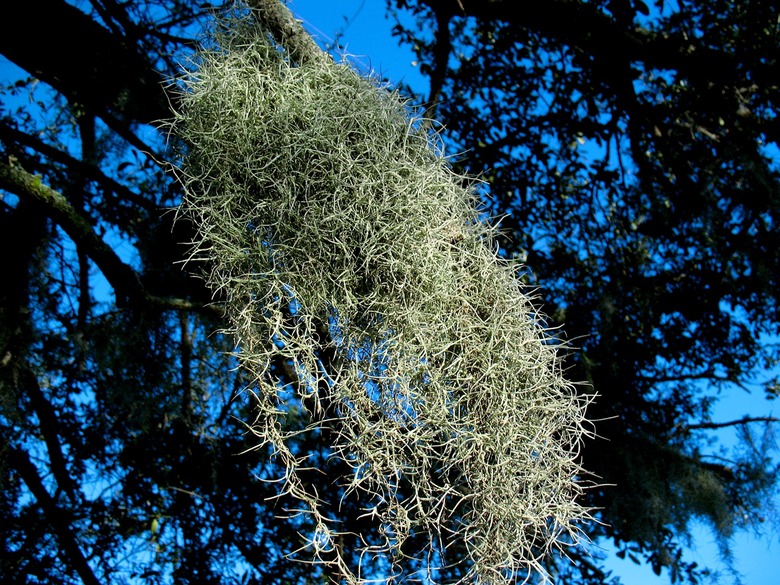
Spanish moss, Tillandsia usneoides, isn't moss at all. It's a massive colony of tiny green blooming plants related to bromeliads. Think of it as being kind of like a coral reef hanging from your oak tree. Contrary to a common belief, Spanish moss isn't parasitic, either. The plants are epiphytes, air plants that don't need soil for survival. They take their nutrition from rainfall and the atmosphere. Spanish moss is very forgiving, grows wild without anybody's help, and is believed to have evolved in the frigid Andes of Peru.
- Spanish moss, Tillandsia usneoides, isn't moss at all.
- Spanish moss is very forgiving, grows wild without anybody's help, and is believed to have evolved in the frigid Andes of Peru.
Step 1
Check with your county extension department to determine whether there are any local or state restrictions regarding the transportation of Spanish moss into your area. Obtain the plants during spring or summer.
Step 2
Remove the Spanish moss from the shipping carton immediately if you ordered it so that it won't mold. It will resemble a big pile of grass clippings. During the hottest months of July and August, it should be packed loose in a cardboard box. It will be grayish-green and feel a little dry, which prevents heat burn while it's being transported. In cooler months Spanish moss will probably be light green and a little moist, in a plastic bag inside the box.
- Check with your county extension department to determine whether there are any local or state restrictions regarding the transportation of Spanish moss into your area.
- In cooler months Spanish moss will probably be light green and a little moist, in a plastic bag inside the box.
Step 3
Take the Spanish moss outside and spread it thinly in a shady spot right away. Give it a good drink of water with a spray from the hose, just like you'd water your flower bed. Fluff it up to get air circulating through it for a few hours.
Step 4
Take a big handful of moss and pull it loose from the mass. Gently separate the strands with your fingers, and don't worry about breaking it. That won't hurt it a bit and will just give you more to spread around.
Step 5
Install the Spanish moss where it will receive lots of bright sunlight. Just hang it wherever you want it to grow. Drape gobs and streamers of it on tree branches just as if you were hanging Christmas tinsel. Using a paint extension pole is a great way to place Spanish moss in high spots. Be creative and decorate a trellis, fences, the lamppost, and your mailbox with a little touch of southern charm if you want, but tree limbs are the best locations for them. If pieces of it fall down, just pick them up and replace them. Wherever you want them, they'll grow.
- Take the Spanish moss outside and spread it thinly in a shady spot right away.
- Give it a good drink of water with a spray from the hose, just like you'd water your flower bed.
Step 6
Water the Spanish moss again when the sun begins to go down to help it secure itself to its new home. The best way to do this is to liberally spray the tree's branches and leaves and allow it to drip into the moss, actually feeding it microscopic nutrients present on the foliage. Never water it in direct sunlight, because Spanish moss will burn just like most other plants will. After initial installation, water it like you do your other plants and lawn during the growing season. If conditions are really dry, give it a drink but don't keep it wringing wet. Spanish moss can go dormant and survive extended dry periods if necessary.
Step 7
Pick up any of the Spanish moss that falls to the ground, as some of it inevitably will. Just stick it back up wherever it may have fallen from, or it will eventually die. If it is growing too thickly someplace, thin it by pulling some of it off. Move excesses to wherever you want to "transplant" some moss, give it away, or discard it.
- Water the Spanish moss again when the sun begins to go down to help it secure itself to its new home.
- Never water it in direct sunlight, because Spanish moss will burn just like most other plants will.
Step 8
Feed your Spanish moss about once a month during the growing season, particularly if it's growing on inanimate objects. Mix a double handful of organic compost with a gallon of water and let it steep for 24 to 48 hours. Strain the liquid into your garden sprayer and coat the moss generously with it.
Step 9
Prepare your Spanish moss for winter by cessation of feeding and watering when sustained temperatures begin dropping below 60 degrees F. It goes dormant below 50 degrees F, and dies back if it freezes. Don't panic, this is natural. If the plants were healthy when they went dormant, they'll survive just fine and return with warmer weather. Do keep an eye on it because heavy snow and ice can drag some of it to the ground. Pick it up right away and return it to the sanctuary of its tree branch.
- Feed your Spanish moss about once a month during the growing season, particularly if it's growing on inanimate objects.
- Strain the liquid into your garden sprayer and coat the moss generously with it.