

How To Get Rid Of Caterpillars In Fruit Tree
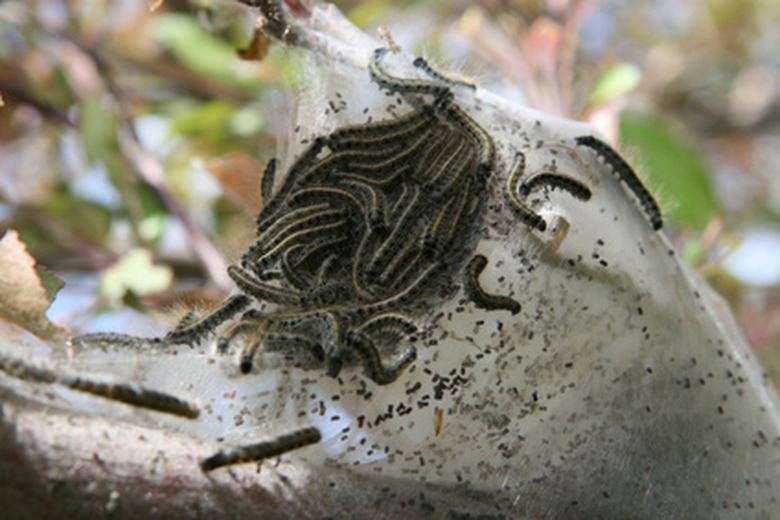
The most common caterpillars that affect the leaves of your fruit trees are forest tent caterpillars, eastern tent caterpillars, webworm or gypsy moths. The tent and webworm caterpillars form tent-like homes which the larvae (caterpillars) crawl into in the evening and lay their eggs. Gypsy moths lay eggs in white egg masses, which are visible to the naked eye. Typically, trees are not greatly affected by the caterpillars since they are a natural part of the ecosystem, but over time or in great quantities, it is possible for them to cause irreversible damage or affect the quality and quantity of the harvest.
Step 1
Wrap a sticky tree wrap around the trunk of your fruit tree to catch and kill the caterpillars as they crawl up and down your tree. These are available at most home and garden centers.
Step 2
Remove the egg masses or tents where larvae develop manually from your tree and dump them into a bucket of soapy water. You can also prune smaller twigs on which tents are located. This is best done in the evening or in the early morning when the larvae are most likely in the tents.
- The most common caterpillars that affect the leaves of your fruit trees are forest tent caterpillars, eastern tent caterpillars, webworm or gypsy moths.
- Remove the egg masses or tents where larvae develop manually from your tree and dump them into a bucket of soapy water.
Step 3
Spray the tents and egg masses with an insecticide labeled to kill caterpillars. Bacillus thuringiensis (Bt) is the most common product used and is harmless to people, animals and trees. Bt is most effective on young caterpillars (smaller than an inch) and is best applied in the early morning or in the evening. Apply Bt according to the manufacturer directions. Bt does not kill the caterpillars on contact. It is a bacteria that they eat and become paralyzed until death.
Rid Of Tent Caterpillars
Tent caterpillars are moth larvae that live together inside protective silken tents. Various tent caterpillar species exist, including forest tent caterpillars (Malacosoma disstria), western tent caterpillars (Malacosoma californicum) and eastern tent caterpillars (Malacosoma americanum), but all species require the same mechanical, biological and chemical control methods. Tent caterpillars overwinter as eggs on bare twigs, so help prevent future pest populations by locating the egg masses in the winter when you can easily spot them. Pruning out small tents effectively gets rid of caterpillars, but wait until early morning or around dusk when the pests are inside of the structure and not out feeding. Attract feathered friends to your yard by hanging birdhouses and bird feeders from branches of caterpillar-infested trees. Beneficial insect-attracting annuals include basil (Ocimum basilicum), borage (Borago officinalis), baby's breath (Gypsophila elegans) and dill (Anethum graveolens). One product recommends mixing 4 teaspoons of Btk for every 1 gallon of water. Use a handheld sprayer to thoroughly cover all foliage surfaces. Although nontoxic, Btk can still cause eye and skin irritation on contact. Wear goggles, waterproof gloves and protective clothing when mixing and spraying this product.
- Spray the tents and egg masses with an insecticide labeled to kill caterpillars.
- Pruning out small tents effectively gets rid of caterpillars, but wait until early morning or around dusk when the pests are inside of the structure and not out feeding.
Things Needed
- Sticky tree wrap
- Bucket
- Soapy water
- Insecticide
References
- NY State Department of Enivornment Conservation: Tent Caterpillars and Gypsy Moths
- University of Kentucky College of Agriculture: Tent Caterpillars
- University of Kentucky Entomology: Tent Caterpillars
- Organic Gardening: Tent Caterpillars
- Texas A&M AgriLIFE Extension: Tent Caterpillars
- Missouri Botanical Garden: Allium Tuberosum
- Ohio State University Extension Fact Sheet: Eastern and Forest Tent Caterpillars and Their Control
- Missouri Botanical Garden: Eastern Tent Caterpillar
- Missouri Botanical Garden: Nepeta Cataria
- Mother Earth News: Organic Pest Control: The Best Plants to Attract Beneficial Insects and Bees
- University of Idaho Extension: Pruning Tools