

Using Hay To Grow Grass
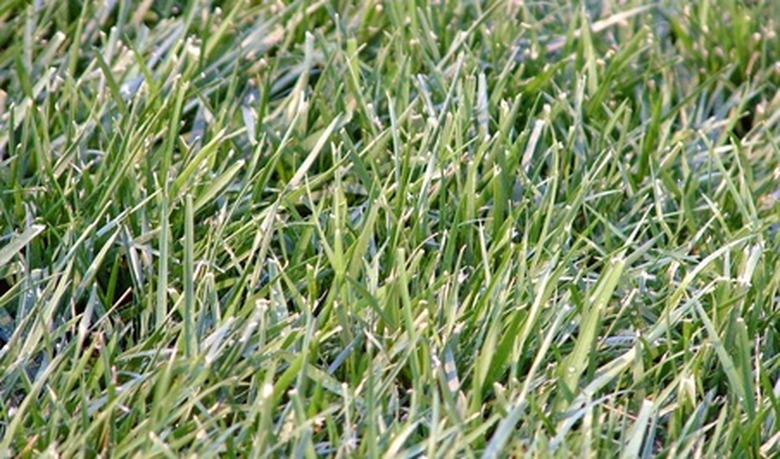
Growing grass from seed is often difficult, usually because homeowners don't keep the seeds sufficiently watered during germination and in the early stages of growth. With the use of mulch, you can help the soil maintain moisture because evaporation is reduced. You can apply many types of mulch to newly seeded lawns. Although straw is recommend over hay because hay contains seeds (which grow into weeds), you can still use it. However, use old hay, such as bails that are a year or two old, rather than freshly harvested hay, which is more likely to cause weeds.
Step 1
Separate the hay with your hands so you do not apply it in clumps.
Step 2
Lay the hay over your newly planted seeds. Use 50 to 80 pounds per 1,000 square feet, which is equivalent to about one to two bales.
- Growing grass from seed is often difficult, usually because homeowners don't keep the seeds sufficiently watered during germination and in the early stages of growth.
Step 3
Look over your lawn and make sure that you can still see 50 percent of the ground. Add or remove the hay so you have 50 percent coverage evenly spread out across your lawn. If you cover your lawn more than this, remove half of it after the grass reaches about 1 to 2 inches so the grass can continue to grow well.
Step 4
Replace the hay as it is removed by the wind. Also remove or respread clumps of hay if they accumulate in your lawn due to the wind.
Step 5
Remove the hay the second year, if desired. The hay will eventually decompose or blow away, if it hasn't already, but removing it from an established lawn is okay.
- Look over your lawn and make sure that you can still see 50 percent of the ground.
- The hay will eventually decompose or blow away, if it hasn't already, but removing it from an established lawn is okay.
Lay Hay In The Winter To Grow Grass
Overseed established grass or thin areas in the lawn by first raking away any leaves, sticks or other debris. Spread grass seed in smaller areas by hand or use a handheld spreader for larger areas. Apply the seed at a rate of at least 4 to 5 grass seeds per square inch of the area. Water the seed to prevent it from drying out between natural rain and snow fall. Apply hay to cover the seeded area at a rate of 1 bale per 1000 square feet. Scatter the straw so that you can look down through the application and see the ground. Lightly till the soil and rake it smooth. Set a spreader to apply seed at a rate of 20 percent as a starting point.
- Overseed established grass or thin areas in the lawn by first raking away any leaves, sticks or other debris.
- Apply the seed at a rate of at least 4 to 5 grass seeds per square inch of the area.