

Pomegranate Tree Fertilizer
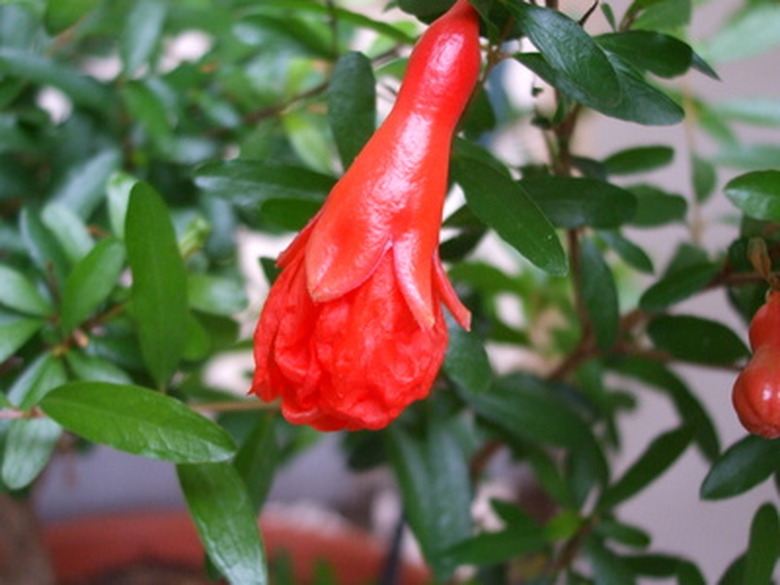
Before you fertilize your pomegranate tree, it is best to understand a few facts about the tree. The pomegranate plant is a thorny, dense deciduous plant that can reach a height of 20 feet. It makes a beautiful ornamental tree, but it is also grown for its unique fruit. Flowers are a flaming orange-red color. In climates with cooler winters, fruits mature between July and November, but in warmer regions, the tree may produce year-round. With all this growth, the pomegranate needs surprisingly little fertilizer.
Pomegranate Trees
The pomegranate is generally a dense plant that grows more like a shrub. It can be trained to grow like a tree by removing sucker growth and shoots from the base and crown of the tree. The trees are pruned to maintain a scaffold structure like most fruit trees to aid in the health of the tree and the harvesting of fruit. Pomegranate trees are subject to few diseases. They possess a surprising cold hardiness given their preference for warm climates.
- Before you fertilize your pomegranate tree, it is best to understand a few facts about the tree.
- The trees are pruned to maintain a scaffold structure like most fruit trees to aid in the health of the tree and the harvesting of fruit.
Growing Conditions
The pomegranate is a tropic, subtropic or subtemperate plant. That means it does well in dry, hot conditions and prefers full sun. Some varieties can take cold down to 18 degrees, while a few can withstand temperatures as low as 10 degrees. Some varieties produce edible fruit, while others are more ornamental, producing only a few small fruits. The plant can tolerate most any soil type as long as it has good drainage.
Fertilizer Needs
Trees should be allowed to become established in their environment before applying fertilizer. Juvenile trees between the ages of 3 and 5 need 2 to 3 lbs. of fertilizer applied in November and again in March. Older trees require 4.5 to 6.5 lbs. of fertilizer applied at the same times. A fertilizer with a nutrient ratio of 8-8-8 N-P-K (nitrogen, phosphorus and potassium) is sufficient for pomegranate trees.
- The pomegranate is a tropic, subtropic or subtemperate plant.
- A fertilizer with a nutrient ratio of 8-8-8 N-P-K (nitrogen, phosphorus and potassium) is sufficient for pomegranate trees.
Considerations
Too much fertilization can lead to excessive leaf growth, giving the plant a dense, bushy appearance. Excessive leaf production sometimes causes the pomegranate to prematurely drop its fruit. Applying too much fertilizer or applying it later in the year than recommended can cause fruit to mature late, and have poor color and poor taste quality.
Troubleshooting
Simply because the tree is drooping, losing leaves or growing poorly is not cause to add fertilizer. If a nutrient deficiency is not the problem, then too much fertilizer makes the tree's problem worse. If the pomegranate tree is not growing well or appears unhealthy, a soil test should be done to determine if nutrient deficiencies are causing the problem. Local extension offices perform soil tests, and the results not only identify nutrients content, deficiencies and pH values, but they make recommendations for rectifying any problems.
- Too much fertilization can lead to excessive leaf growth, giving the plant a dense, bushy appearance.
- If the pomegranate tree is not growing well or appears unhealthy, a soil test should be done to determine if nutrient deficiencies are causing the problem.