

Characteristics Of Carnivorous Plants
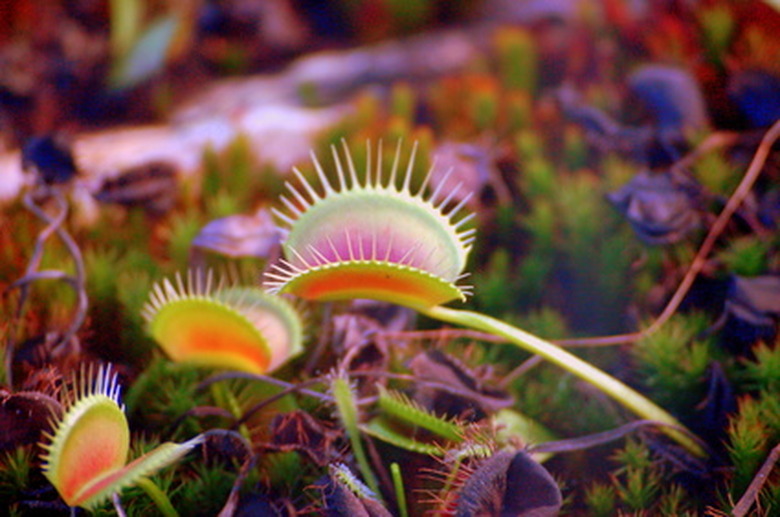
Carnivorous plants include a variety of plants that catch and feed on animals and insects as their food source. With special anatomy, these plants are structured with traps that attract wildlife for entrapment and digestion. Many carnivorous plants such as the Venus flytrap, the pitcher plant and the cobra lily inhabit North America.
Carnivorous plants include a variety of plants that catch and feed on animals and insects as their food source. With special anatomy, these plants are structured with traps that attract wildlife for entrapment and digestion. Many carnivorous plants such as the Venus flytrap, the pitcher plant and the cobra lily inhabit North America.
Nitrogen Deficiency
Carnivorous plants are found in soil lacking necessary nutrients such as nitrogen. To make up for the lack of nutrition, these plants catch live prey because they are naturally nitrogen-rich. During digestion, carnivorous plants digest prey through special glands and absorb nitrogen through their leaf structures.
Attractants
Animal prey is attracted to carnivorous plants through a variety of attractants that play on animals' senses. Carnivorous plants display colorful or patterned exteriors or small globes of shining liquid, emit pleasing odors, exude flavorful nectar and they even project ultraviolet guides that confuse the animal or insect into approaching.
- Carnivorous plants include a variety of plants that catch and feed on animals and insects as their food source.
Inescapable Traps
Snap traps look like mouths that open and shut with hair-lined, tined edges. When an animal touches the hairs, it triggers the trap to "snap" shut, trapping the animal behind the tines. Suction traps consist of a cupped top with trigger hairs; once an animal touches the hairs, a trap door opens and the animal is dropped into a sac full of water. Once inside the sac, the trap door reseals and the animal is stuck. Pitfall traps are slippery tube-like structures with slick interiors into which prey fall and cannot escape. Sticky traps are plant stalks covered in a sticky mucus-like substance called mucilage; animals become stuck in the substance and cannot struggle free.
Digestive Enzymes and Organisms
Once captured, prey is digested in one of three ways. Some carnivorous plants excrete digestive enzymes that break down the prey for absorption. Internal plant parts in other carnivorous plant types have populations of mites or bacteria that mirror the actions of the human intestinal system; these internal organisms digest the food for the plant's absorption. Instead of internal organisms, the plant may have external organisms that live on plant surfaces where they eat and digest prey; the excrement released by the organisms is then used for nutrient absorption by the carnivorous plant.
- Snap traps look like mouths that open and shut with hair-lined, tined edges.
- Instead of internal organisms, the plant may have external organisms that live on plant surfaces where they eat and digest prey; the excrement released by the organisms is then used for nutrient absorption by the carnivorous plant.
Wet Site Inhabitants
Carnivorous plants evolved in areas of soil poor in nutrients and are dependent on moist, acidic soil and high humidity. Characteristically, habitats include wet sites including bogs, swamps, coastal plains, wetlands, borders of springs and wet sites near cool waters. Carnivorous plants exist in different areas of the world including wet sites of North America, tropical regions and Australia.