

Early Blue Spring Flowers
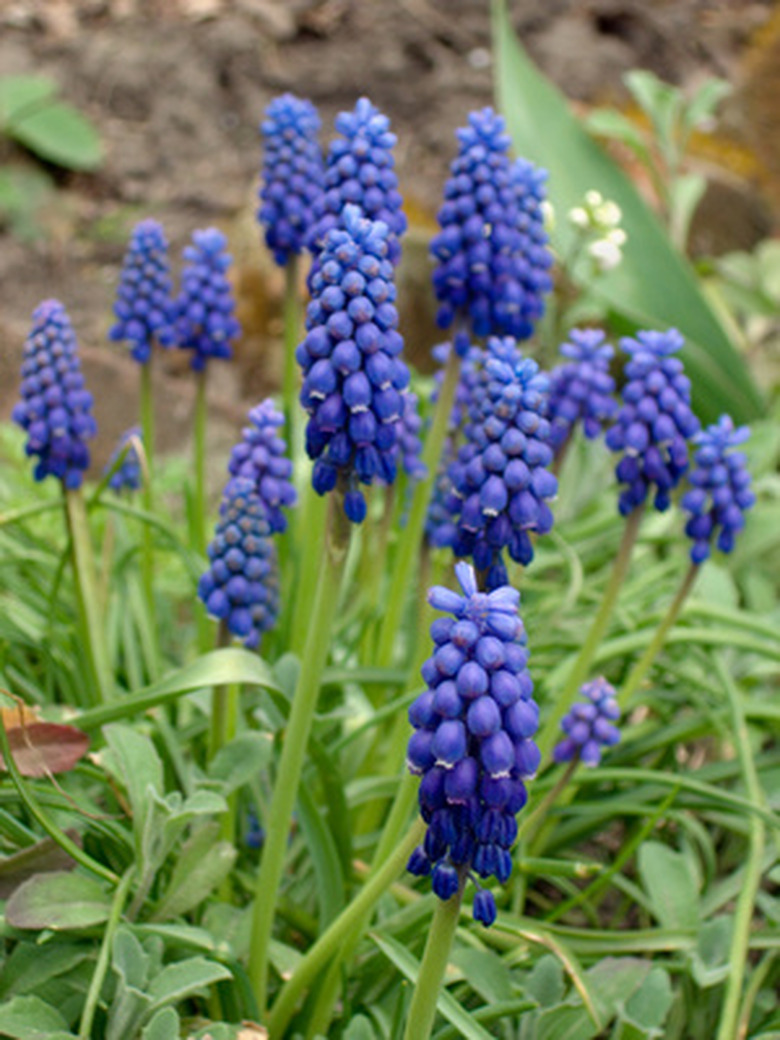
Whether you decribe their blossom color as sky blue, cobalt, dark blue or even blue-violet, early spring-blooming flowers herald the return of warm weather. Early spring, from February to April, reveals plants that appreciate cool temperatures, including small bulbs that were planted last autumn, and sprouting seeds of woodland wildflowers.
Glory-of-the-Snow
Peeking up from the ground in early spring, glory-of-the-snow (Chionodoxa forbesii, Chionodoxa luciliae) naturalizes in rock gardens, woodlands or lawns. Plant bulbs where you want them to grow and watch them slowly multiply in autumn. The tiny six-petaled flowers range in color from medium to light blue with small, whitish centers.
Bluebells
Two different species of bulbs produces blue flowers commoly called bluebells. Spanish bluebells (Hyacinthoides hispanca) form spikes of drooping, bell-like flowers of deep blue to blue-violet. Cultivar Excelsior especially grows large flowers in a deep blue tone. English bluebells (Hyacinthoides non-scripta) grow a bit smaller with deliciously fragrant flowers of dark blue-violet.
- Whether you decribe their blossom color as sky blue, cobalt, dark blue or even blue-violet, early spring-blooming flowers herald the return of warm weather.
- English bluebells (Hyacinthoides non-scripta) grow a bit smaller with deliciously fragrant flowers of dark blue-violet.
Hyacinth
Catch the sweet fragrance of a hyacinth's (Hyacinthus orientalis) flower and instantly you become an admirer. Planted in autumn, the bulbs send up their flower spikes in early spring. Some excellent blue-flowering cultivars are Blue Jacket, Crystal Palace, Delft Blue, and Isabelle. The grape hyacinth (Muscari spp.) develops intensely colored flowers a bit later, usually into mid to late spring. Some varieties form pale blue or multicolored blue flower spikes. This species also grows from bulbs planted in autumn.
- Catch the sweet fragrance of a hyacinth's (Hyacinthus orientalis) flower and instantly you become an admirer.
- Some excellent blue-flowering cultivars are Blue Jacket, Crystal Palace, Delft Blue, and Isabelle.
Star Flower
WIth grass-like leaves that smell of garlic when crushed, the star flower (Ipheion uniflorum) looks great in a lawn or border, multiplying quickly. Three cultivars produces exceptionally blue flowers–Jessie, Rolf Fiedler, and Wisley Blue.
Pansy
Plant pansy (Viola spp.) for frost-tolerant flowers in fall, winter or early spring. Some of the purest blue flowers in existence grow from pansies; select plants when in flower at the nursery to get the shade you love most. Don't forget Johnny-jump-ups, less refined wild-type pansies with smaller but more numerous blossoms.
Forget-Me-Not
Sprinkle seeds of forget-me-not (Myosotis sylvatica) in woodland gardens and perennial borders and watch them sprout and flower in spring's lengthening days. Upright sprays of tiny pale to sky blue flowers appear as early as the vernal equinox in mild winter regions and then drop seeds to produce new plants in different locations next spring.
- WIth grass-like leaves that smell of garlic when crushed, the star flower (Ipheion uniflorum) looks great in a lawn or border, multiplying quickly.
Siberian Bugloss
Siberian bugloss (Brunnera macrophylla) is also called brunnera by gardeners. Their blue flowers resemble those of forget-me-nots but bloom when forget-me-not's floral display is waning. Variegate white and green leaves occur on some cultivars, all of which set seeds and sprout up around the garden the following year.
Phlox
The eastern American woodlands fill with delicate pale to sky blue flowers under the bare trees thanks to the blue woodland phlox (Phlox divaricata). These perennial plants prosper in moist, shady spots with occasional sunshine. Cultivars with exceptionally fragrant blue flowers include Chattahoochee and Clouds of Perfume. Creeping phlox (Phlox stolonifera) forms spreading mats fully covered with flowers in early to mid-spring. Blue Ridge makes lavender-blue flowers.
- Siberian bugloss (Brunnera macrophylla) is also called brunnera by gardeners.
- Variegate white and green leaves occur on some cultivars, all of which set seeds and sprout up around the garden the following year.
Virginia Bluebells
If you have a moist shady garden spot, Virginia bluebells (Mertensia virginica) would grow well. These perennials flower in early to mid-spring before trees leaf out, with pink flower buds that open to sky blue. Seeds form and scatter naturally across the landscape. In summer's heat, the plant disappears into dormancy.
Dwarf Iris
These small plants start blooming fragrant flowers in late winter and continue into mid-spring. Iris bakerana produces wisteria-blue flowers, and Iris histrioides cv. Frank Elder blooms display a delicate light sky blue bloom with yellow veins. Species Iris reticulata comprises many selections with dark blue, cobalt and dark blue-violet flowers, including cultivars Harmony, Joyce, Gordon, Cantab, Lady Beatrix Stanley and Marquerite. Katharine Hodgkin variety bears light blue and white petals.
- If you have a moist shady garden spot, Virginia bluebells (Mertensia virginica) would grow well.
- These perennials flower in early to mid-spring before trees leaf out, with pink flower buds that open to sky blue.
Squill
Chipmunks and squirrels don't eat Siberian squill (Scilla siberica) bulbs, alowing them to multiply across a forest floor, meadow or garden border easily. Cultivar Spring Beauty forms dark blue blossoms in early spring the same time as crocus and glory-of-the-snow. Early squill's (Scilla mischtschenkoana) persistent flowers are pale blue with a dark blue strip on each petal occuring in very early spring. Striped squill, also called puschkinia (Puschkinia scilloides var. libanotica), displays bright light blue flowers with dark blue stripes from early to mid-spring.
Windflowers
Also called anemones (Anemone blanda), little sky blue to lilac-blue daisies appear from tubers planted the previous autumn. Their foliage is delicate and fern-like, too. Cultivar Blue Shades offers a mix of blue-tinted plants, ranging from blue-violet to pale blue and lilac.
- Chipmunks and squirrels don't eat Siberian squill (Scilla siberica) bulbs, alowing them to multiply across a forest floor, meadow or garden border easily.
- Also called anemones (Anemone blanda), little sky blue to lilac-blue daisies appear from tubers planted the previous autumn.
References
- "A-Z Encyclopedia of Garden Plants"; Editors Christopher Brickell and H. Marc Cathey; 2004
- Gardener's World: Blue-flowering Bulbs
- Missouri Botanical Garden: Brunnera macrophylla
- University of Texas at Austin: Phlox divaricata