

How To Care For Eureka Lemon Trees
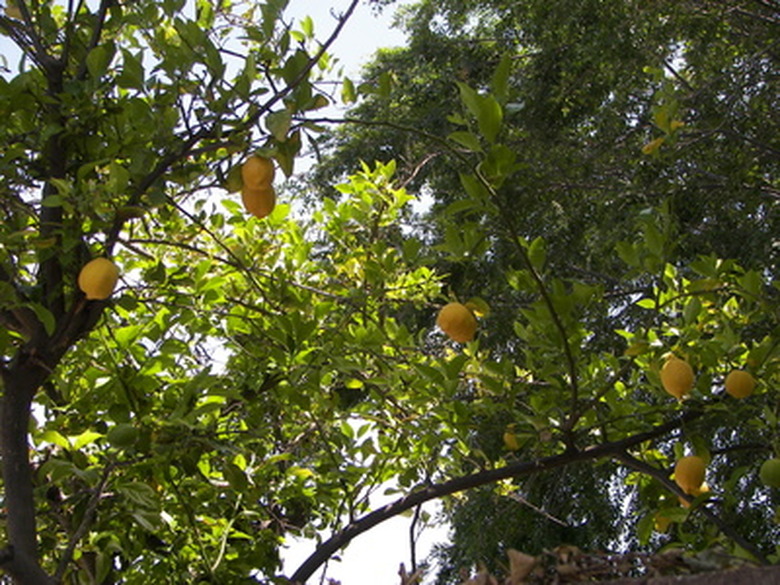
Things Needed
- Garden hose
- Ammonium sulfate
- Pruning tools (optional)
- Herbicide
- Heavy duty aluminum foil
- Shovel
Eureka lemon trees (Citrus limon 'Eureka') are medium-sized, nearly thornless citrus trees that bear oblong to elliptical lemons. The lemons are acidic, juicy, ridged lengthwise and slightly rough with oil glands on the peel. Eureka lemon trees originated from an Italian lemon tree seed and bud wood from a propagated variety. These lemon trees are extremely cold-sensitive and can grow only in the warmest climates. In the appropriate environment, Eureka lemon trees produce large clusters of fruits year-round, and are especially abundant during late winter, spring and early summer.
Step 1
Water your Eureka lemon tree slowly and deeply to thoroughly moisten the soil around the root ball once every two weeks. If you have especially sandy soil, water moderately but more frequently.
- Eureka lemon trees (Citrus limon 'Eureka') are medium-sized, nearly thornless citrus trees that bear oblong to elliptical lemons.
- These lemon trees are extremely cold-sensitive and can grow only in the warmest climates.
Step 2
Fertilize your Eureka lemon tree with 1 cup of ammonium sulfate (21-0-0 NPK fertilizer) during the first year after planting it, dividing the fertilizer into three or four separate applications. Spread the fertilizer on the ground over the root area and water it into the soil thoroughly. Increase the amount of fertilizer at a rate of 1 cup per each year of tree age, up to 6 cups, divided into separate applications in February, May and September.
Step 3
Prune away any damaged or dead branches from your Eureka lemon tree in spring, after the winter damage becomes apparent. No other regular pruning is needed.
Step 4
Keep a 2-foot (diameter) area around your Eureka lemon tree free of weeds and grass. Hand-pull the weeds or apply an appropriate herbicide. If you apply a weed killer chemical, protect the lemon tree by wrapping the trunk from the ground level to the first branches with heavy-duty aluminum foil.
- Fertilize your Eureka lemon tree with 1 cup of ammonium sulfate (21-0-0 NPK fertilizer) during the first year after planting it, dividing the fertilizer into three or four separate applications.
- If you apply a weed killer chemical, protect the lemon tree by wrapping the trunk from the ground level to the first branches with heavy-duty aluminum foil.
Step 5
Protect your Eureka lemon tree from winter frosts and freezes by creating a soil bank around the tree trunk. Mound up the soil around the trunk in late November or December and remove the soil in February or early March.
Tip
Water your newly-planted Eureka lemon tree once every two or three days during the first three weeks. Gradually decrease the watering frequency to once every seven to 10 days during the following three to four months.
Warning
Don't create a shallow watering basin around the base of your newly-planted Eureka lemon tree, as this will severely damage the roots and kill the tree. Also, avoid mulching around the lemon tree to prevent root and foot rot. If you need to mulch, keep the mulch at least 12 inches away from the Eureka lemon tree's trunk.