

How To Trim Pin Oak Trees
Things Needed
- Pruning shears
- Pruning saw
- Branch loppers
- Pole saw
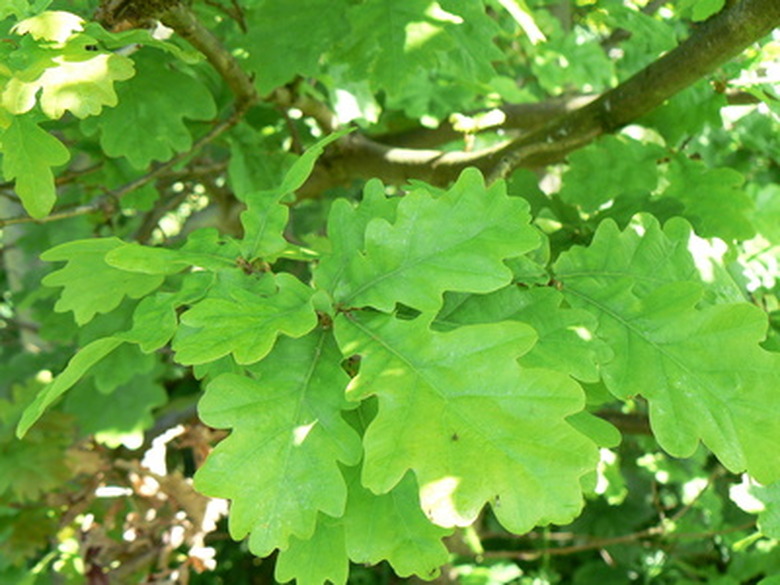
Pin oak trees are a popular species in the Midwest. The trees form a pyramid shape with a dominant central trunk and green, glossy leaves on limbs with a small diameter. Though pin oak tree leaves turn bronze in fall, many pin oaks do not shed their leaves until just before producing new leaves in early spring. Early pruning of pin oaks will help reduce the need for pruning the tree later in life. Maintenance pruning of pin oaks will then focus on removing dead, diseased or broken branches.
Step 1
Remove the limbs of small pin oak trees after planting to train pin oaks to the correct shape. Prune away the weaker leader of a forked pin oak to establish a strong double leader. Also, remove limbs that grow too close to one another, grow at a weak angle less than 90 degrees, rub or grow inward toward the tree. Use shears for branches smaller than a pencil. Use branch loppers for limbs smaller than 1 1/2 inch in diameter. Use a saw for larger limbs. Use pole saws for limbs higher than 6 feet above your head.
- Pin oak trees are a popular species in the Midwest.
- Remove the limbs of small pin oak trees after planting to train pin oaks to the correct shape.
Step 2
Cut each limb starting at a point just outside of the growth ridge between a tree's fork. Slant each cut at a 45-angle away from the tree. For larger trees, make three cuts to safely remove the limb without stripping bark. The first cut should start at the bottom of the limb and extend upward 1/3 of the way through the branch. This cut should be 4 inches from the point where the limb joins the trunk. The second cut should remove the limb from the tree. It should be 6 inches from the point where the limb joins the trunk and should start at the top of the limb and cut downward through the tree. The final cut should remove the stub from the tree. It should start at the top of the tree just outside of the growth ring between the tree's fork. It should extend downward at a 45-degree angle that slopes away from the tree.
- Cut each limb starting at a point just outside of the growth ridge between a tree's fork.
- This cut should be 4 inches from the point where the limb joins the trunk.
Step 3
Remove any diseased, dead or broken limbs as well as branches infested by pests such as tent caterpillars by cutting them back to the first healthy shoot. The healthy shoot will become the limb's new primary leader. Cut the old limb straight across just above the shoot.
Tip
Prepare a solution of one part bleach and nine parts water. Saturate a cloth with the solution and wipe the blades of your tools with it to sterilize them. Use this solution in between pruning individual trees and after removing diseased or dead wood to avoid spreading diseases. Sharpen your tools with a sharpener before using them to avoid injuring pin oak trees. Always wear safety goggles, gloves and a hard hat when pruning branches above your head. Prune a pin oak in late winter or early spring while the tree is dormant. Pruning during this time of the year will help you avoid weakening the tree. Pruning in winter will also help to avoid sunscald, a version of tree sunburn. Trees pruned to remove the canopy in summer often experience sunscald because they have not developed tolerance to sun in their undercanopy areas.
Warning
Never remove more than 30 percent of a pin oak's overall size. Removing too much of a tree's canopy at once will weaken the tree. If a pin oak's double or multiple leader cannot be removed completely with one pruning, slowly prune out the double or multiple leader gradually. Removing a multiple leader may take 15 to 20 years, according to the University of Florida.