

How To Tell The Difference Between Virginia Creeper & Ginseng
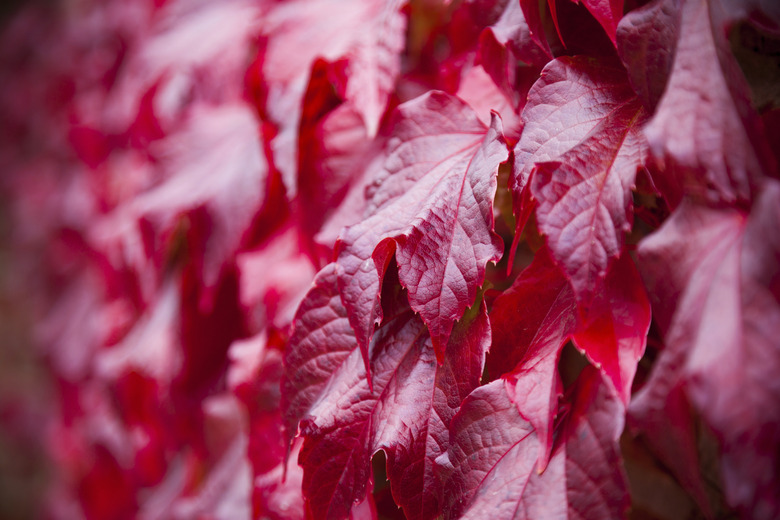
Gardeners sometimes think they've stumbled upon the rare American ginseng (Panax quinquefolius) growing wild in their woodland gardens, only to be disappointed to discover that the plant is, instead, the much more common Virginia creeper (Parthenocissus quinquefolia). The two plants are similar in some ways, but a few distinctive characteristics set them apart from one another.
Step 1
Virginia creeper is a woody vine native to eastern North America; it is hardy in U.S. Department of Agriculture plant hardiness zones 3 to 9, and in the wild, it is commonly found in wooded areas and ravines. It's characterized by compound leaves, each usually consisting of five leaflets each, that grow along the vine. It is a vigorous grower that tolerates a wide range of soil, moisture and light conditions, and in areas where it's able to thrive, it can be invasive. The berries of Virginia creeper, which are dark blue or black in color, are toxic and may be fatal if ingested. Exposure to the plants' leaves causes skin irritation in some people; wear gloves when working with the plant to avoid exposure.
American Ginseng
Step 1
American ginseng is a perennial that is, like Virginia creeper, native to eastern North America; American ginseng is hardy in USDA zones 4 to 8. It grows 10 to 15 inches tall with three or more five-leaflet clusters per plant at maturity. It has been widely harvested for its fleshy, aromatic roots, and it is now an endangered species in the wild. In the garden, it prefers to grow in shady locations with moist soil that's rich in organic matter.
Step 2
- Virginia creeper is a woody vine native to eastern North America; it is hardy in U.S. Department of Agriculture plant hardiness zones 3 to 9, and in the wild, it is commonly found in wooded areas and ravines.
- It is a vigorous grower that tolerates a wide range of soil, moisture and light conditions, and in areas where It's able to thrive, it can be invasive.
- The berries of Virginia creeper, which are dark blue or black in color, are toxic and may be fatal if ingested.
Leaf Forms and Color
Step 1
The similarities between the compound leaves of Virginia creeper and ginseng often lead to confusion between the two plants. The leaflets of both plants are oblong and toothed around their perimeters. Virginia creeper leaflets are more coarsely toothed than those of ginseng, however, and the serrations do not continue around the base of the Virginia creeper leaflet as they do on the ginseng leaflet. The leaflets of ginseng branch out from the plant's stem on petioles, stalks that attach the leaf blade to the central stem; Virginia creeper leaflets emerge from a central point and attach directly to the stem, without petioles. The leaflets of Virginia creeper also tend to be of roughly equal size within each compound leaf. Each compound leaf of ginseng, however, usually consists of three large leaflets and two smaller leaflets. In the fall, the leaves of Virginia creeper turn a brilliant red. Ginseng leaves turn yellow late in the season. Ginseng produces red berries in mid- to late summer that are especially visible in the fall.
Step 2
- The similarities between the compound leaves of Virginia creeper and ginseng often lead to confusion between the two plants.
- The leaflets of Virginia creeper also tend to be of roughly equal size within each compound leaf.
Growth Habits
Step 1
Ginseng grows in clusters in wooded or rocky areas, and although its leaf prongs are upright, they don't branch, instead remaining low to the ground. Virginia creeper, by contrast, is a climber that uses tendrils to cling to other plants and surfaces. Each vine can grow up to 50 feet in length, and it will sprawl along the ground or spread vertically using tree trunks and branches, walls or other structures for support.