

If Navel Oranges Have No Seeds How Do We Grow More?
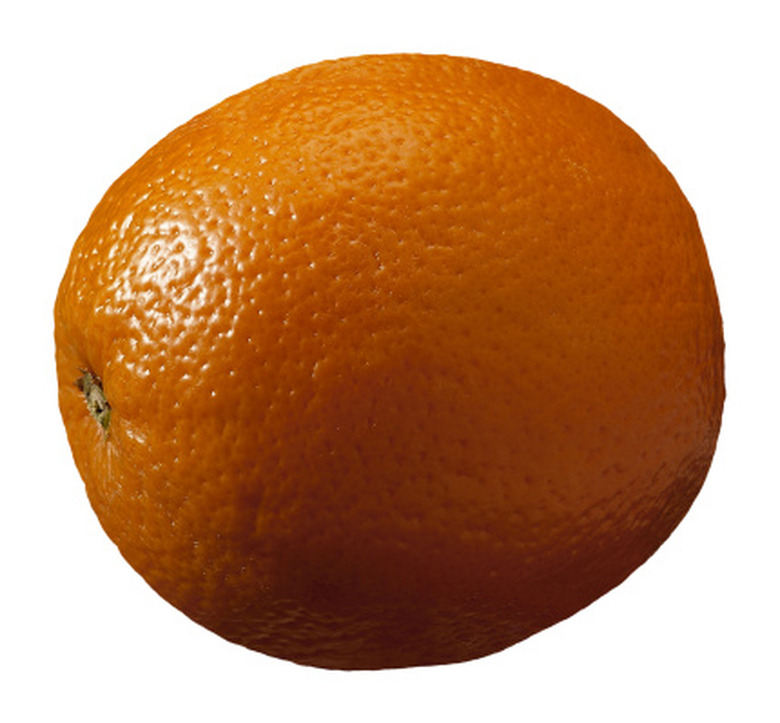
Navel oranges, grown the world over and prized for their undeniably delicious flavor, cannot be propagated from seed like most fruit trees. Since the fruits lack seeds, all navel orange trees are clones derived from a single genetic specimen. This asexual propagation technique, called grafting, ensures that the sweet citrus fruit will not be lost.
History
The precise origin of the navel orange tree is unknown, but the original tree may have been a mutant grown in Brazil. The tree has been continuously propagated, despite being seedless and sterile, because of the fruit's many desirable traits, including a sweet taste and easy-to-remove peel. Arriving in Florida in 1835, it became an immensely important crop in California by the latter part of the 19th century. The tree has been repeatedly grafted in groves around the world, making all navel orange trees genetically identical.
- Navel oranges, grown the world over and prized for their undeniably delicious flavor, cannot be propagated from seed like most fruit trees.
- The precise origin of the navel orange tree is unknown, but the original tree may have been a mutant grown in Brazil.
Seedless Fruit
Navel orange blossoms lack viable pollen and ovules, so all fruits are seedless. This is why it cannot reproduce through seeds or pollinate other citrus trees. To propagate them, growers graft navel orange stock onto a different orange tree's rootstock, so that it has a root system to grow from.
Grafting
Grafting is used on many fruit trees to take advantage of the desirable traits of different varieties of the same kind of fruit, or in the case of the navel orange, to reproduce a seedless fruit. A branch that produces navel oranges must be grafted onto other orange tree stock. The navel orange part — called the scion — will unite with the root system of the new tree, and the grafted tree will produce navel oranges. The scion is cut to fit the rootstock. It is then inserted into the rootstock and they will grow as one as long as the plants are healthy and the feat is performed with care.
- Navel orange blossoms lack viable pollen and ovules, so all fruits are seedless.
- The navel orange part — called the scion — will unite with the root system of the new tree, and the grafted tree will produce navel oranges.
Popularity
Despite the complicated nature of grafting, navel oranges are prized for eating because of their consistently tasty flavor and a structure that easily peels and separates into segments. Since the oranges are not very juicy and contain limonene, a substance that makes the juice bitter when pasteurized, they are not utilized for juice. The trees are propagated through grafting throughout Brazil and California, as well as South Africa, Spain, Paraguay, Australia and Japan.